











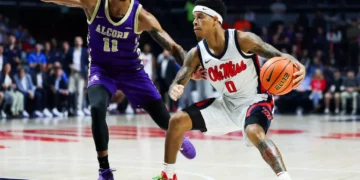














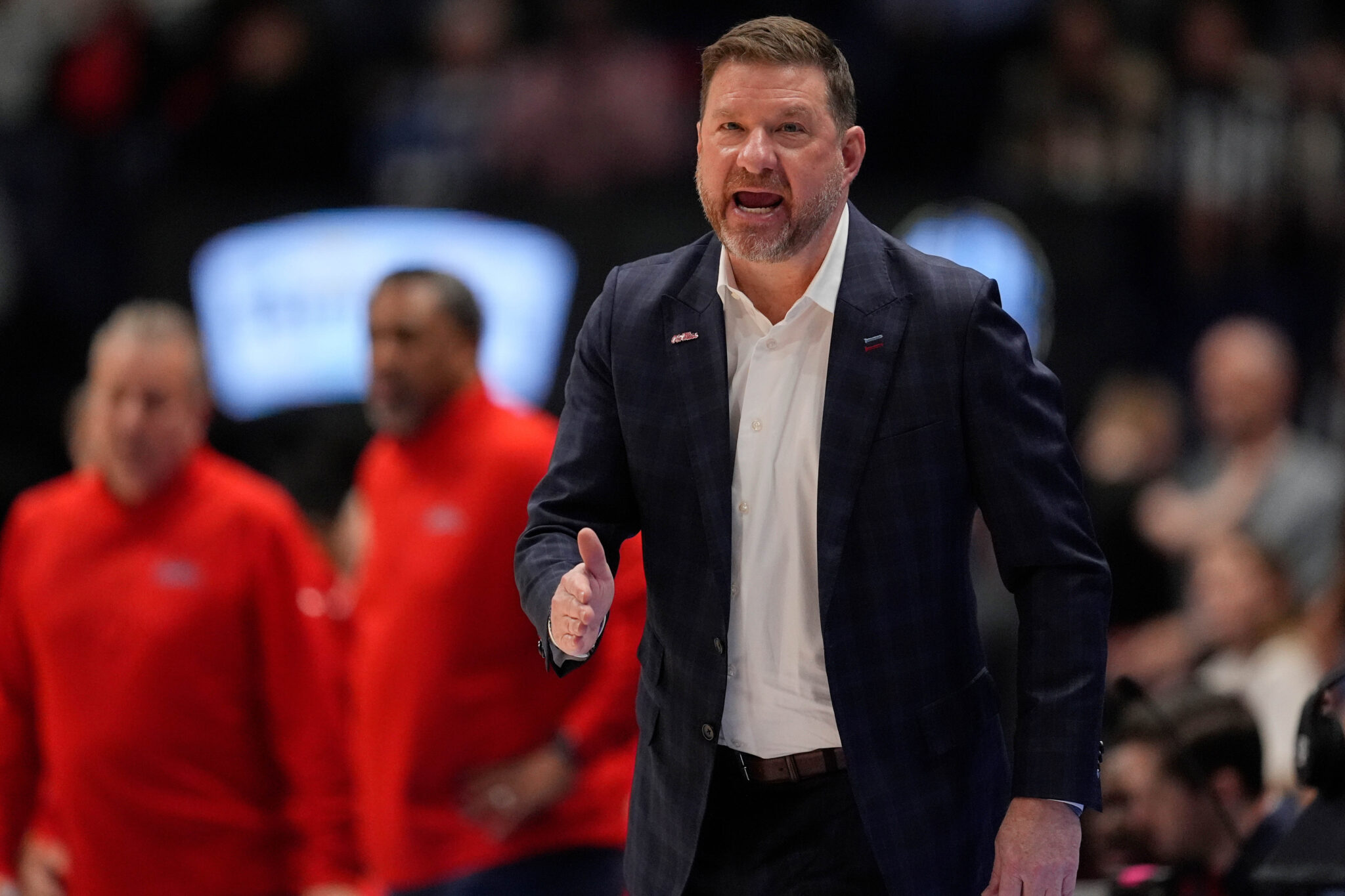
Although Ole Miss Men’s Basketball head coach Chris Beard is only just beginning his fourth year with the program, some fans are already voicing skepticism — namely, because the Rebels had a catastrophic 2025-26 season, coupled with Beard being the eighth-highest-paid coach in men’s college basketball following Purdue coach Matt Painter’s extension last week.
Ole Miss fans need to be patient. Beard is only in his fourth season with the Rebels. Ole Miss Men’s Basketball is not a storied program, and fans need to rein in their expectations.
Fans may point to Florida’s Todd Golden, whose Gators improved exponentially under his leadership, winning the National Championship in only his third season. The Gators have sustained this success; they advanced to the round of 32 last season and are currently the No. 1 team in the nation.
Such a rapid turnaround is the exception that proves the rule. Transformations like this are few and far between. When even the most highly regarded coaches in college basketball inherit struggling programs, it often takes a few years for these coaches to remodel rosters and implement their schemes.
Michigan State’s Tom Izzo failed to lead the Spartans to the NCAA Tournament in his first two seasons, and Tennessee’s Rick Barnes experienced similar struggles in his first two seasons with the Volunteers. As the years went on, though, both of these programs rose to the top.
Similarly, in Beard’s first season, the Rebels finished 20-12 (7-11 SEC) and did not make the tournament. In 2024-25, however, Beard’s second season at Ole Miss, he led the Rebels to a Sweet 16 appearance, the program’s first since 2001 and only the second in program history. In fact, the Rebels have never advanced past the Sweet 16.
The difference, of course, is that these other coaches have since turned their programs into perennial Top-25 teams and mainstays in the postseason tournament, while Ole Miss is still struggling to stay afloat.
Part of the reason why last season was so unbearable was because most fans seemed to think that Ole Miss Basketball had made it over the hump after the Sweet 16 run. Considering the circumstances, though, Ole Miss’ poor showing last season is not all that surprising, and fans should grant Beard some slack. After 2024, the Rebels graduated seven of their top eight players in minutes per game, including four starters and sixth man Jaemyn Brakefield.
Go back to Florida. After winning the National Championship in 2024-25, the Gators brought back forwards Thomas Haugh and Alex Condon and center Rueben Chinyelu — all three of whom are still on the roster. Haugh is the Preseason SEC Player of the Year; Chinyelu is a preseason All-SEC first-team selection, and Condon is a member of the preseason All-SEC second team. If, say, guards Sean Pedulla and Matthew Murrell had not run out of eligibility after 2024 and had returned to Oxford in 2025-26, last season likely would have been a much different story.
While replenishing rosters may seem easier than ever in the current era of transfer portal madness, experience and veteran leadership are both difficult to replace. Reporters Brendan Marks and CJ Moore at The Athletic point out that high school recruits are becoming less and less relevant due in large part to NIL and the new 5-for-5 eligibility rule.
According to the article, an anonymous ACC coach expressed doubt that high school recruits outside of the Top 25 in player rankings would be able to make an immediate impact on a roster full of players in their third, fourth and fifth years. Indeed, in 2024, current San Antonio Spurs guard Stephon Castle was the only freshman starter on any Final Four team.
Additionally, multiple coaches said they only planned to recruit two high school players in the 2027 high school class, as compared to the four or five they pursued in previous years. High school recruiting, it seems, is no longer a reliable way to revamp a depleted roster.
Transfer portal rankings are also not always quite accurate, because transfers often perform differently in new environments; many players would not have entered the portal in the first place had they flourished at their former schools, so it is logical to expect jumps or slumps in production from incoming transfers. In 2024, Ole Miss’ portal class, featuring guard Pedulla and forwards Dre Davis and Malik Dia, was barely in the top half of the conference according to 247sports, yet the players clearly outperformed their rankings.
There is no reason to doubt this year’s team based on mediocre portal or recruiting rankings, especially considering that for all of Beard’s success, only three of his players have been drafted by NBA teams (although others have signed with NBA teams, and still others have been drafted after transferring to other programs). Historically, Beard has not needed top-tier talent; he has made do with competent players with upside, which last year’s roster lacked.
Moreover, at blue-blood programs, instant results are the standard, and Final Four appearances are an expectation. Following last season, North Carolina fired head coach Hubert Davis after only five seasons with the team — five seasons, which included a National Championship runner-up finish in his first season, a Sweet 16 appearance and two other NCAA Tournament berths.
Ole Miss is not a blue-blood program. Granted, considering how much Beard is making, perhaps it is not unrealistic to expect rapid results, but it should be noted that financially, Ole Miss does not have the same resources as blue-blood programs — or even some of the top programs in the SEC.
According to CBS Sports, the average cost of a Power Four roster in 2026 is $13.5 million; in the SEC, the average cost is $17.3 million. Florida, Kentucky, Texas and Tennessee are all reportedly spending more than $20 million on their players, with Arkansas just barely under that threshold; Ole Miss is on the same spending tier as Auburn, Texas A&M, LSU, Vanderbilt, South Carolina and Oklahoma at approximately $15.1-17.5 million. While Ole Miss is dedicating large amounts of money to its basketball roster, the top spenders in the conference will naturally be able to afford more high-caliber players.
Yes, Ole Miss stumbled last season. But the Rebels also lost the biggest contributors from arguably their most talented roster ever, and the program does not have the same funds as other top teams in the conference to instantly secure replacements. Additionally, the 2025-26 season result does not tarnish the Sweet 16 appearance in 2024, and it does not mean the Rebels cannot get back on track this season.
Consider another SEC team. In Alabama’s first season under head coach Nate Oats, the Crimson Tide finished 16-15 and missed the tournament. A season later, in 2020-21, the Crimson Tide advanced to the Sweet 16, but in Oats’ third year, Alabama lost in the first round of the tournament — a step back from the year before. Yet in 2022-23, the Crimson Tide was back in the Sweet 16, and a season later, Alabama made the Final Four.
Will there be cause for concern if the Rebels miss the tournament this year? Absolutely, but for fans of a program that has only advanced to the Sweet 16 twice in history, we need to be a little more self-aware with who we are as a program, a little more practical with what we expect from the Rebels and a little more lenient with the coach leading us.