






Mississippi’s Senate race between Democratic candidate Scott Colom and Republican incumbent Cindy Hyde-Smith is too close to call at the time, with Colom standing approximately at 1,138 votes ahead of Hyde-Smith with 96% of the state’s votes reported so far at the time of publication, per the Associated Press.
Counties have until Nov. 13 to submit certified election results to the Secretary of State’s office. Mississippi is the only state in the country that does not permit recounts in statewide elections, meaning that receiving a plurality of votes is necessary to win the Senate race. It may be days before Mississippi’s new senator is officially declared.
If Colom were to be elected, he would be the first Democratic Mississippi senator since 1982, and he would be the first Black senator Mississippi elected since Reconstruction in 1875.
This unprecedented race has left University of Mississippi students in surprise. Mississippi has entered the national spotlight as one of the only states remaining with uncalled Senate races, along with Alaska.
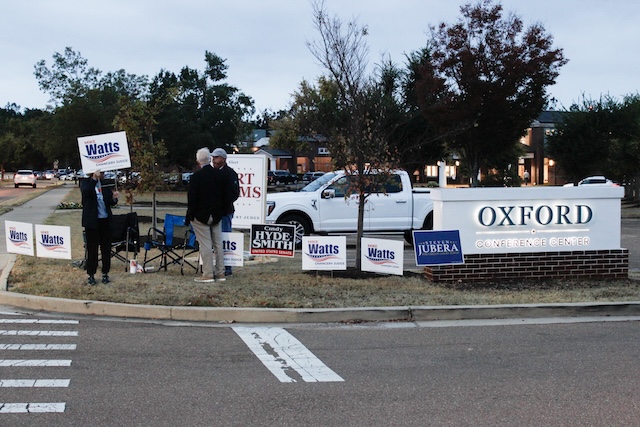
Adam Maatallah is a senior public policy leadership and international studies double major from Madison, Miss. Madison the city is part of Madison County, which has historically voted Republican but flipped blue during this race.
“Mississippi even being considered a battleground state for the 2026 Senate race has left me somewhat surprised,” Maatallah said. “All of these emotions boil down to this: hope. Hope that more federal politicians and national parties pay attention to Mississippi and the untapped voters here, hope that more young people feel mobilized to vote in this state, hope that there are more people interested in running for public office at all levels (local, state and federal) and hope that Mississippi can come together to demand public officials to create real policy changes.”
Mississippi voters who don’t appear on local polling precincts’ registration records can cast provisional, or “affidavit,” ballots. This year, Mississippians cast huge numbers of affidavit ballots after Secretary of State Michael Watson flagged 230,000 voter registrations as “inactive.” Watson’s office authorized counties statewide to use unverified data from credit bureau Experian when cleaning voter rolls, leaving 1 in 9 Mississippi voters inactive ahead of Election Day.
Under state law, Mississippi election officials must count affidavit ballots provided that the voter was previously registered in the precinct where he or she attempted to vote, the voter and the precinct’s poll manager properly signed the affidavit ballot’s envelope and the voter provides acceptable voter identification within five business days of Election Day.
Colom’s campaign estimated late Tuesday evening that between 10,000-15,000 affidavit ballots remained outstanding, according to Mississippi Today. Watson issued a statement on Wednesday that approximately 3,600 absentee ballots are still outstanding, as well.
Colom said his campaign has deployed attorneys across Mississippi to monitor local election officials counting the remaining ballots and processing outstanding affidavit and absentee ballots over the next week.
Counties have until Nov. 13 to submit certified election results to the Secretary of State’s office.
Republican incumbent Trent Kelly beat Democrat Cliff Johnson in the U.S. House of Representatives race for Mississippi’s 1st Congressional District. Kelly won with 138,744 votes to Johnson’s 94,273 votes. Lafayette County went red for the House of Representatives, with Kelly having 8,715 votes and Johnson receiving 8,086 votes.
“Thank you MS01 for your trust,” Kelly said. “I will continue to fight for our Mississippi values, our men and women in uniform, small businesses and for our farmers.”
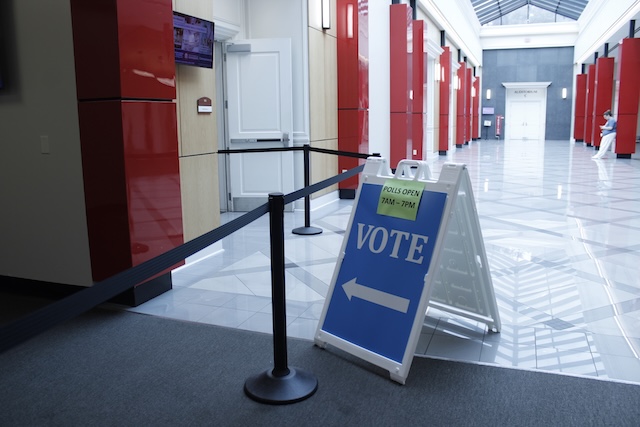
Students anticipate election developments
Lafayette County was blue overall for the Senate race with 8,383 votes for Colom and 8,265 votes for Hyde-Smith; 95% of the vote has been gathered so far. UM College Democrats is hopeful about this shift and how it reflects upon the organization’s voter registration efforts leading up to the midterm elections. The student political group helped register approximately 300 students to vote, according to UM College Democrats president Mike Cavanaugh.
“Here in Lafayette County, we’re seeing an over-20-point shift, and it looks like we could flip the county,” UM Democrats said in a statement to The Daily Mississippian. “This is what happens when you put Mississippi first and don’t take a single voter for granted. … We feel good about Colom’s chances in this historic race, and we’re currently focused on this race, but we are excited about the future.”
Many university students participated in the midterm elections by heading to the polls. Emily Torres Espinoza is a junior journalism major from Derma, Miss., who drove to her hometown on Tuesday to vote in-person.
“As a first-time voter, I understand the importance of this civic duty,” Torres said. “Growing up in a primarily red state, I was even more motivated to cast my vote to help play a role in breaking this cycle.”
Many students voted for candidates whom they felt would best represent their values and communities. Liana Virgil is a graduate student from Holly Springs, Miss., who wanted a candidate she believed would care for her community and the wellness of all people.
“As a Black, queer woman, I want someone who recognizes the challenges and inequalities that affect my communities and is committed to protecting our rights, safety and opportunities,” Virgil said. “I look for a candidate who values diversity, equality, inclusion and justice, and whose actions demonstrate that they care about all people, not just those who fit into certain categories.”
The UM Voting Engagement Ambassadors sponsored a bus-shuttling program to take students to the polls in Oxford. Ami Ba is a senior public policy leadership major from Southaven, Miss., who is a member of the UM Voting Engagement Ambassadors. Ba stated that the organization shuttled at least 50 students to polling locations on Tuesday, Nov. 3.
“Just the energy around midterm elections this year has been really inspiring, and it really just goes to show that when you give people resources like free ride-share programs or free tabling opportunities for voter registration … they will do their part as civic members of our society,” Ba said.
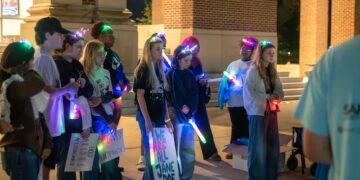
Other students engaged with the midterm elections by hosting election result watch parties. The Nu Upsilon Chapter of the Alpha Phi Alpha Fraternity, Inc. hosted a watch party to promote civic engagement and community development.
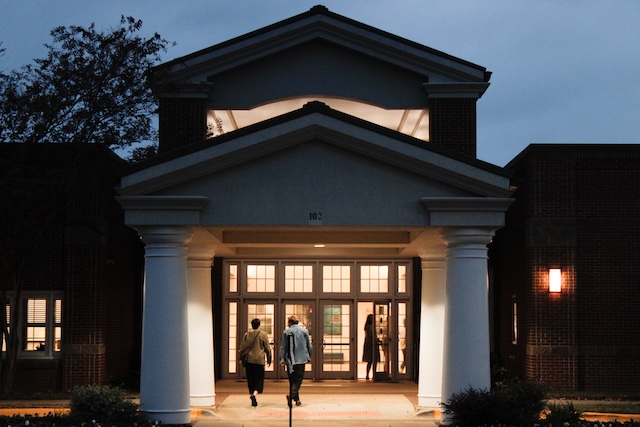
Shane Rosenthall is the secretary for Alpha Phi Alpha and a senior psychology major from Grenada, Miss. Rosenthall has observed an increase in excitement and engagement from the Black community because of Colom’s candidacy.
“I think a lot of times, (Black Mississippians) don’t see ourselves represented in the political frameworks for Mississippi, so just seeing somebody that’s out there … willing to walk with us and try to represent us (is exciting),” Rosenthall said. “It just encouraged a lot of Black people to try to come out and vote and try to use their voice.”
The Daily Mississippian reached out to Colom, Hyde-Smith, Ole Miss College Republicans and Ole Miss Turning Point USA but did not receive comments by the time of publication.
Local election results
Lafayette County election results are unofficial as election officials continue to count affidavit and absentee ballots, but several winners have emerged.
Over half of registered voters in Lafayette County voted in the midterm election (51.69%).
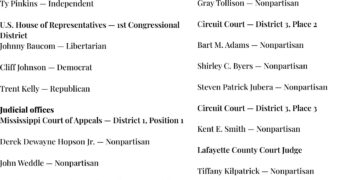
John Weddle has won the Court of Appeals District 1, Position 1 race, defeating Derek Dewayne Hopson Jr. and carrying five of the seven counties in the Third Circuit Judicial District.
In the Circuit Court District 3, Place 2 race, Bart M. Adams received the most votes over Shirley C. Byers and Steven Patrick Jubera. Adams carried four of the seven counties in the election, including Lafayette County.
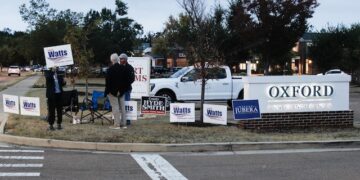
Michael Watts led the Chancery Court District 18, Place 1 race across the five counties that make up the district. Jenessa Carter Hicks finished second, followed by Jennifer L. Shackelford and Sarah J. Liddy.