






















Black History Month is an opportune time to reflect on Black coaches and athletes who shaped college sports. Two athletes and one coach, specifically, were instrumental in ushering in integration to the SEC.
Nate Northington
Nate Northington was the first Black football player in the SEC. A native of Louisville, Ky., he and Black teammate Greg Page were the first two Black men to join an SEC football roster when they accepted offers to Kentucky in 1966.
As freshmen, the duo played only on Kentucky’s freshman team; the next season, they were slated to move up to the varsity roster, but Gage suffered a brutal injury during practice which left him paralyzed from the neck down. He died shortly before the 1967 season began. In an article by Jerry Bembry on Andscape.com, Northington spoke about how difficult a time this was for him.
“It was a tough day for everybody,” Northington said. “I wasn’t even thinking about football because Greg was a good friend, but his parents wanted us to play.”
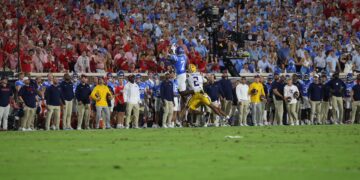
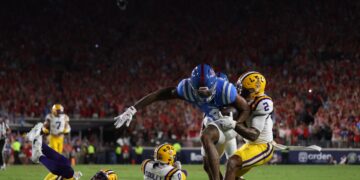
Northington officially integrated the SEC on Sept. 30, 1967, when he played in a game against Ole Miss. However, he was so bothered by his friend’s death and still felt so isolated around campus, that he transferred to Western Kentucky after only a few games.
Kentucky named him an honorary captain in the Wildcats’ home game against East Carolina in 2017 in honor of the 50-year anniversary of his SEC debut.
Sylvester Croom
Sylvester Croom was the first Black head coach in the history of SEC Football. He coached Mississippi State from 2004-08.
Croom tenure got off to a bumpy start. In each of his first three seasons in Starkville, Miss., he did not top three wins — which, when factoring in the seasons before his hire, put Mississippi State at six straight seasons with three wins or less.
These struggles can hardly be pinned entirely on Croom. The prior Mississippi State head coach, Jackie Sherrill, had been fired in the wake of an NCAA investigation into recruiting violations by Mississippi State coaches and boosters from 1998-2002.
As a result, the team was penalized with a playoff ban in Croom’s first season as head coach and were limited in scholarships for the next few seasons. This, coupled with the team’s poor performance on the field, resulted in several players transferring out of the program.
Things began to look up in 2007-08 when Croom led the Bulldogs to a 7-5 regular season record, the best in nearly a decade. The Bulldogs finished the season 4-4 in SEC play and won the 2007 Liberty Bowl. Croom was named SEC Coach of the Year that season.
After another losing season in 2008-09, however, Croom resigned.
The fact that Croom, the conference’s first Black head coach in football, was not hired until the early 2000’s points to a potential lingering bias in the Deep South, claims an article by ESPN’s Chris Low titled, “Why are there no Black college football head coaches in the SEC?” In the article, Croom is quoted on the disparity between the SEC and the rest of the football world.
“It’s very frustrating. I was the first in the SEC, and you look around now and nobody really says anything about it,” Croom said. “Look at how disproportionate it is: (a) large percentage of players and assistant coaches who are Black. Yet here we are in the hotbed of college football, and there are no Black head coaches in the SEC anymore.”
Peggie Gillom-Granderson
Though it is unclear who the very first Black female student-athlete was in the SEC, Ole Miss’ own Peggie Gillom-Granderson was one of the earliest and one of the most impactful.
As the first Black female student-athlete at UM, she started for the Lady Rebels for four seasons. Her 2,486 points and 1,271 rebounds make her the only women’s basketball player in the history of the program to exceed both 2,000 career points and 1,000 career rebounds.
After her playing days were over, she served as an assistant coach under Ole Miss Women’s Basketball head coach Van Chancellor for 16 seasons. The Lady Rebels qualified for the NCAA Tournament in 14 of these seasons. Gillom-Granderson also served as an assistant for USA Basketball.
In 1996, she was inducted into the Ole Miss Athletic Hall of Fame, and in 1997, she was inducted into the Mississippi Sports Hall of Fame, then the Women’s Basketball Hall of Fame in 2013. The Gillom Athletics Performance Center at Ole Miss was named after Peggie and her sister Jennifer — who are the highest scorers in program history — in 2000. She now works as the Fellowship of Christian Athletes (FCA) Campus Representative at UM.