






























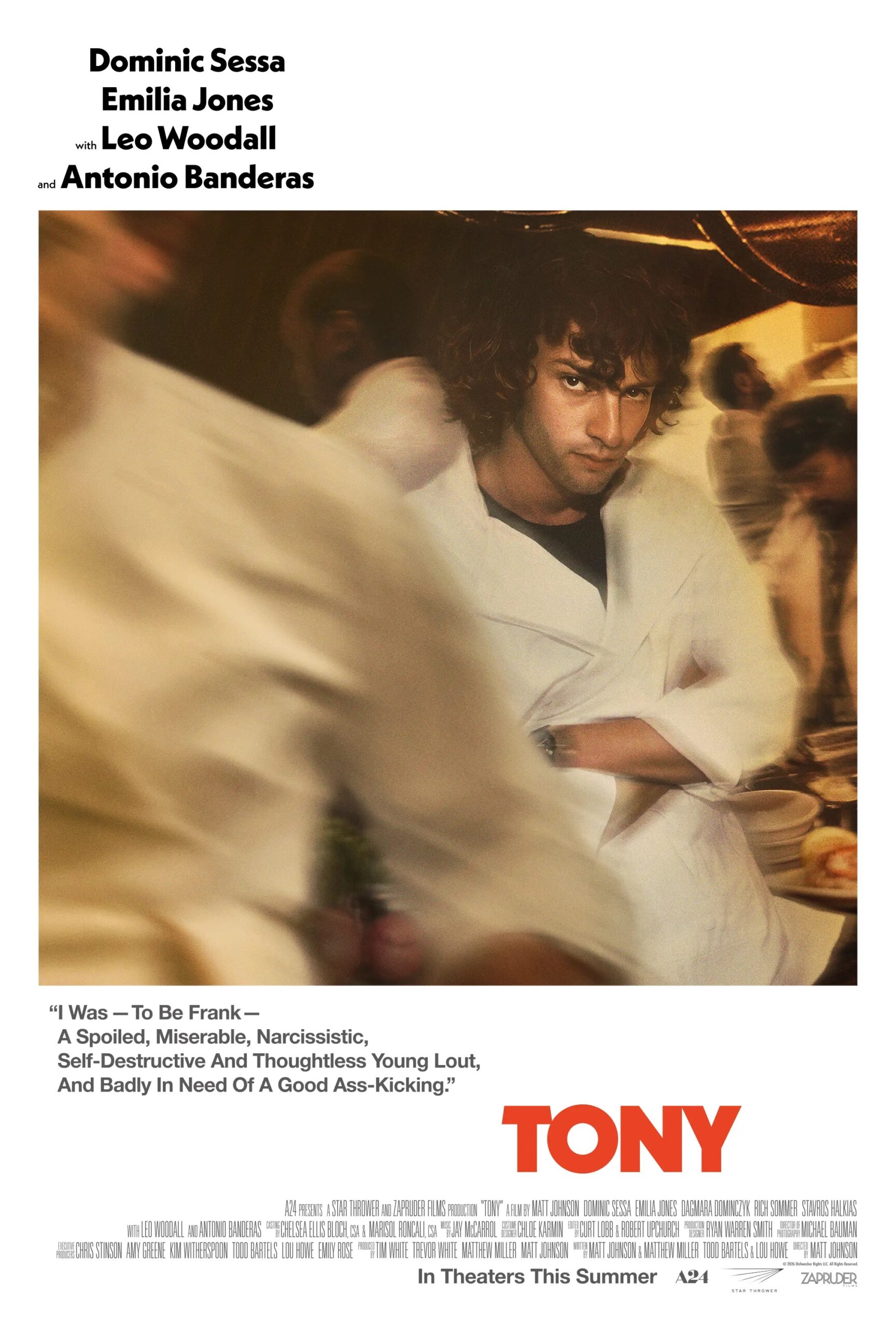
Beloved celebrity chef, writer and television host Anthony Bourdain’s biopic, “Tony,” hit theaters nationwide on Aug. 21. Canadian filmmaker Matt Johnson worked with A24 on the film and focused on Bourdain’s young adulthood, when he was first introduced to the culinary world. The film’s announcement in April 2025 sparked discourse around Bourdain’s complicated legacy.
Set in the summer of 1975 in Provincetown, Mass., “Tony” borrows from the early chapters of Bourdain’s 2000 bestselling memoir, “Kitchen Confidential: Adventures in the Culinary Underbelly.” The film follows a 19-year-old Bourdain, played by Dominic Sessa, as he dives headfirst into the restaurant world.
The film opens with a title card of the iconic “Kitchen Confidential” quote: “I was — to be frank — a spoiled, miserable, narcissistic, self-destructive and thoughtless young lout, and badly in need of a good ass-kicking.” This quote serves as an apt setup for the film’s adaptation of Bourdain’s teenage years.
Bourdain spent 28 years working in the restaurant industry before transitioning to writing with his release of “Kitchen Confidential.” The memoir’s success launched Bourdain’s travel television career in 2002, with shows like “A Cook’s Tour,” “Anthony Bourdain: No Reservations” and “Anthony Bourdain: Parts Unknown.”
Bourdain’s television shows explored international cuisine and the human condition. His quick wit, candidness and deep introspective storytelling made him a well-respected figure in the culinary, writing and travel spheres. The television host’s career was cut short when he died by suicide at the age of 61 in 2018.
Since his death, Bourdain’s rebellious, rockstar reputation has turned him into a mythologized, saintlike figure idolized by cooks, travelers, foodies and misfits. Bourdain fans feel a deep protectiveness over his legacy and voiced concerns about the biopic on social media. In spite of fan fears, “Tony” manages to interpret Bourdain’s mythology while not subscribing to brazen iconography.
Unlike many recent biopics, though, the filmmakers of “Tony” were not trying to accurately depict Bourdain’s life story. Instead, “Tony” has a narrow, fictionalized focus that incorporates quintessential moments from his memoir. In an August interview, Johnson reiterated this goal to Rolling Stone.
“I wanted this to feel like a memory that Bourdain would have that was totalizing his youth,” Johnson said. “I don’t think about it in a linear, year-to-year way — it’s a flash and a color and a feeling and maybe four or five conversations.”
We first meet Bourdain in the film as a 19-year-old aspiring writer when he fails to get a summer writing fellowship at Vassar College to write his coming-of-age story. The audience is then pushed into Bourdain’s younger years when he lies to his family and high school crush Nancy (Emilia Jones) as he follows her to Provincetown.
Bourdain ends up working as a dishwasher for Antonio Banderas’ character, simply known as “Chef,” in his small seafood restaurant, and a mentor-mentee relationship soon follows. Sal (Leo Woodall), a shady and tumultuous cook, also takes Bourdain under his wing, albeit in an unconventional way.
Chef and Sal are key to Bourdain’s development throughout the film with their antithetical mentorship. Chef teaches Tony how to work in a kitchen, and Sal teaches him how to do hard drugs. Chef embodies the discipline of a kitchen, contrasting with the destructive and toxic energy of the restaurant industry that is channeled through Sal.
Sessa plays a convincing Bourdain, sporting a classic 1970s curly hairdo, a band T-shirt and leather jacket. Sessa’s way of walking and holding himself was eerily similar to Bourdain and, from certain angles, he looks a lot like Bourdain. He is fantastic at portraying an angsty teenager with self-sabotaging tendencies.
“Tony” does not stray away from Bourdain’s youthful anger and brashness. The good, the bad and the ugly are all on display in the film.
Banderas and Woodall also had standout performances. Woodall’s cheeky grin and mischievous chaos is paired perfectly with Banderas’s controlled and compelling performance. Banderas has even received Oscar buzz for his role.
Audiences have become tired of the repeated movie formulas coming out of Hollywood, which includes the biopic. Biopics have started to feel disingenuous, with a focus on making money rather than telling a story. So many biopics today fall short in storytelling and miss the mark with who they are depicting. They condense someone’s life story into 2 hours, while usually hitting the same points of a hard childhood, sudden fame and a tragic downfall.
As a member of the audience, I am tired of the same movie formulas. That is why the filmmaker’s unconventional approach with “Tony” made me excited for its release. This different approach is why I initially was not against the biopic being made, unlike many parasocial fans.
Overall, I appreciated the essence of Bourdain’s spirit in the fictionalized film. I enjoyed the little details like the New York Dolls poster in his bedroom and the soundtrack featuring The Stooges; it all felt like a genuine attempt to stay metaphorically true to Bourdain.
The unique approach of focusing on the Provincetown chapters, a period of which little is known about Bourdain’s life, gave the filmmakers and actors creative freedom to interpret Bourdain’s beginnings in courteous way, while not shying away from his early volatility.
The style of “Tony” is similar to Bourdain’s literary voice — raw, witty and honest. There were moments in the film that made me double over laughing and moments so somber I felt a pit in my stomach. The film’s interpretation of Bourdain’s early years makes a unique and sincere addition to his legacy.