






























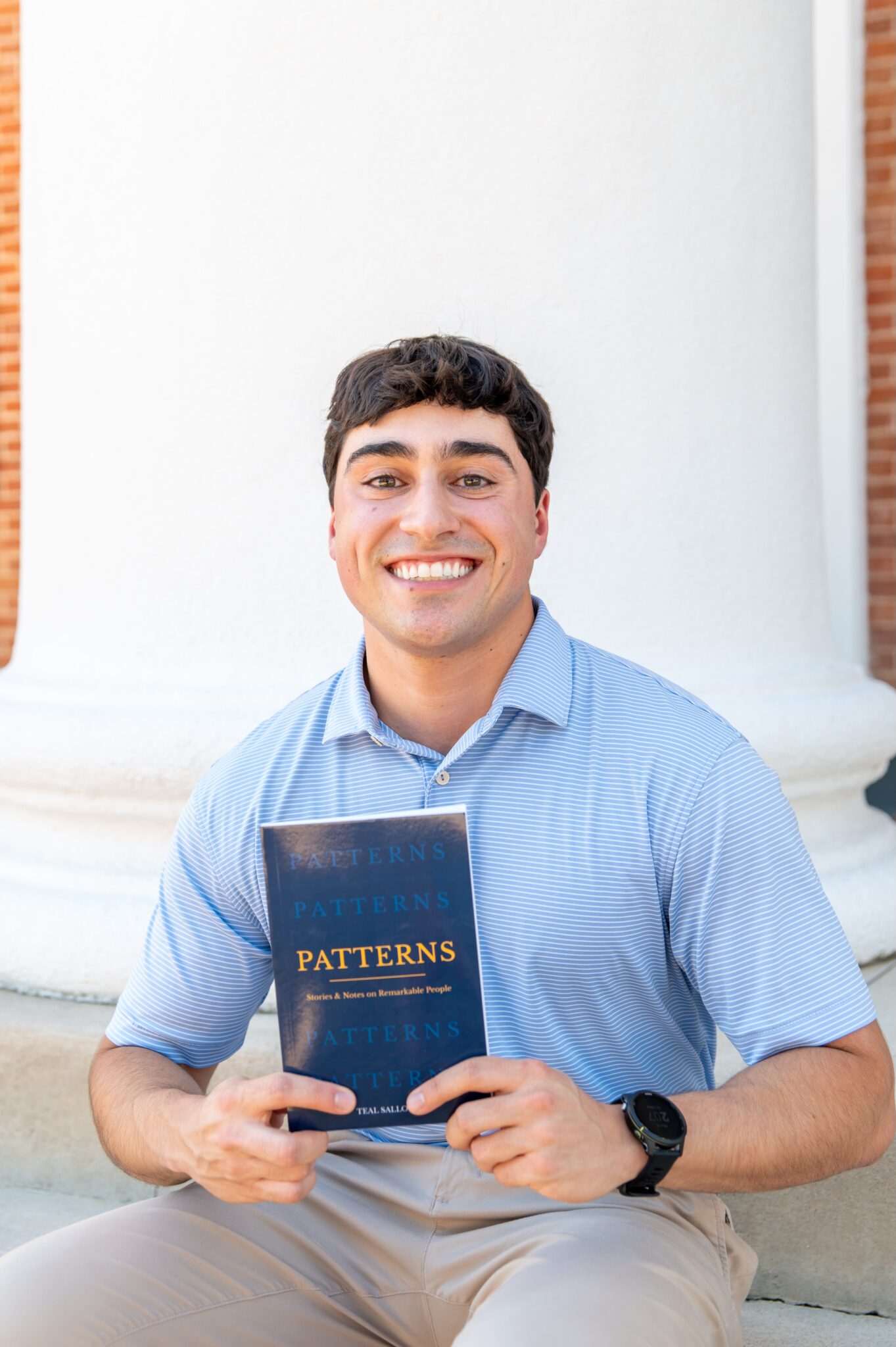
Teal Salloum, who graduated from the University of Mississippi in 2024 with his Bachelor of Accountancy, recently published his first book, “Patterns: Stories & Notes on Remarkable People.” Salloum, from Gulfport, Miss., is completing his final year at the UM School of Law.
Salloum grew up around the entertainment industry. His grandmother, Barbara Ann Thomas Salloum, recorded at Sun Records, the local news station WLOX in Southern Mississippi and other media outlets. He said his grandmother’s work framed his childhood.
“This book was inspired by my grandmother’s career in entertainment,” Salloum said. ”I’ve just grown up sitting on her couch and hearing story after story about her career.”
Through her work, his grandmother had opportunities to record at Sun Records in the same era as musicians Elvis Presley and Jerry Lee Lewis. She traveled to California to interview celebrities for ABC, including Dolly Parton. Those experiences introduced Salloum to the stories of people from different backgrounds, eventually inspiring him to document some of those lives himself.
“I’m someone that really likes to learn from the lives of others,” Salloum said.
That interest became the foundation for his book, a collection of 17 short chapters, each one documenting a real person’s life. Although the project began just a year ago as a personal interest, Salloum eventually decided to invest more time in its completion.
“I took a little bit of a break from it in the spring and really put a lot of work into it over the past summer, where I had an editor based out of Nashville help me with the final product,” Salloum said.
The collection draws from three main sources: people his grandmother encountered throughout her career, other people whom Salloum has met throughout his own life and still other people whose experiences or personal qualities he found worth documenting.
“There’s people that my grandmother knew and that she interviewed and that she worked with,” Salloum said. “There’s people that I’ve encountered in my life, and then there’s people that I felt the way they lived was just worth noting, and something about the way they moved through the world was really cool.”
Despite balancing the project with his final year of law school, Salloum said writing was an enjoyable pursuit rather than another academic obligation. He did not feel pressured to finish the book according to a strict deadline, which allowed him to work on it without sacrificing his studies.
“It never really felt like work, because I really enjoy law school, and I’ve also really enjoyed the process of writing this book,” Salloum said. “So, it’s not something that I found to be particularly stressful.”
Salloum said that he intends the book’s title to reflect a larger connection among the stories. While the featured individuals come from different industries, generations and backgrounds, he noticed recurring qualities.
“The reason that I picked ‘Patterns’ (as the title) is because the first (part) is an early signal of success, so it kind of goes through the career path of all these different people, from where they started to when they were in their prime and then to how it resulted in the end,” Salloum said. “I noticed that just across different industries and generations, that a lot of these people had things in common, and certain characteristics about them that were timeless.”
Rather than assembling a lengthy collection of life stories, Salloum aimed to create a book that is accessible, practical and easy to read for college students and other young readers who might not otherwise pick up a book.
“I really wrote this with college students in mind as something that I would have liked to pick up … in college, because it’s something that is a quick and beneficial read,” Salloum said.
To make the book appealing to a younger audience, Salloum kept each chapter to a length that could be read in only a few minutes, bringing the quick pace of social media into print while still offering readers meaningful takeaways. The book’s short format allows its chapters to serve as something of a daily ritual, Salloum said.
“Each chapter is about five pages long, and I’ve designed it to be almost like doomscrolling but in print,” Salloum said. “I wanted it to be something that was fun and something that was easy to read, where you can pick up a chapter, spend five minutes reading it and then put the book down for the day.”
Since the book’s publication, Salloum said he has been pleased with the response from those who have read it. Now, he hopes to introduce “Patterns” to a wider audience and share the stories that first inspired him to write.
“I’ve been very pleased with the overall reaction to the book’s publication,” Salloum said. “Everybody that has seen it has had nothing (but) great things to say about it, so I’m now just hoping I can get it into more people’s hands.”