





















In Thomas Fuller’s book “The Boys of Riverside,” the common reading book for Ole Miss class of 2030 students, Fuller writes that differences can be something that can be used as a superpower. He originally made this comment about the California School for the Deaf football team, but it applies to reading as well. The University of Mississippi has required a common reading book since 2011 because the school understands the benefits of reading.
Reading is the very foundation of human knowledge, and it will hold your hand and walk you down the great path of life. It will guide you through any dilemma. In college years, students’ brains are sponges, soaking up vast amounts of information which they will retain for their entire lives; take advantage of that. Reading is the key that unlocks the gargantuan, imposing, threatening gate that barricades you from your greatest desires.
Anytime you pick up a book, you are guaranteed to learn something. I have read many works in my young college days, including a steady mix of fiction and nonfiction. I think this has been particularly conducive to my enhanced appreciation for reading because both categories present different advantages. Fiction, for one, will teach you about the romance and majesties of life, as well as the lives and cultures of the past. It presents a plot with a problem that each of us could face and gives us a sense of how to solve it.
Andrew Bishop, an instructor in the UM Department of English, teaches several courses, many of which tie literature and fiction to broader concepts. He explained the benefits of reading fiction.
“It activates a part of my brain that doesn’t always get activated. … (Fiction books) reveal (a lot) about the way the mind works,” Bishop said.
Bishop also noted that it is through fiction that children’s brains develop the empathetic, sensitive nature we require as humans.
Alternatively, nonfiction gives us the details, explores the history of life and teaches us how to fix physical objects. I feel such gratitude seeing the free books about the Civil War that line the counter on the first floor of Bishop Hall. I urge all students to go get one.
It is important to understand history for two reasons. One reason is that this understanding will help us learn from our mistakes, of course. The other is that understanding history gives us a sense of what it takes to be great — the secrets of success, perhaps. Great people are often great students of history.
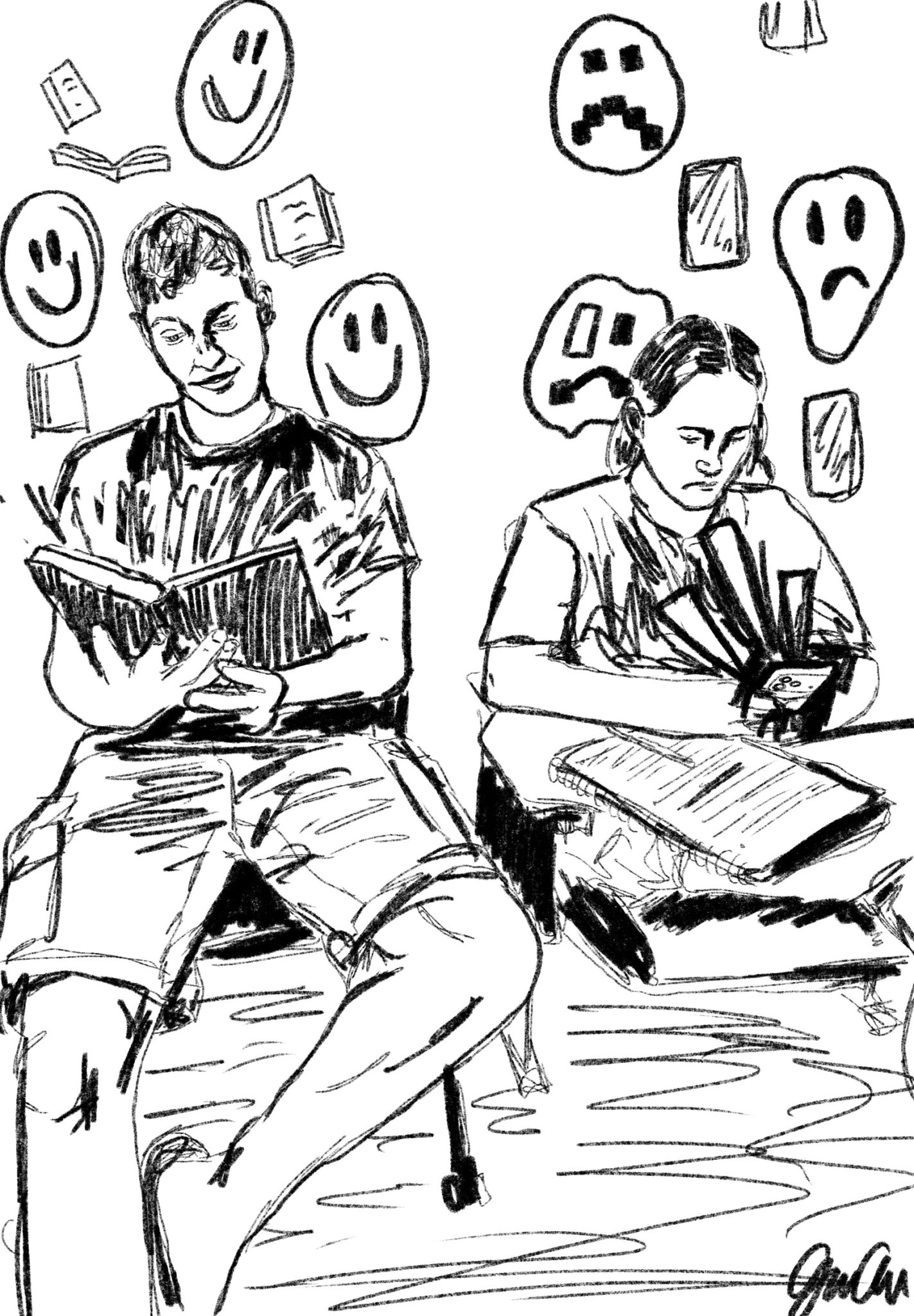
Unfortunately, reading from a physical book and, quite frankly, reading in general has slowly been eclipsed by online articles, audiobooks and the deadly beast that is social media. These new advancements do not prompt the same level of deep thinking that actual reading does.
Reading promotes a profound connection from the brain to the topic because it challenges the brain to exercise all of its power. It expands your vocabulary and helps you become a wiser human. People who are diligent readers will succeed infinitely more than the people who spend the majority of their time scrolling. It is called “doom scrolling” because it dulls and dooms the mind.
Looking at a screen gives you a physical sensation, while reading words forces you to create the setting, the characters and the solution. Cast aside your screens, and open up a book. There are infinite worlds of words to be discovered.
Griffin Armstrong is a freshman political science major from Tuscaloosa, Ala.