
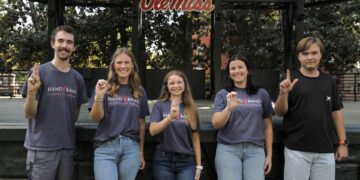

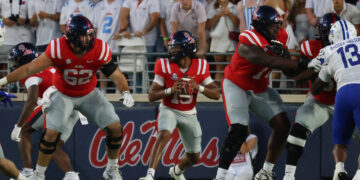
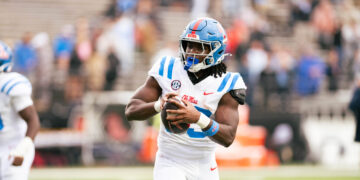



While The Pride of the South band plays the national anthem before kickoff at Ole Miss football games, another type of band files onto the field: the HandBand. Dressed in navy blue shirts, white pants and white gloves, members of the Ole Miss HandBand perform “The Star-Spangled Banner” in American Sign Language.
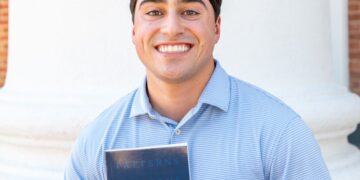
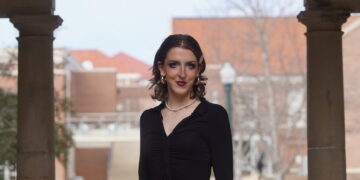
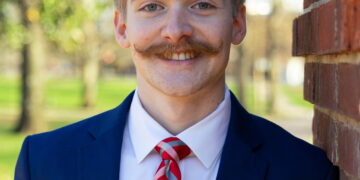
Reagan McCullough, the president of the organization, is a senior public health major and American Sign Language minor from St. Augustine, Fla. She said that the group’s presence on the field is a significant step toward making Ole Miss Football games more inclusive for the Deaf community.
“All (we) want to do is really advocate for the Deaf community, and (we) want to do well because it is a big deal for us to be on the field to … provide accessibility like that,” McCullough said.
After more than a year of meetings, emails and advocacy, the HandBand secured a spot on the Vaught-Hemingway Stadium jumbotron, allowing fans to watch the signing of the national anthem through a picture-in-picture display.
“I think there’s just so many layers in order for it to happen,” McCullough said. “It shouldn’t be as hard for accessibility, but sadly, that’s just kind of how the world works.”
Providing this kind of accessibility at football games is a large step for the university. With support from the university’s Department of Communication Sciences & Disorders, the HandBand petitioned Ole Miss Athletics to include an ASL translation for the national anthem performance.
HandBand made its first appearance on the jumbotron during this year’s 2026 season opener against Charlotte. McCullough hopes the performances will lead to larger visibility for the Deaf community.
Although being featured on the jumbotron is a recent development, the HandBand has played a role in Ole Miss football traditions for over a decade. McCullough estimated that the organization’s members have signed the national anthem on the field before games for approximately 15 years.
A typical game day for a HandBand member signing the national anthem begins an hour before kickoff, when they gather at The Sandy and John Black Pavilion to receive matching uniforms.
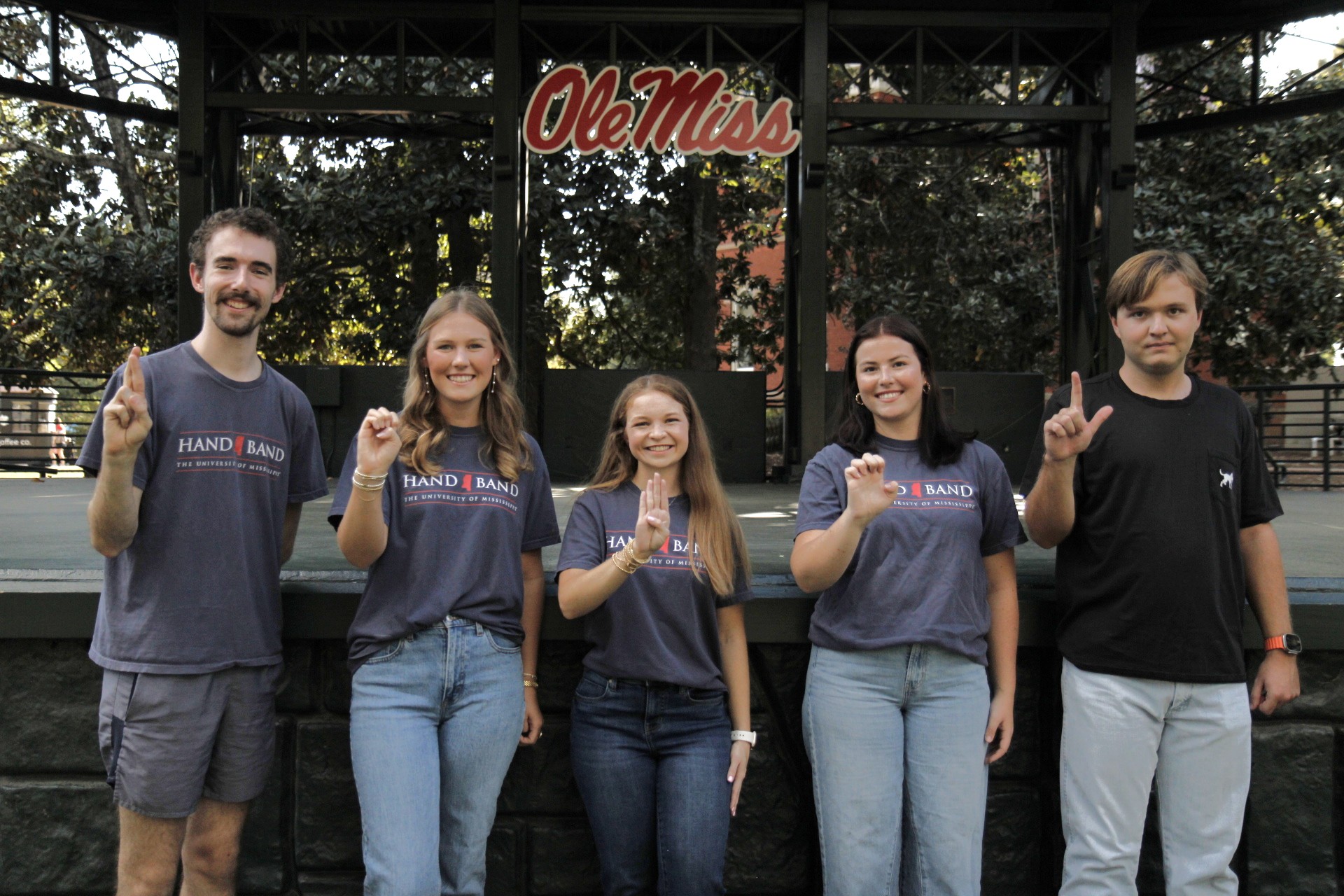
Students wear navy blue HandBand shirts and white gloves so that their hands stand out in contrast to their uniforms.
After changing into their uniforms, members rehearse several more times before finally taking the field 30 minutes before kickoff.
HandBand athletic coordinator Nick McKee also meets with the singer of the national anthem before the performance to discuss the anticipated pace of the song.
Students typically rehearse using Chris Stapleton’s rendition of the national anthem. However, live performances vary in speed, requiring HandBand members to adjust the pace of signing accordingly.
“(McKee) will always go up to who’s singing the national anthem and introduce himself, talk a little bit about what we do interpreting the national anthem and normally ask them what speed they’re going to sing at so that we can prepare a little bit in our heads if it’s going to be super fast or super slow,” McCullough said.
Once on the field, interpreters position themselves on either side of the singer. Although the organization ensures each student is prepared to perform, signing in front of thousands of spectators can still induce stage fright.
McCullough said that, even after years of signing, performing in the packed stadium can be intimidating for her.
“Every single time you get on that field, you do feel a little bit of jitters and nervousness,” McCullough said.
She recalled her experience signing during the highly anticipated LSU game, when the overwhelming noise from the crowd made it difficult to hear the national anthem. The addition of the jumbotron has also introduced heightened pressure.
Still, McCullough encourages first-time performers to trust their preparation and rely on experienced fellow members.
“(I tell members,) ‘You’ve practiced this. You know it. Just go ahead and do it,’” McCullough said.
McCullough’s passion for ASL began long before her undergraduate career.
Her hometown of St. Augustine, Fla., is home to the Florida School for the Deaf and the Blind. As a result of the prominent Deaf community in the town, McCullough had the opportunity to study ASL throughout high school.
When McCullough began studying at the university, she enrolled in an introductory ASL course to fulfill a language requirement. Through the introductory class, she met Ronda Bryan, HandBand’s faculty coordinator, who pushed her to pursue an ASL minor.
McCullough’s first introduction to the university’s HandBand was through the organization’s ASL rave at the end of fall semester her freshman year, where students sign lively songs for an audience.
Today, the HandBand has approximately 100 members, all dedicated to promoting Deaf awareness and increasing accessibility throughout the Oxford and university communities.
Beyond performing at football games, HandBand hosts signing raves each semester outside of the Gertrude C. Ford Ole Miss Student Union. Members and ASL students learn and perform up to seven songs translated into ASL, attracting crowds of students, friends and family.
The theme of this fall’s signing rave is musicals. McCullough is currently teaching members to sign “Defying Gravity” from the hit musical “Wicked.”
Students interested in joining the HandBand do not need previous ASL experience. The primary goal of the organization is to expose any and all students to the Deaf community.
“You do not need an ASL experience, because we will teach you all those signs,” McCullough said. “All we want to do is really advocate for the Deaf community, and (we) want to do that well.”