

























The University of Mississippi Associated Student Body has been developing a proposed attendance policy that would add three new cases for university-wide excused absences since fall 2024. This semester, student government leaders are finally bringing their proposal to the faculty senate.
The current university attendance policy gives instructors the responsibility to set attendance policies for their classes and to include their policies on the course syllabus. The university offers guidelines for what “better class attendance policies” include but does not mandate what instructors should include in their policies. The guidelines do state that students should not be penalized for absences associated with legal, civic or military duties.
ASB is hoping to add three new scenarios to the university attendance policy that would allow for excused absences: a student’s attendance at a university event, including NCAA-sanctioned competitions or Ole Miss Athletics events; in cases of major medical procedures or in bereavement-related absences for one calendar week.
Bereavement refers to the death of an immediate family member or a significant person with whom the student had a relationship. The addition of bereavement into the university policy is a major priority for ASB President OC Williford.
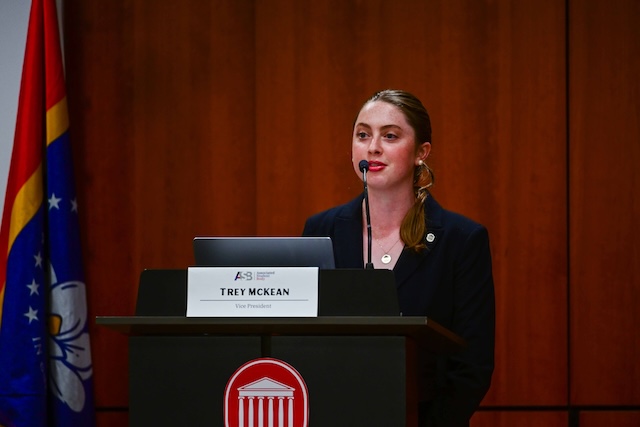
“Bereavement was not the reason that the attendance policy was brought to our attention — that would have been the athletics,” Williford said. “But when we further did a deep dive into the need for an upgraded attendance policy, one of the main conversations that kept coming up was bereavement-related class absences that were not necessarily excused in a reasonable manner.”
Collaboration with the faculty senate
The faculty senate has discussed the attendance policy and offered suggestions since ASB first introduced the proposed policy in December 2024. ASB worked with UMatter and the UM Testing Center to incorporate the faculty senate’s suggestions.
A joint governing council composed of ASB members, faculty senators, graduate student council and staff council members convened in spring 2025 before becoming an official committee in January 2026. The group fully approved a revised attendance policy proposal in March 2026, which then unanimously passed the ASB Senate.
Since making these revisions, ASB has been working to finalize its presentation to the faculty senate set for Dec. 1.
“The leadership of faculty senate, as part of a larger working committee tasked with working through the student attendance policy, recently met with ASB leadership and had a productive talk in finalizing the policy to bring before the faculty senate at the December meeting. ASB leadership have been invited to present it then,” Chair of faculty senate John Lobur said. “In every likelihood, (the) faculty senate will vote on the policy in the same meeting.”
Williford mentioned two main concerns from the faculty senate and other professors regarding the proposed attendance policy. The faculty senate’s primary concern is whether the proposed policy would limit professor freedoms.
“A lot of (the members of the faculty senate) have just been worried about the policy impeding on their academic freedom just because right now, their attendance policy is completely up to professor discretion, which we, as ASB, understand that that’s very important for professors,” Williford said. “That’s not something that we want to completely take away, which is why we have implemented a lot of academic discretion within the current proposed draft.”
The second concern is in regards to students falsifying documents to get out of class.
“Just because there are … people that fabricate or falsify information, bad actors are not a reason to not have a policy,” Williford said.
How does UM’s attendance policy compare to other schools?
The attendance policy proposed by ASB is partly inspired by the attendance policies of Mississippi State University and other SEC schools. Mississippi State excuses absences for the following conditions: bereavement, severe illness, participation in a university activity, participation in legal proceedings or administrative procedures, religious holy days, military duties and mandatory admission interviews for professional or graduate school that cannot be rescheduled.
“These approved excused absences are not subject to instructor direction in course attendance penalties,” the Class Attendance and Reporting Absences policy said. “Death in a student’s immediate family to include a student’s parent, legal guardian, sibling, grandparent, grandchild, spouse or partner, as well as natural, adopted and/or in-law children.”
Mississippi State’s policy emphasizes that an excused absence cannot result in an academic or attendance penalty, including the use of drop grades.
“Excused absences shall not result in attendance or grade penalties,” the policy says. “Use of a drop grade will be considered as a penalty.”
ASB’s proposed attendance policy also includes this stipulation.
“Instructors shall provide accommodations for missed classes and/or coursework related to excused absences,” ASB’s proposed undergraduate attendance policy says. “Accommodations include making up, in a timely manner, missed coursework. While specific accommodations are left to the discretion of the instructor, the use of drop grades should not be used as an accommodation for excused absences.”
Williford believes having university-sanctioned time to grieve without penalties for missing class within the period of one calendar week is ultimately a positive for the student and their work.
“If a student is experiencing a death in their immediate family, they’re not going to be in the mindset to be continuing coursework and to be taking exams to their fullest potential,” Williford said. “As a university, we have the responsibility to be providing our students with the resources to allow our students to demonstrate their knowledge and what they have learned to their fullest capabilities.”
Personal experiences prompt students to support bereavement policy
In light of student testimonies regarding negative classroom experiences after the deaths of family and friends, Williford stands firm that this policy revision is necessary for student wellness.
Audrey Dufrene is a senior public policy leadership major from Shreveport, La. Her father died during the spring semester of her freshman year.
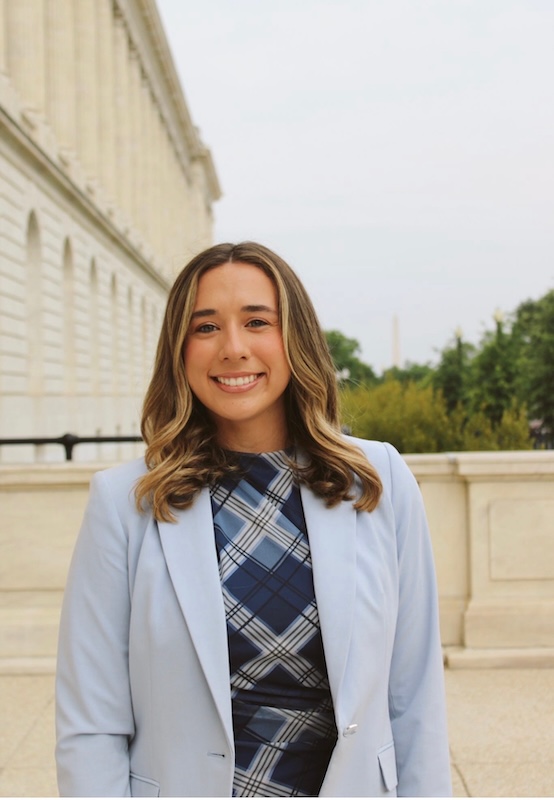
While most of Dufrene’s professors were understanding of her need to miss class and return home for her father’s funeral, Dufrene felt that two of her professors did not extend the same grace.
“One (professor’s) words expressed vague condolences and (granted) partial participation for absences, a class for which participation makes up a rather large chunk of the grade,” Dufrene said in her testimony to ASB. “It felt like no true understanding was taken into account.”
Participation points are awarded based on performance in class discussions. Dufrene said she views the loss of participation points as a punishment for behavior within students’ control.
“The death of my father, despite my absolute best efforts, was totally out of my control,” Dufrene said. “I was being deducted points for solely wanting to be at my father’s funeral or with family when I could barely concentrate.”
Lydia Horton is a senior journalism and psychology double major from Texarkana, Texas, whose childhood friend died at the beginning of her sophomore spring semester.
Horton reported similar experiences to Dufrene, wherein most of her professors were understanding with one exception.
“I went up to (my professor) … in-person because I knew he had a very strict attendance policy. We have to submit our homework at the beginning of class every day and take a quiz,” Horton said. “I … told him, ‘Hey, I have a funeral on this day — I’m not going to be here.’ … He was like, ‘Oh well, I teach this section again at 1 o’clock, if you just want to come into that class.’”
Horton’s usual class time was 11 a.m. The funeral she was set to attend was approximately 5.5 hours away. Horton said she felt put off by this interaction.
“Wanting me to come into class two hours after I’ve had a funeral for somebody … is an appalling thing to ask of somebody,” Horton said.
What’s next?
ASB and the faculty senate continue to be in conversation with one another ahead of ASB’s upcoming presentation on the proposed attendance policy.
Whether or not faculty senate passes it, the attendance policy will then go to two other committees — the undergraduate council and council of academic administrators. While the faculty senate’s signature of approval is not necessary for the proposal to reach those councils, Williford stated that its approval would give the proposal more legitimacy.
“If (the) faculty senate does not pass it, it will still have to go to the councils, but it’s very important to have faculty support,” Williford said. “At the end of the day, they’re the ones instituting the policy, and the two councils following them will be looking for what (the) faculty senate’s opinions (are) … when they place their vote.”