





























The University of Mississippi broke its previous enrollment record for the fourth year in a row with a 2% increase in overall enrollment. The freshman class size fell for the second consecutive year, but the decrease in first-year students was offset by transfers and increased retention.
The university enrolled 28,960 students for fall 2026 compared to 28,405 in fall 2025. According to an announcement released on Monday, Nov. 2, this number includes students from all 82 counties in Mississippi, every U.S. state and 93 total countries. The increase is due in part to the 6.2% increase in Mississippi residents enrolling at UM.
While this is the third-largest freshman class in school history with 5,363 first-year students enrolled this fall, freshman enrollment at UM peaked in 2024 and decreased in both 2025 and 2026.
Nationally, birth rates began to fall at the end of 2007, first triggered by the financial recession, and have not recovered. Now, there are fewer students graduating from U.S. high schools and subsequently attending colleges. This is widely known as the demographic cliff; the number of 18-year-olds is projected to fall 13%, or nearly half a million students, by 2041.
University of Mississippi Provost Noel Wilkin acknowledged demographic trends impacting college enrollment, highlighting the university’s retention strategies that are helping maintain growing total enrollment.
“The enrollment cliff, driven by demographic trends, is predicted to affect the number of college-age students for the foreseeable future,” Wilkin said. “In addition to our efforts to enroll students, we also focus on providing the support and opportunities they need to succeed and graduate. Our 87.6% retention rate and state-leading graduation rates reflect the dedication of our students and the faculty and staff who support them throughout their academic journeys.”
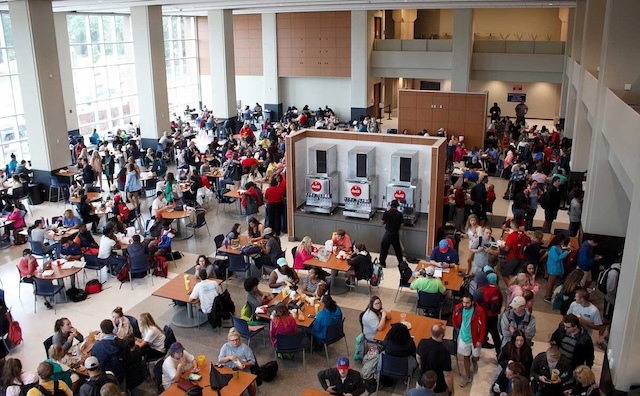
The University of Mississippi leads the state in retention with 87.6% of last year’s freshmen returning this fall. This is 18.5% higher than the national average and is the sixth consecutive year the university has retained more than 85% of its freshmen.
Piper David, a junior integrated marketing communications major from Columbia, La., sees the uptick in enrollment as a great way for campus involvement to expand and an opportunity to grow her network.
“With more people enrolling, there are more opportunities for clubs, activities and organizations which keep students involved. I know I have grown fond of watching … more organizations like Run With Christ develop, even just this year,” David said. “The more people that come to Ole Miss, the more people you get to meet and connect with. I love how our campus has grown. You never run out of people to meet or things to do.”
However, not all students see another record-breaking year of enrollment as a good thing.
Junior exercise science major Trevor Goodbred from Oswego, Ill., is concerned that the university is not growing its infrastructure in proportion to its student population, which inconveniences students who are currently enrolled.
“As a student, I think it’s really interesting to keep increasing enrollment without having the housing or parking to facilitate that,” Goodbred said. “Parking, especially, is already a nightmare. … I just think they should be holding off on increasing (enrollment) until they have projects closer to completion to mitigate the increased need for parking and housing that comes with increased attendance.”
UM currently has 170 active infrastructure projects evaluated at roughly $1.3 billion. This includes the construction of new student housing, parking lots and garages — some of which are estimated to be completed in 2027.
At the Sept. 1 Board of Aldermen meeting, Oxford-University Transit’s new budget of $7,823,120 was approved for the 2026-27 fiscal year. These funds include those set aside to purchase three 35-foot heavy-duty buses to further expand public transportation in Oxford.
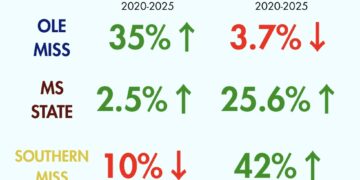
Five of Mississippi’s eight major public universities have experienced increases in enrollment: the University of Mississippi, Mississippi State, Mississippi University for Women, Alcorn State University and Delta State University.
Jackson State University and Mississippi Valley State University both faced sharp declines of over 10% in enrollment this fall. Jackson State’s enrollment decreased by 691 students and Mississippi Valley State lowered by 300.