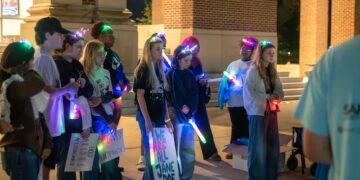








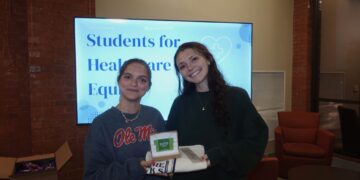





















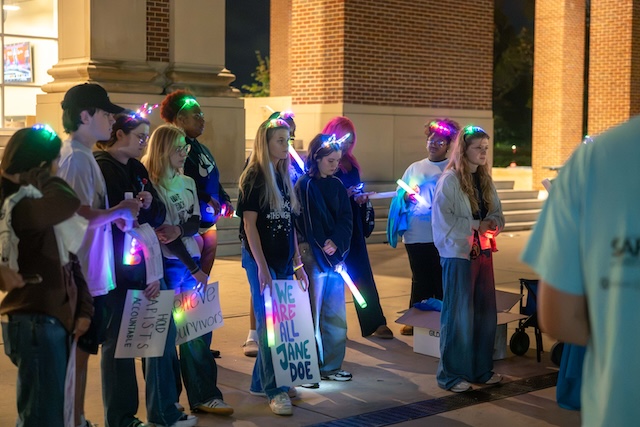
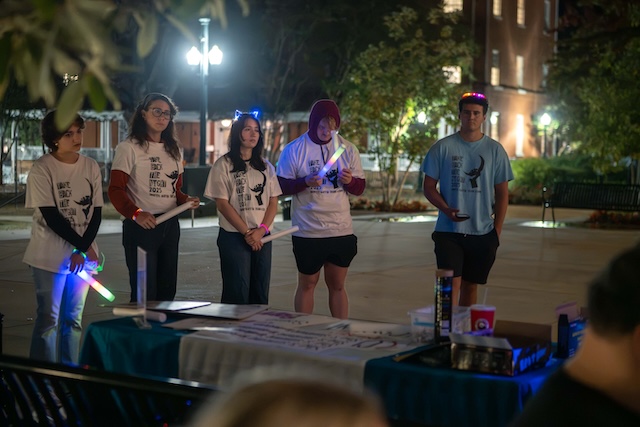
The University of Mississippi Rallying Against Sexual Assault (RASA) organization held its annual Take Back the Night march to speak out against sexual violence on college campuses on Sunday, Nov. 1 at 7 p.m. The event, held on over 40 college campuses, featured a live stream with several keynote speakers sharing their personal experiences on abuse.
RASA hosts an annual march, but this year’s rally was part of a movement to spread awareness about sexual violence on college campuses in light of the Cornell Seven alleged sexual assault case, which has received widespread scrutiny.
Take Back the Night is an international nonprofit organization whose mission is to end sexual violence in all forms and support survivors in their healing journeys. This rally was meant to connect over 40 college campuses together with the goal of having the largest national campus rally against sexual violence in history.
The campuses were connected through a livestream, and students were encouraged to register their colleges for the rally. Other colleges that participated include Ivy League schools Harvard University and Yale University, along with other SEC colleges like Auburn University and Texas A&M.
The live stream included a speech from Amy Tilton, the assistant director for the Take Back the Night national organization, and three other speakers who discussed their experiences as sexual violence survivors.
Tilton introduced the purpose of the Take Back the Night rally, along with the history of the event and its beginnings.
“Take Back the Night has a history spanning over five decades. Its roots stretch back to the 1970s when women all over the world took to the street to demand safety from violence and abuse,” Tilton said. “Our campus protests demand change, and the movement continues to grow with students.”
The first speaker to share her story was Claire Barnett, a professor from Georgetown University Law Center. She detailed the history of campus sexual assaults and the steps that colleges have taken in the past to prevent it.
“In 1972, Title IX promised us that no student would be shut out of an education because of sex,” Barnett said. “They have barely scratched the surface, but they have uncovered a pattern of violence.”
Barnett went on to detail specific attacks across college campuses, stating that offenders often did not receive sufficient punishments for their crimes.
“In 2016, a jury convicts Stanford swimmer Brock Turner for three felonies of sexually assaulting now-author and advocate Chanel Miller behind a dumpster while she was unconscious,” Barnett said. “The judge sentenced him to just six months in prison.”
Barnett detailed several stories discussing the harassment of women across college campuses in the United States. She emphasized that a change must occur or students will not be comfortable discussing their stories in public.
“Across the decades and across the nations, the law has only changed when survivors advocated and forced it to,” Barnett said.
Broadway actor Antuan Raimone also spoke at the rally through the live stream. Raimone is a survivor of childhood sexual abuse and an advocate for survivors of abuse. He encouraged survivors to use their voices and demand change whenever possible.
“Speaking up has helped heal the shame my younger self carried for so many years,” Raimone said. “I know now that my younger self did (his) best to keep (himself) safe and protected, and it is because of that courageous act that I am still here today.”
He further detailed the ways people and loved ones can support survivors, as well as prevent abuse from occurring in the first place. He urged college students to stick together and support one another.
“If you go out together, make sure you leave together,” Raimone said. “Support survivors by listening to what they need, not what you feel they should do, and finally, demand change and accountability from your institution.”
The next speaker was Margaret Hoelzer, a two-time Olympian, medalist and former world record holder in swimming. She was also one of the first athletes to publicly speak about childhood sexual abuse and is a strong advocate for prevention.
“When we talk about children, we use a word called ‘grooming,’ which is just defined as gaining a child’s trust,” Hoelzer said. “It is really not difficult to get someone to fall into your circle of trust. It can just be a person you trust enough to give you a ride home, or just someone you trust to be alone with.”
She urged survivors to speak out and share their stories even if they are afraid.
“Unfortunately, there are a lot of people out there who have not been believed or are scared that they won’t be believed,” Hoelzer said. “I will promise you that even if someone won’t believe you the first time, someone will believe you eventually.”
The next speaker was educator and speaker Kateri Marion. She detailed her story of sexual abuse in a religous setting and said she hopes to inspire other women to speak up and not be afraid.
“I cannot change what happened to me, but I can change what happens to the next survivor,” Marion said.
RASA has hosted other events in support of stopping sexual violence across campus. Senior Julienne Alinsub, the co-president of Ole Miss RASA, shared other ways the group has spread awareness.
“We always go to EDHE classes and talk to the freshman about things to be cautious (about), as well as doing presentations in the (Gertrude C. Ford Ole Miss Student) Union ballroom,” Alinsub said.
She further explained that the group prioritizes educating students on sexual assault prevention and resources during the “red zone,” which is the first two weeks back on campus when the most cases of sexual assault are reported.
“One in four women and one in eight men are victims of sexual assault on college campuses,” Alinsub said.
Along with this rally, Take Back the Night is also promoting a billboard campaign, where 21 billboards will be placed across 14 cities beginning Oct. 29. The billboards include statistics about sexual assault on college campuses and direct viewers to Take Back the Night’s website.
On the website, students can send an open letter to their university, which include five different steps for universities to take to prevent harm to students, hold the institution accountable or provide support for survivors.