






























Over the past five years, the University of Mississippi has succeeded from the classroom to the football field. Still, it does not seem that this news has reached the state legislature. Despite the university’s record growth and academic achievements, state funding has not kept pace compared to other public universities in the state, exposing funding disparities that are long overdue for change.
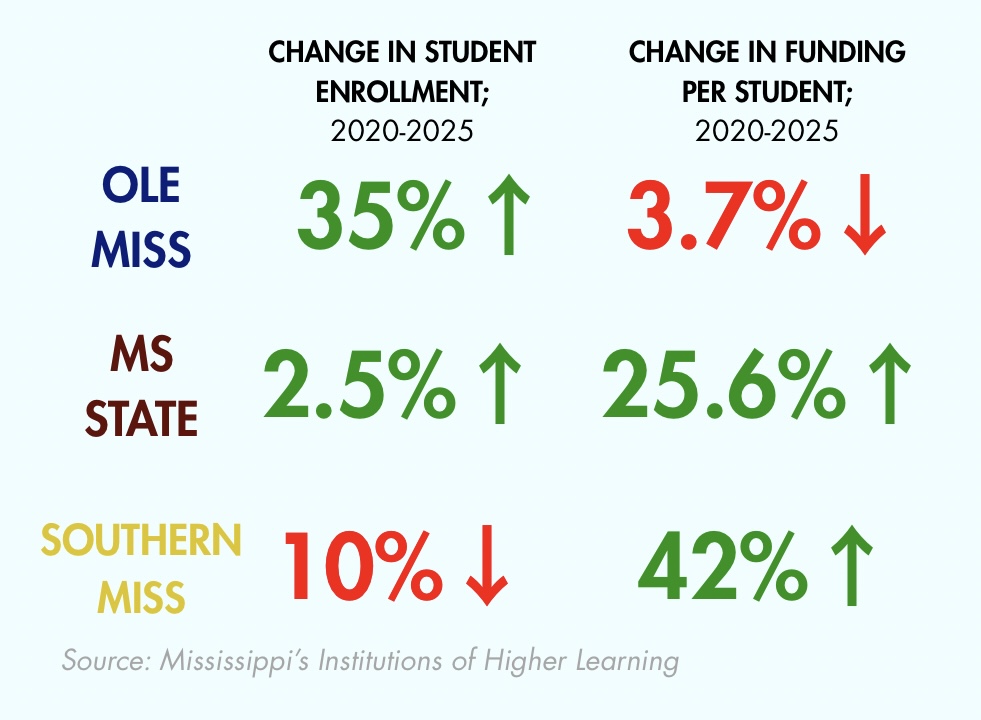
From 2020 to 2025, the University of Mississippi saw almost a 35% increase in enrollment, yet its state general fund appropriations per student decreased by 3.7%, as made clear by the 2020 and 2025 funding reports. Among Mississippi’s three largest public universities, Ole Miss was the only one to experience a decrease in general fund appropriations per student.
As a result, this lack of funding puts greater emphasis on tuition and fees. On its face, some may argue this is understandable because of the university’s substantial number of enrolled out-of-state students and large donors. However, when compared to the state’s other two largest universities, Mississippi State University and the University of Southern Mississippi, the unfairness of this discrepancy becomes increasingly clear.
Mississippi State experienced a 2.5% enrollment growth during the same period, but its funding per student increased by approximately 25.6% based on 2020 and 2025 funding reports. To further put this in perspective, MSU’s collective general funding was over $7.5 million more than the $85.2 million that was allocated to Ole Miss.
The comparison with Southern Miss is even more dramatic. USM experienced almost a 10% decline in enrollment between 2020 and 2025, while its funding per student increased by approximately 42%.
Simply put, Ole Miss has experienced the fastest enrollment growth among the state’s three largest public universities, while also improving its academic performance. The university now boasts the highest four- and six-year graduation rates in Mississippi.
Despite these successes, state funding has failed to keep pace with the university’s growing student population. To be clear, I am not advocating for decreasing funding for other universities in the state. Rather, I believe the state should properly invest in and incentivize growth and success, and the current funding model falls short of doing so.
Many of us have heard of the concept of “brain drain,” which refers to the phenomenon of the departure of educated and skilled individuals from one state or region to another. In recent years, Mississippi has experienced one of the worst rates of brain drain in the country..
Some state officials, particularly State Auditor Shad White, have raised concerns about graduates from Mississippi universities leaving the state, and understandably so. However, considering that more than half of Ole Miss’ on-campus students are from outside of Mississippi, I believe the university presents a unique opportunity to reverse that trend by attracting and retaining educated young adults who might otherwise never consider living here.
Attracting students is only the first step, and I think the state should begin to ask itself whether it is taking full advantage of its opportunities to attract and retain them. I do not believe the state is properly maximizing Ole Miss’ potential or that of the other public universities in Mississippi.
I think there is no better example of the potential economic benefits of a successful university than the so-called Velvet Ditch of Oxford itself. The university is currently working on projects totaling over $1.3 billion. Oxford is constantly investing beyond the university, including in multiple housing developments and new businesses.
The formula is relatively simple: As the university grows, so too does the local community and its opportunities. At times, this growth may be accompanied by growing pains, and that is evident when trying to drive around town. Imagine what the state could accomplish if it properly utilized the university and changed its incentive structure.
At a minimum, Mississippi should reconsider how it funds its public universities and ensure enrollment growth and academic success are partly tied to funding. After all, if the state is going to capitalize on its momentum, investing in the universities that help drive that growth seems like a reasonable place to start.
Taylor Young is a third-year law student from Gulfport, Miss.