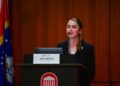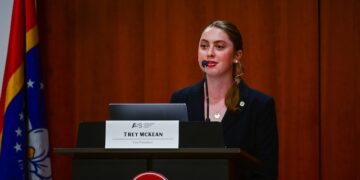






















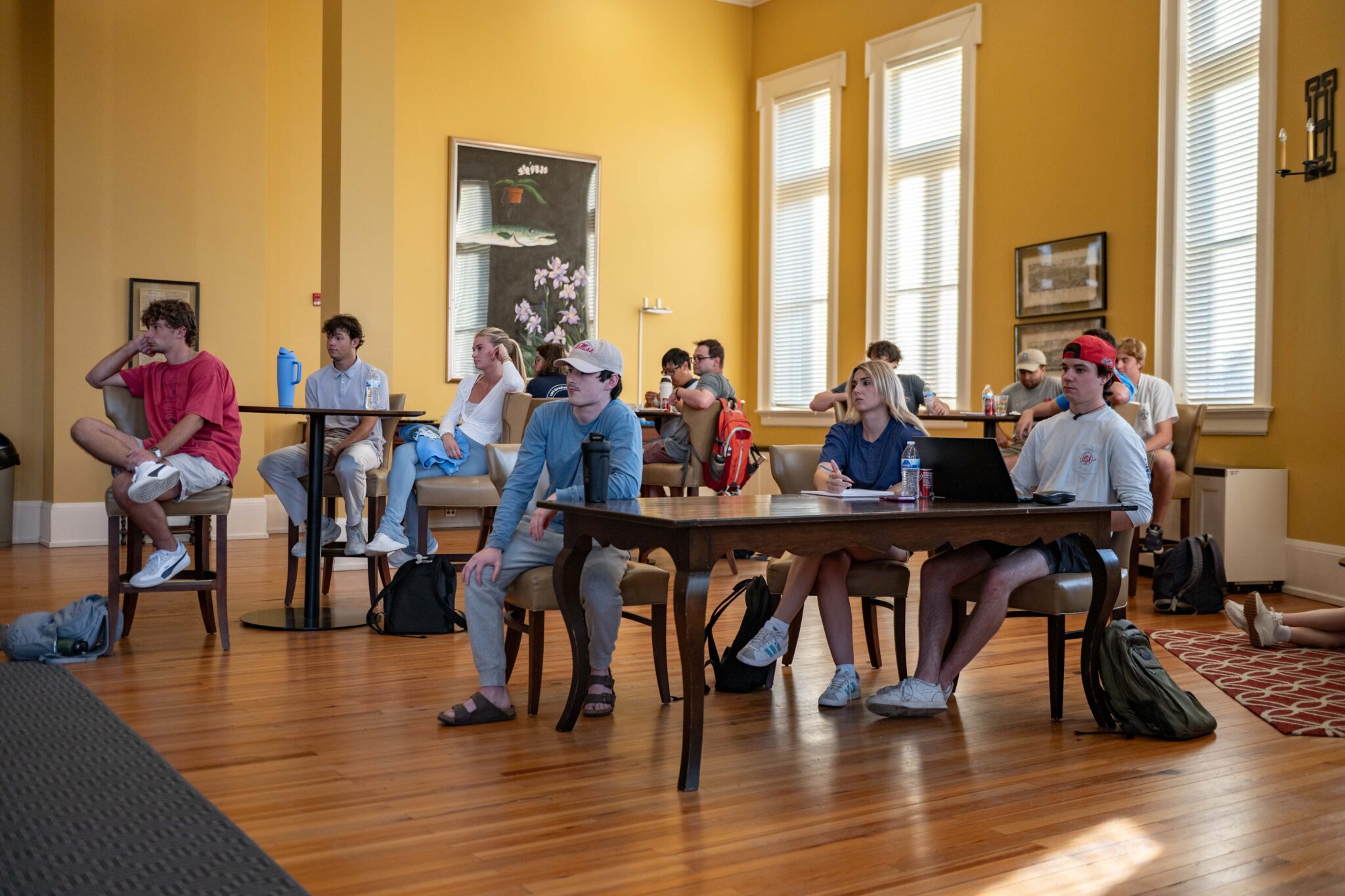
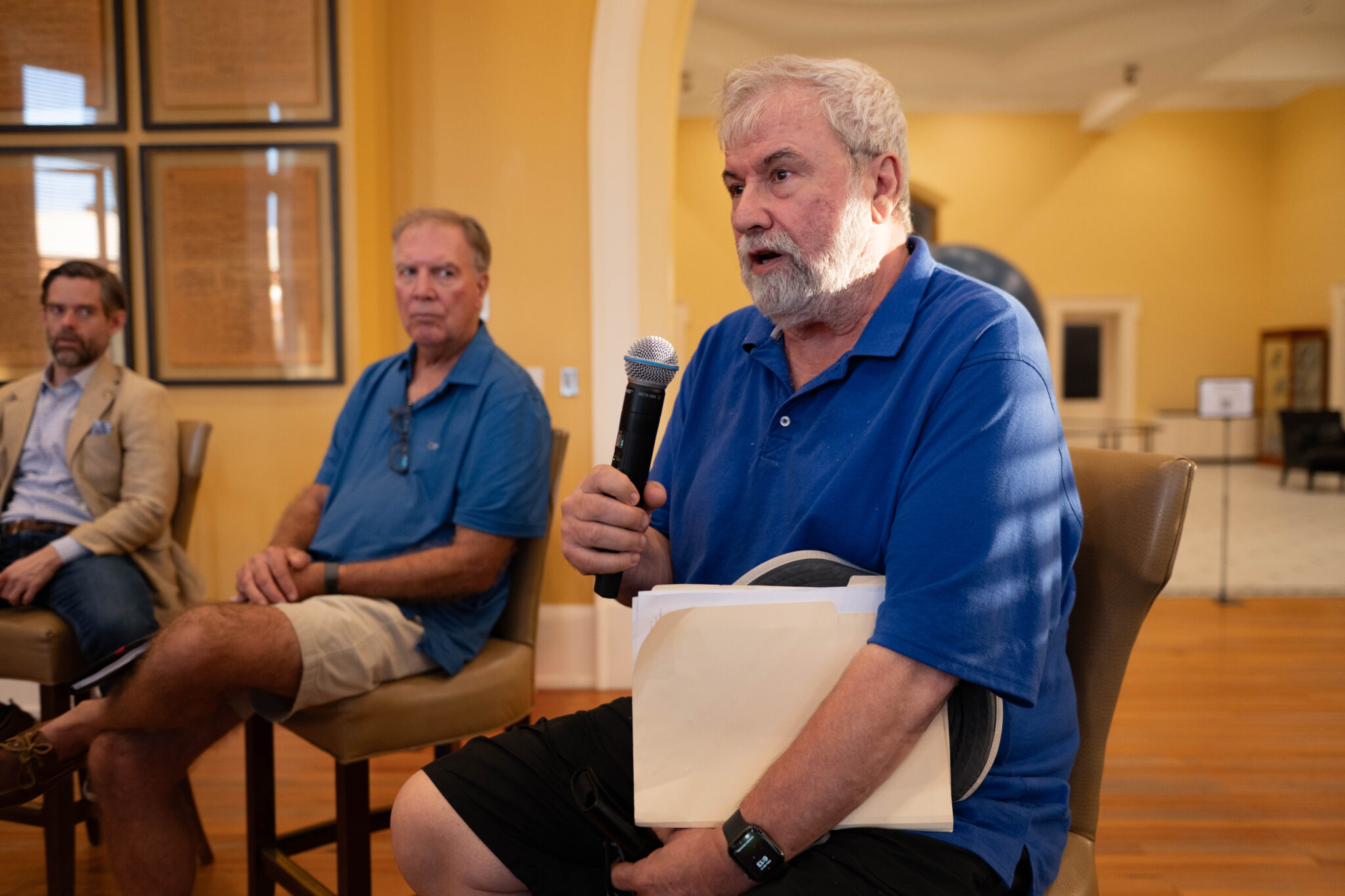
The Center for Practical Ethics hosted its “Are These Wars Just?” panel in the gallery of Bryant Hall on Monday, Sept. 21. The discussion centered around the morality of modern wars and featured Instructional Assistant Professor in Philosophy and Religion Katherine Moses and Adjunct Professor of Intelligence and Security Studies Jamie Barnett. Borrowing on their years of practical experience, the professors examined war through ethical, philosophical and military perspectives.
Nathan Oakes, the director of education and student programs for the Center for Practical Ethics, organized the event. He said that the goal of the discussion was to inform students on the complexity behind present-day political and ethical conflicts.
“My main goal with all of these discussions, but especially with this one, is just that any big, hard political topic is nuanced,” Oakes said. “Probably neither extreme is going to be able to capture all of the complexity of the situation.”
The discussion addressed international law, just war theory, proportionality and the responsibilities of citizens who disagree with their government.
Moses introduced just war theory by explaining what principles may be used to deem a war justified, and determine what action is proportionate. She concluded that there was no single answer to the question of whether a war is justified.
“These are very complex issues,” Moses said. “Even if you think that some wars are justified, it’s almost impossible to say that any given war is perfectly justified or is justified in every single respect.”
In contrast, Barnett approached the discussion from a military and national security perspective. A University of Mississippi graduate himself, Barnett served in the U.S. Navy for 32 years and achieved the rank of rear admiral, a senior flag officer rank.
Barnett emphasized his belief that military force should only be used after other avenues have been exhausted.
“War should always be the last possible thing you have to do,” Barnett said.
The panelists applied just war theory to the ongoing conflicts between Ukraine and Russia, Israel and Palestine and U.S. and Iran.
The conflict between the U.S. and Iran became a central example as Barnett and Moses questioned how a country determines its objectives in war. They proposed the question of whether citizens can judge a conflict as just or unjust without access to the breadth of information their government holds.
Moses said that the uncertainty surrounding war should encourage people to approach conflict with “intellectual humility.”
“I think a lot of people today really do believe that they have certainty, and know, whether a war or any kind of conflict is just or not,” Moses said. “I hope that after (this discussion), people would realize that if they reflected a bit on their knowledge and their position in our country, that, in a lot of cases, we just don’t know, and we can’t know.”
After the discussion, Moses applied this attitude of uncertainty to the conflict between the U.S. and Iran.
“Maybe the Iran war is just, and we just don’t understand that,” Moses said. “Maybe it’s been unjust from the start.”
Moses said the disagreement among Americans over moral issues can give the U.S. government more leniency when it comes to decisions involving war.
“If we don’t share any kind of foundational moral beliefs, not just about war … then how could we ever have any kind of agreement that would put pressure on the government to actually make the right decision with respect to a conflict as big as Iran?” Moses said.
Barnett proposed a similar approach but took a military perspective. He argued that the U.S. needs to clearly define the goals of any conflict it enters.
“Until the American government articulates what they want to do, and puts the right amount of stuff behind it, then I think it’s just going to be a quagmire,” Barnett said.
Barnett described the lack of clearly communicated objectives by the U.S. government as a huge setback for both the American public and service members responsible for carrying out the government’s policies.
“It’s a failure to the people of America,” Barnett said. “But it’s also a failure to our troops.”
The idea of what victory in Iran would look like was also questioned by Barnett. Without a defined goal, Barnett argued, there is no end in sight.
The uncertainty of present-day conflicts also resonated with students in attendance. Kate Strawn, a junior international studies major from Hernando, Miss., said the discussion connected to questions she has encountered throughout her study of international law.
“You can’t really have a yes or no,” Strawn said. “I think their different insights about that was very eye-opening.”
For Gordon Whitwell, a 2026 public policy leadership alumnus from Oxford, the Iran war makes all of those questions especially relevant for college students who have recently become eligible to vote.
“Right now, with different wars going on in the world and the U.S. involvement in Iran, (there are) a lot of people — especially around my age — that are now voters for the first time in the past few years (who are) having to think about these things and the moral justifications of it,” Whitwell said.
Whitwell said the discussion emphasized the obstacles that lie in the way of reaching a definitive conclusion about the morality and ethics of war.
“I think it just shows the complexity of everything you have to take into consideration as citizens (and) voters,” Whitwell said.
To Oakes, that complexity was the point of the event. Rather than providing students with a single answer about whether the wars are just, Oakes said the discussion was intended to allow students the opportunity to reach their own conclusions based on different perspectives.
“Getting a couple of people who are really smart and who know about the topic and letting them speak freely… They can disagree or agree, just, they’re telling you what they genuinely think,” Oakes said. “It’s productive to have good dialogue about important topics.”