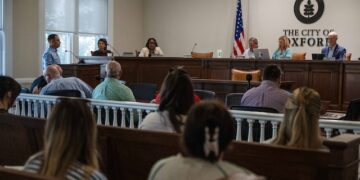
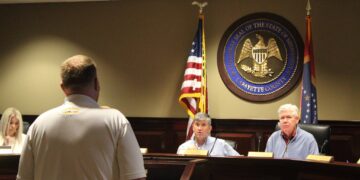

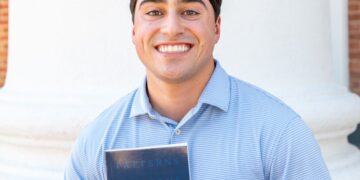





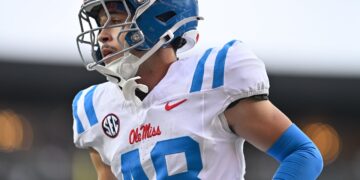









Judge Robert Whitwell granted Ole Miss quarterback Trinidad Chambliss a preliminary injunction in the Calhoun County Courthouse on Thursday, Feb. 12, which will allow Chambliss to participate in the 2025-26 College Football season.
For Ole Miss fans, this is a major step toward success in the 2026 season. Chambliss led the Rebels to their most successful season in program history last year, when the team reached the semi-final round of the College Football Playoff. He hopes to do it again in his additional year of eligibility.
The trial will continue; however, Chambliss will have eligibility for its duration. In the hearing on Feb. 12, Chambliss’ attorneys sought to ensure that Chambliss could participate in the upcoming college football season. The injunction was not filed against the NCAA, rather it was filed for Chambliss.

The NCAA denied Chambliss’ waiver request for another year of collegiate eligibility on Jan. 9. The NCAA also denied his subsequent appeal. On Jan. 16, Chambliss’ counsel submitted a petition for preliminary injunction, which led to the Feb. 12 hearing.
Chambliss’ lawyers took the stance that the NCAA acted in bad faith with the decision to deny Chambliss an additional year of eligibility.
The NCAA argued that Chambliss should not be allowed to play next season for multiple reasons, including that a ruling in Chambliss’ favor would result in more student-athletes bypassing NCAA rules and going to the courts for redress.
U.S. Sen. Roger Wicker, R-Miss., Chambliss’ mother, Ole Miss quarterbacks coach Joe Judge and a room full of observers were in attendance. Tom Mars, a well-known lawyer in collegiate sports legal cases, represented Chambliss alongside William Liston.
Chambliss’ lawyers opened by bringing Dr. Ford Dye, an Oxford-based ear, nose and throat specialist, to the stand. Dye reviewed documents regarding Chambliss’ medical history, including a letter from Dr. Anthony Howard, Chambliss’ doctor at Ferris State University, a Division II school where he played football before transferring to Ole Miss last season.

Dye stated that because of Chambliss’ tonsillitis, he was unable to adequately prepare and participate in college football in 2022. During that time, Chambliss told Howard he was doing better, a point the opposition used against Chambliss; however, Dye refuted.
“He was better — not well,” Dye said.
Dye agreed with Howard’s statement regarding his incapacity to play in the 2022 season. Dye’s testimony focused entirely on Chambliss’ medical history and made numerous references to Howard’s time with Chambliss and his letter supporting Chambliss’ additional year of eligibility.
Upon cross examination, the NCAA’s legal representative focused on Chambliss’ decision to not have surgery, which would have allowed him to participate in the 2022 season and attend classes. Dye maintained that he would not have recommended surgery if he were in Howard’s position and agreed that Chambliss was incapacitated in 2022.
The NCAA pushed that Chambliss never missed anything football-related due to tonsillitis. Dye cited weight loss as a factor for why Chambliss missed time for tonsillitis and could have been unable to play for two weeks. The opposition pointed out that football season is much longer than two weeks.
Whitwell agreed with Dye that it was unreasonable to expect Chambliss to be prepared for the 2022 season due to tonsillitis, which the NCAA states is the responsibility of the athlete.
“Referring to his rule … the NCAA instructs you to get in shape in the summertime before you report, so you won’t have these problems, but he wasn’t able to do that in 2022 based on your analysis,” Whitwell said.
Judge was next up on the stand as an expert on football and quarterbacks; however, after a thorough introduction and an objection from the NCAA, the judge ruled that Joe Judge could only offer a layman’s opinion.

“(Football is) an undefined science,” NCAA lawyer Taylor Askew said.
Judge said that the Ole Miss Football program has a quarterback school. Since Chambliss joined the team in spring 2025, he was unable to attend the quarterback school and instead received a crash course on the team.
Chambliss’ lawyers made the point that NFL teams do not want to draft a one-year starter; instead, they prefer multi-year starters. Judge said that the majority of successful NFL quarterbacks started for multiple years.
“What you’re looking for when you draft somebody is … sustained evidence,” Judge said. “Where there’s more years of development of the quarterback, (it) gives you a better vision of what he can be, where he’s at.”
In the last 10 to 20 years, only four NFL quarterbacks signed a second contract after only starting for one full year in Division I.
“(The second contract) is the most important contract you can have in that league (NFL),” Judge said.
With Judge on the stand, Chambliss’ lawyers made the case that it was in the best interest of Chambliss, from a developmental and financial standpoint, to allow him another year of college football.
Cheryl Chambliss, Trinidad’s mother, was up next on the stand. She recounted Trinidad’s sickness in 2022, particularly while he was sleeping.

“There were times that he would, in my opinion, stop breathing,” Cheryl Chambliss said. “I couldn’t hear him breathing.”
Additionally, Trinidad had tonsil surgery in December 2024 to remove his tonsils. Cheryl said that Trinidad thought he was dying during his recovery.
Ferris State declared Trinidad Chambliss a medical redshirt in 2022 but did not file for the designation.
“They made the assumption that he was remaining at Ferris and that they did not foresee that he would be transferring to an SEC or DI or any other school, so they saw no reason to file,” Cheryl Chambliss said.
After a lunch break, Trinidad Chambliss took the stand. To open, Chambliss said he was under the impression he had two years of eligibility left when transferring to Ole Miss.

Fatigue was an issue for Chambliss throughout the 2022-23 academic year even when he was not in pain or affected by a poor appetite, resulting in weight loss.
In 2022, Ferris State head football coach Tony Annese told Chambliss that he would not play that season.
From a financial standpoint, Chambliss sought the injunction because he was unable to sign a revenue share agreement with Ole Miss, which requires eligibility.
With his extra year of eligibility, Chambliss will continue to work with AT&T and other companies for commercial purposes.
The opposing counsel noted that DII eligibility allows 10 semesters of athletics and for student-athletes to pause their eligibility. Once Chambliss left the stand, closing arguments began.
After an hourlong recess, Whitwell granted Chambliss an additional year of eligibility.
“Trinidad Chambliss has demonstrated, based on the evidence presented, that he is entitled to an additional year of eligibility at the University of Mississippi and the NCAA has failed in its argument to withhold that right,” Whitwell said. “The injunction is necessary to prevent irreparable harm to Trinidad.”