

























Ole Miss Football accounts for approximately three-fourths of Ole Miss’ estimated NIL market, which accounts for both NIL and revenue sharing, and men’s basketball takes another 15% and baseball takes 3%, according to The Sideline’s 2026 NIL Market Index. By the time women’s sports enter the individual breakdown, 93% of the Rebels’ estimated market has already been accounted for by those three sports.
The Sideline estimates Ole Miss athletes have a combined market value of approximately $56.4 million (No. 13 nationally and No. 7 in the SEC). These figures are estimates, not confirmed university spending, because so much information surrounding NIL spending across the NCAA does not legally have to be reported.
The Sideline creates its estimates using active rosters, recruiting profiles, sport economics, public NIL information and other market data. Still, the breakdown offers a look into how NIL markets have developed differently across men’s and women’s sports.
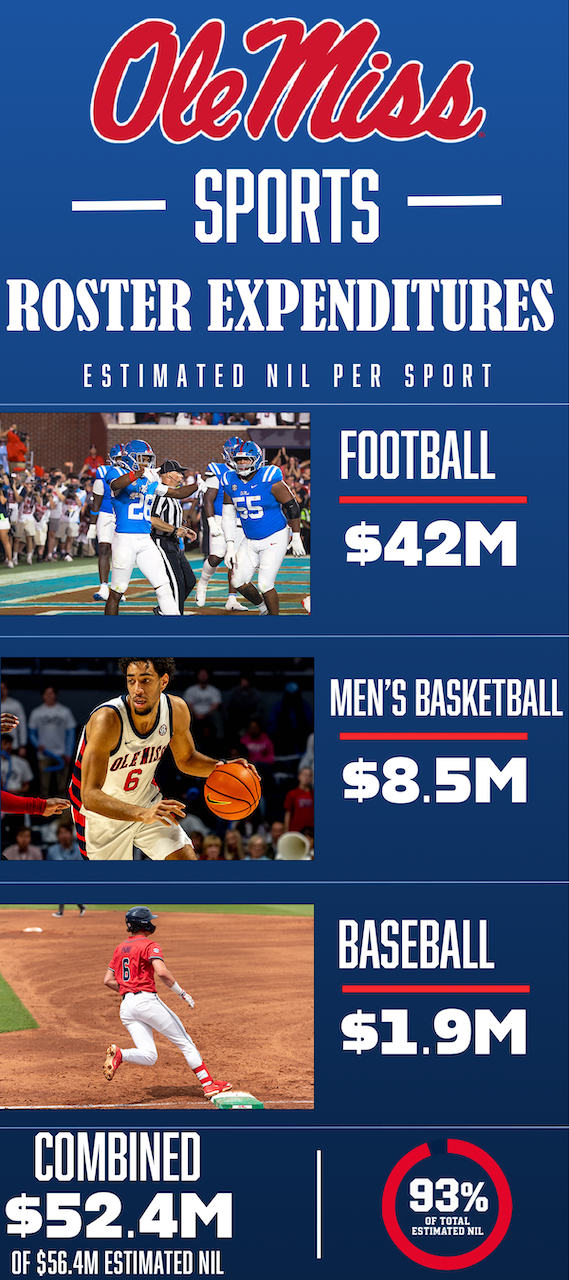
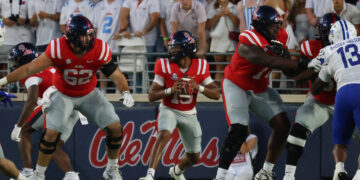
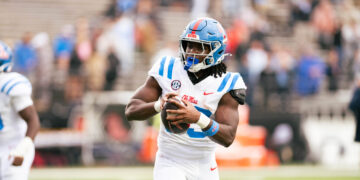
Football dominates at Ole Miss with an estimated market of $42 million, accounting for 75% of the total. Men’s basketball sits at approximately $8.5 million, followed by baseball at $1.9 million.
Together, these three sports represent approximately $52.4 million of Ole Miss’ $56.4 million estimated market.
A recent report from The Athletic puts Ole Miss Football’s budget in the $39 to $45 million range. Ole Miss Vice Chancellor for Intercollegiate Athletics Keith Carter said those figures “were in the ballpark” during an Overby Center for Southern Journalism and Politics panel on Thursday, Sept. 17, so The Sideline’s estimate is not far off for football.
Softball is the first women’s sport to appear in the breakdown at approximately $950,000, or 2% of the estimated total market. Track and field, which includes men’s and women’s athletes, follows at $850,000. Other men’s and women’s Olympic sports are valued at $775,000.
Volleyball has an estimated $700,000 market, while soccer sits at approximately $625,000. Women’s basketball is not individually listed in The Sideline’s Ole Miss sports breakdown.
Ole Miss is far from the only SEC school with a significant disparity between its men’s and women’s sports.
Texas has the largest estimated NIL market in college athletics at $76.9 million. Football accounts for 65% of that, while men’s basketball and baseball are valued at 16% and 9%, respectively.
Women’s basketball ranks fourth at the University of Texas, but its estimated 7% share and market of $5 million is still more than twice the value of Ole Miss’ individually listed softball, volleyball and soccer markets combined.
LSU shows a slightly smaller concentration at the top and a larger women’s basketball market. Football accounts for an estimated $48.5 million (71%) of LSU’s $68.5 million total. Men’s basketball follows at $6.8 million (10%), and women’s basketball ranks third at $6 million (9%).
At other SEC schools, women’s programs outside of basketball command larger shares. Alabama gymnastics is estimated at $3.6 million, making it the fourth-largest sport in the Crimson Tide’s NIL market behind football, men’s basketball and baseball. At Tennessee, softball carries an estimated $1.1 million market, approximately 2% of the school’s total.
Ole Miss seems to spend a little less on women’s sports than the rest of the SEC, but the numbers fit into a larger national pattern. Estimates put the entire Division I athlete market at approximately $4.19 billion for 2026-27. Football represents 57.9% of that market, while men’s basketball accounts for 23.6%. Women’s basketball represents 2.8%, softball 1.6% and track and field 1.3%.
Ole Miss’ football market is even more concentrated than the national figure. Its 75% share is 17 percentage points higher than football’s estimated share nationally.
NIL is also no longer the only way college athletes can receive compensation. The House v. NCAA settlement allowed universities to begin sharing revenue directly with athletes in July 2025.
Ole Miss announced plans to share up to $20.5 million annually through distributions and new scholarships, while athletes remain able to earn additional money through NIL opportunities.
The university has not publicly released a current sport-by-sport breakdown of those revenue-sharing payments.
Ole Miss has continued investing in its broader NIL system, including The Grove Collective and a 2026 partnership with TheLinkU designed to create additional NIL opportunities for Rebel athletes.
Ole Miss Athletics has said its goal is to remain competitive across its entire department as the financial model of college sports changes.
“We want to compete for championships in every sport,” Carter said in 2025.
The estimated market values show just how different the financial landscape can look from each sport to another.