































Academy Award-winning British director Emerald Fennell’s latest film adapts Emily Brontë’s 1847 gothic novel “Wuthering Heights,” starring Margot Robbie as Cathy and Jacob Elordi as Heathcliff. Controversy over the adaptation sparked when the original casting was announced in 2024 and has since received mixed reviews from audiences and critics for its style-over-substance approach to the classic drama.
The first volume of the novel “Wuthering Heights” follows the story of Cathy and Heathcliff’s tumultuous relationship from childhood to early adulthood on the property Wuthering Heights, with the second volume focusing on their children. The 2026 film adaptation omits the entire second half of the story, focusing on their coming of age.
This is Fennell’s third feature film following her 2020 thriller “Promising Young Woman,” which won the Academy Award for Original Screenplay. Her 2023 film “Saltburn” received similar praises and critiques as “Wuthering Heights” for its beautiful cinematography and entertaining but superficial story.
Three actors from “Saltburn” joined the “Wuthering Heights” cast including Elordi, Alison Oliver as Isabella Linton and Ewan Mitchell as the servant Joseph. Robbie’s entertainment company LuckyChap Entertainment produced the film along with Fennell’s previous films.
Other actors include Shazad Latif as Edgar Linton, Isabella’s ward and Cathy and Heathcliff’s wealthy neighbor. Hong Chau plays Ellen Dean, Cathy’s servant and companion, whose major role in the book is sidetracked to focus on Cathy and Heathcliff’s relationship.
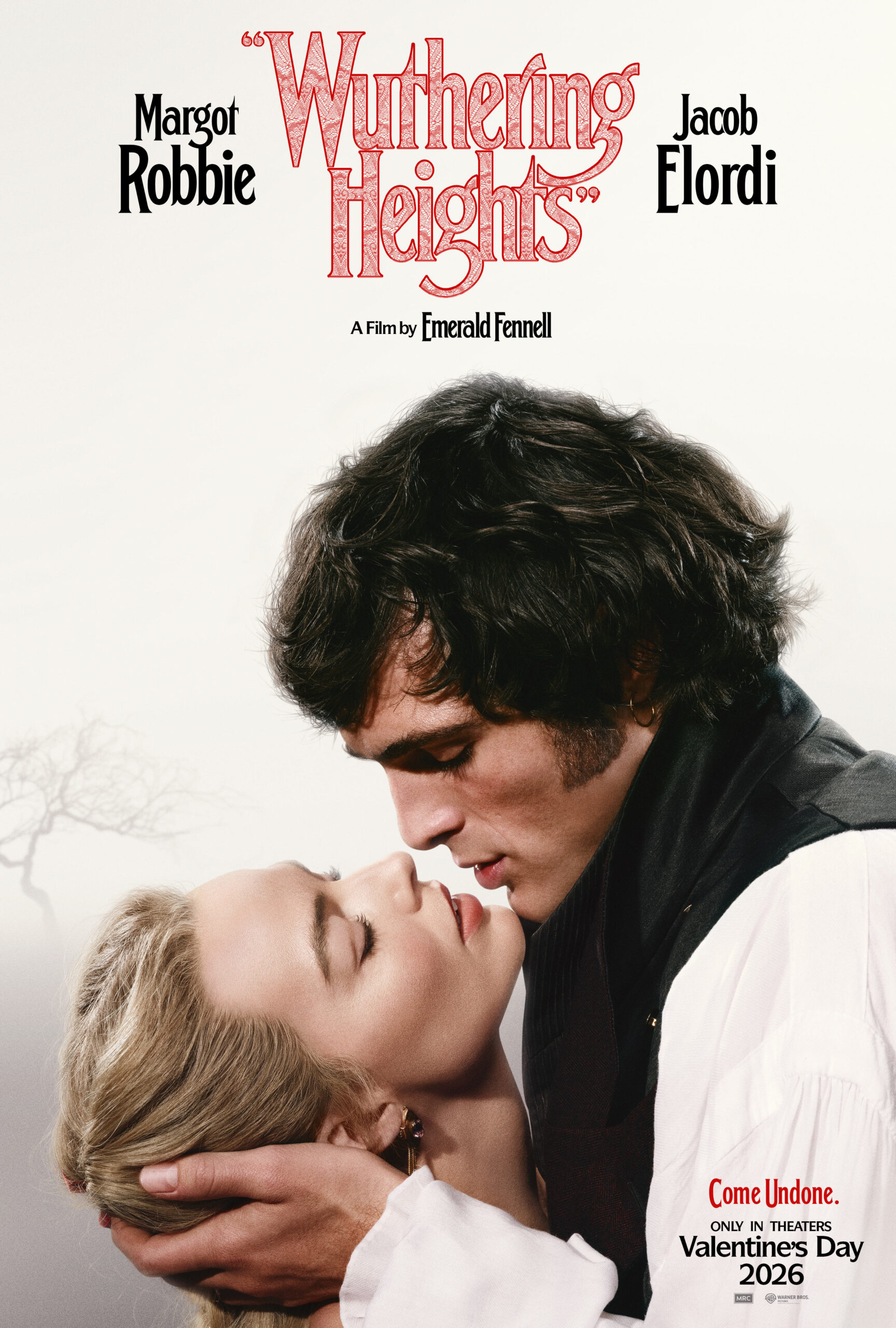
In a January interview, Fennell told Fandango that Brontë’s novel is too “dense and complicated and difficult” to adapt faithfully, and she considers her film a “version” of “Wuthering Heights.” This explains the stylized quotation marks on the film’s poster, with Fennell laying claim to the story and making it her own.
Fennell’s films have been praised for their coloring, set design, costumes and cinematography. These praises definitely translate to “Wuthering Heights,” with Robbie wearing bright ruby gothic dresses (made of fabric that certainly did not exist in the 19th century) and large, eye-catching jewelry.
The set design and cinematography are undoubtedly beautiful, yet disturbing. In the Yorkshire moors, Wuthering Heights is oppressive and unwelcoming. It remains gothic in its architecture, with skinned animals and empty alcohol bottles littering the place, creating an uncomfortable but intriguing viewing experience.
This sharply contrasts the set of the Linton’s home, Threshcross Grange, that explodes with color. The red acrylic floors, bright blue jewel-encrusted walls in the sitting room and the silver dining room with a dollhouse replica of Threshcross Grange are visually stunning.
One infamous room design is Cathy’s bedroom, or the “skin room.” The entire room is nude pink, with the walls being paneled with actual scans of Robbie’s skin, including her freckles and veins.
The film has caused controversy since the casting announcement of Robbie and Elordi as the two leads in the fall of 2024. Robbie, who was 34 during filming, was to play the wild and passionate teenage Cathy, with Elordi to play opposite as the brooding love interest Heathcliff.
Much of the concern about the casting regarded Elordi’s role as Heathcliff, who is described as “dark-skinned” in the novel. Heathcliff’s ethnicity is left ambiguous in the book and is still an on-going debate. Scholars theorize he could be of Romani, Southeast Asian or Spanish descent.
The whitewashing of Heathcliff is not new to “Wuthering Heights” screen adaptations. The character has been played mainly by white actors such as Laurence Olivier, who wore skin-darkening makeup in the 1939 adaptation. Other actors who have played the role include Ralph Fiennes and Tom Hardy. The 2011 adaptation directed by Andrea Arnold was the first and only time Heathcliff has been played by a Black actor, with James Howson playing the role.
The erasure of Heathcliff’s dark skin does not only a disservice to his character, but to the entire story. Heathcliff is traumatized by the racism and abuse he faces in Georgian-era England, which creates a cycle of abuse as Heathcliff inflicts pain upon every character in the story, including himself.
Fennell defended the casting choice in a BBC interview. She said Elordi, “looked exactly like the illustration of Heathcliff on the first book that I read.”
Before the film came out, Fennell prefaced that it is not a faithful adaptation. So my question is, why make it? She admits it herself that “Wuthering Heights” is too difficult to adapt. It is obvious that Fennell’s reading of “Wuthering Heights” misses the mark.
Why not make something new? Hollywood has been telling the same story over and over again for decades. I think it is possible to adapt “Wuthering Heights” and put a new and interesting spin on it while remaining faithful to the themes, which Fennell did not do. Instead, she inserted sexual and explicit scenes between the characters and removed the “soulmate bond” Cathy and Heathcliff share. Fennell dilutes their love for each other to lust.
To be marketed as “the greatest love story of all time” strips the book’s major themes. Cathy and Heathcliff’s love is not romantic; it is destructive and traumatic. “Wuthering Heights” at its core is a story of abuse, violence, revenge and the lasting effects of trauma.
The film is definitely entertaining, and I was never bored during my viewing. But I could not overcome my grievances with Fennell’s narrative and casting choices. Her version tries to turn a gothic horror into a contemporary love story with a Charli xcx soundtrack, which ultimately translates as hollow and devoid of substance on the screen.