




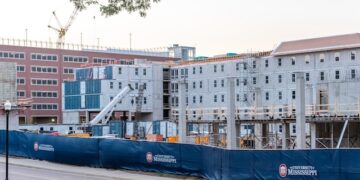

























Rising rent prices in Oxford are forcing some students at the University of Mississippi to rethink their futures, including whether pursuing graduate school in the city is financially realistic.
For Ben McCollum, a junior accounting major from Walnut, Miss., the numbers no longer add up.
“I definitely would consider staying longer and staying for graduate school here in Oxford if housing was more affordable,” McCollum said. “I just cannot see myself being able to live here comfortably while there are more opportunities for me elsewhere.”
Between his sophomore and junior years, McCollum said his rent increased by $200 per month. It is set to rise by another $200 in his upcoming lease this fall.
“It seems pretty typical for most student apartment complexes to jump $150 to $300 between each school year now,” McCollum said. “My roommates and I have thought about moving, but it feels impossible to find places that are cheaper or even the same price.”

Some of his peers, he added, are paying close to $1,000 per month, a cost that rivals housing prices in larger Mississippi cities.
According to RentCafe market data updated in February 2026, the average rent for an apartment in Oxford is now $2,283 per month, a 10.28% increase from the previous year, when the average stood at $2,070. One-bedroom apartments average $1,476 per month, while two-bedroom units rent for about $1,844.
Compared to other Mississippi cities, Oxford’s rental market remains significantly higher. The average rent in Jackson is $1,098, while Hattiesburg averages $1,244 and Gulfport $1,147, according to rental property website RentCafe.
For McCollum, those comparisons reinforce his hesitation about remaining in Oxford for graduate studies.
“As an accounting major, internships are really important,” McCollum said. “While I can gain access to those here at Ole Miss, I feel like I have a better chance if I move to a city I could see myself working in, and it would be about the same price to live there.”
Graduate students in particular are navigating unique challenges in Oxford’s tight rental market.
Annette Kluck, dean of the graduate school and professor of leadership and counselor education, said rising rents are putting significant financial pressure on students whose stipends or income have not kept pace with the housing market.
“A $200 per month increase translates to a $2,400 increase in annual rent,” Kluck said. “This has been a common experience for our graduate students in recent years.”
Timing also plays a role. Many complexes sign leases in the fall, but incoming graduate students often do not know their acceptance status until mid-spring. This leaves students at a disadvantage when trying to secure housing.
“Because graduate admissions are often determined by program-specific deadlines, moving up the timeline isn’t really an option,” Kluck said. “We’ve heard from students who struggle to find affordable housing during the typical lease cycle in Oxford.”
Graduate students also often need separate housing from undergraduates. Living with younger students can mean more distractions and less privacy, making it harder to focus on demanding coursework, research and assistantship responsibilities.
The UM Graduate School maintains a Slack channel for graduate students to communicate about available housing and potential roommates. However, collaborations between the university and local off-campus housing are managed through the student housing department.
“We are eager to work with others on campus to create solutions to better serve graduate students and meet their needs for affordable housing while they pursue their advanced degrees,” Kluck added.
Housing insecurity isn’t unique to McCollum. A recent survey conducted by the University of Mississippi’s Associated Student Body Senate found that 24.5% of students have faced housing insecurity. Graduate students were the most affected, with 71% reporting difficulty and 81.9% citing affordability as their main concern. International students faced even higher barriers, often lacking a U.S. credit score or a guarantor.
The growing student population in Oxford is adding pressure to an already-tight rental market. As more graduate and international students enroll each year, competition for available housing intensifies, leaving some scrambling for suitable and affordable places.
Other graduate students are feeling similar pressures. Brooklyn Mills, a first-year communication sciences and disorders graduate student, said her rent has jumped from $700 when she started her program to $1,000 a month, and she has seen steady increases each year.
“Rising housing costs have made me more mindful about budgeting my money and creating more time for work,” Mills said. “I’ve had to make sure rent and tuition come first, and I’ve had to decrease time spent on hobbies and activities that are good for mental health, like working out, to make more time for work.”

While the financial strain has created added stress, Mills said it hasn’t affected her academic focus or involvement on campus.
“I considered a different program at first, but the Ole Miss program was ultimately better and more convenient for me,” Mills said.
Looking at the bigger picture, she worries about how rising rent might impact future students.
“As a grad student not receiving much school funding, the increased rent plus tuition can deter future students from coming here,” Mills said.
Mills added that steady cost-of-living increases can discourage students from choosing Oxford and that appropriate aid for graduate programs could help offset the financial stress.
Options like the Villa West complex, which rent by bedroom rather than entire units, help fill some gaps. Students can enjoy larger, more private homes while sharing costs with roommates, rather than paying for a whole house alone.
For many students, the challenge is not just financial. Housing decisions affect where they can study effectively, maintain a healthy lifestyle and plan for their academic and professional futures.
Students are increasingly turning to alternative housing options. Allison Beaty, assistant property manager at Villa West, said their detached homes and apartments, which rent by bedroom, have become a popular option for students seeking both privacy and affordability.
“Each person is responsible for their part of the rent,” Beaty said. “Even though they’re still sharing the space, they feel like it’s more at home than just being in an apartment. They have a whole house with a garage and can choose their roommates.”
Villa West sees interest from a mix of undergraduates, graduate students and young professionals.
“I did a tour this afternoon with a Ph.D. grad student in pharmacy,” Beaty said. “They’re willing to pay a premium for newer luxury-style housing, and it seems to give them more privacy and independence.”
Beaty said developments like Villa West give students the feeling of living on their own without paying for a whole house.
“Even renting one bedroom here can be cheaper than a one-bedroom apartment in other areas of Oxford,” she said. “It’s more space, more privacy and more of a home feeling.”
Villa West also received city support to make units more affordable. The Oxford Board of Aldermen approved incentives including waived building permits, water and sewer fees and tree mitigation costs, valued at about $171,000. All 57 units include three bedrooms and two bathrooms, ranging from 1,300 to 1,400 square feet.
As Oxford and UM continue to grow, providing housing solutions for graduate students will become increasingly important. New developments help fill gaps, but rising costs mean students will continue making academic and career decisions based on whether they can afford to live in the city. For students like McCollum, that may mean leaving Oxford altogether.