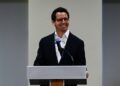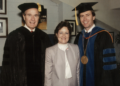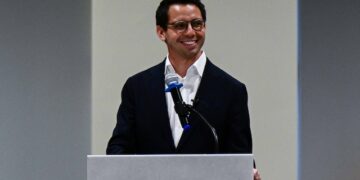

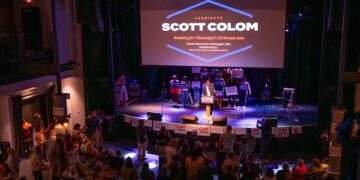

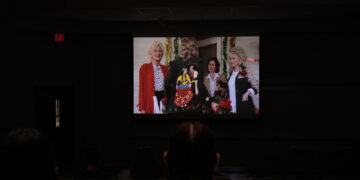














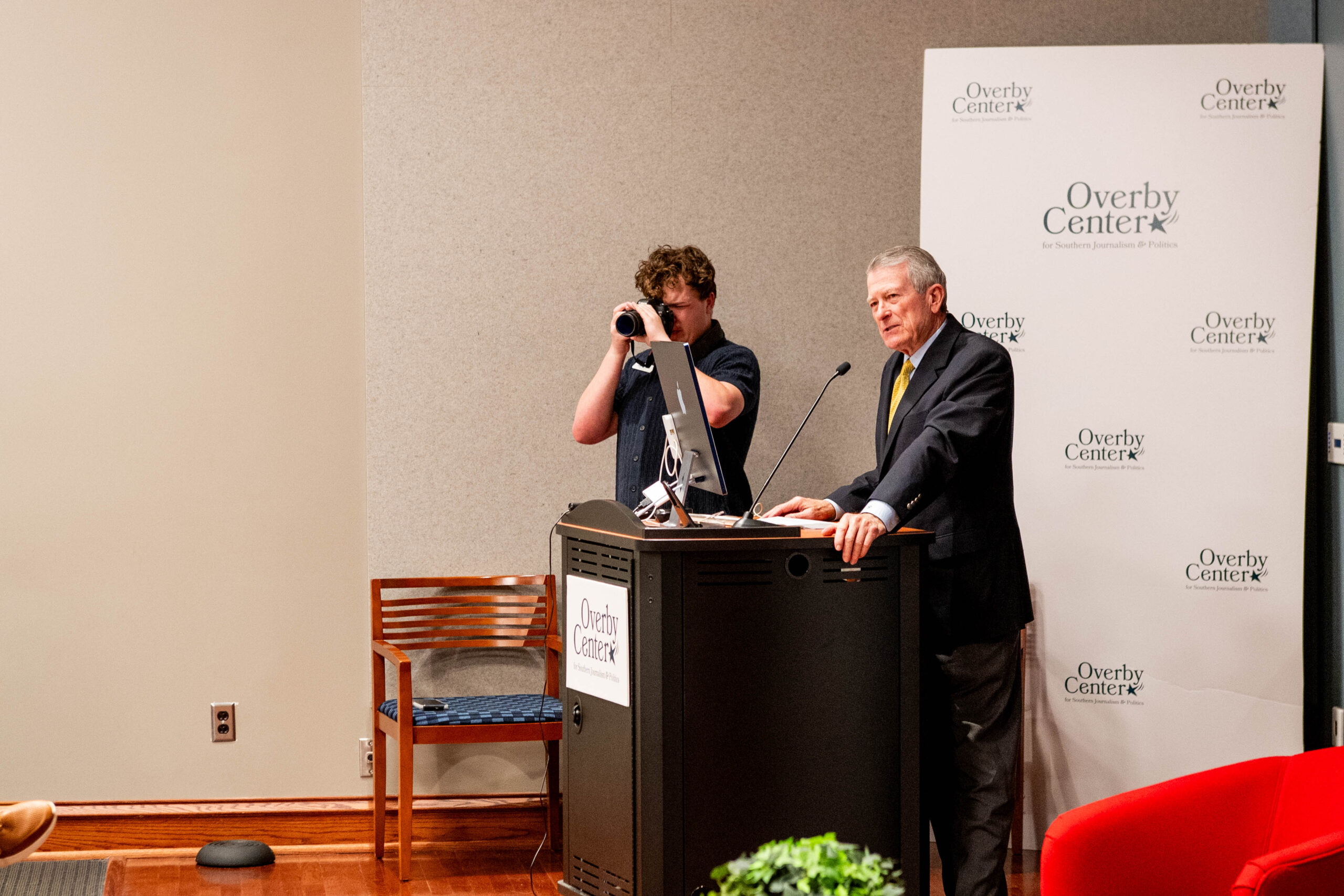
University of Mississippi students, faculty and members of the local community gathered Tuesday, March 24, at the Overby Center for Southern Journalism for a pre-release screening of the documentary film “The Whiskey Speech: Soggy Sweat and the Power of Storytelling.”
The event was sponsored by the UM School of Law, the Mississippi Judicial College and the Lafayette County Bar Association.
The film showcases the life and work of Noah S. “Soggy” Sweat Jr., an alum of the UM law school, judge and a former state representative known for delivering the famed “if-by-whiskey speech” in 1952, the final year of his term in the Mississippi Legislature.
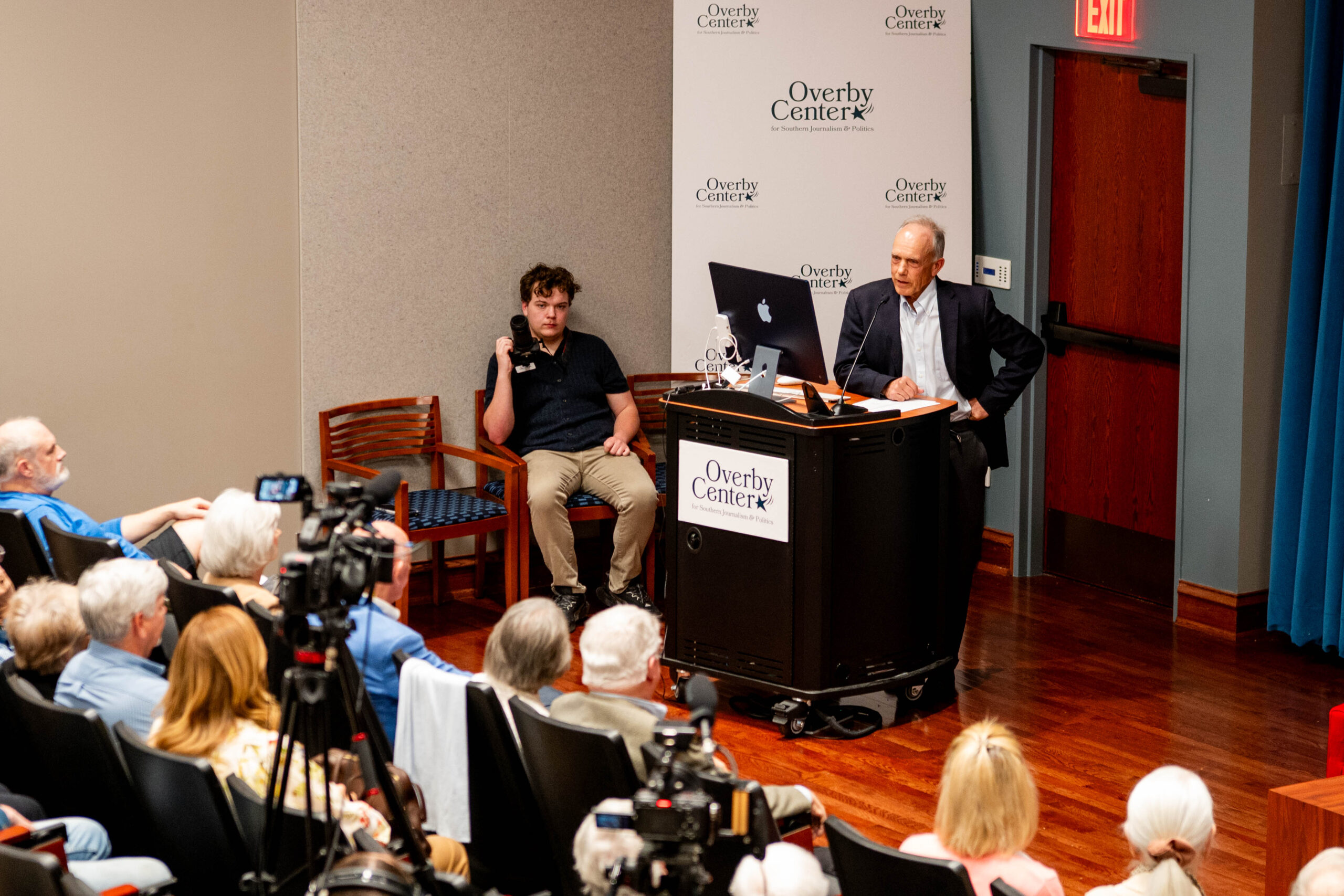
The film is in its post-production stages and will air on public broadcasting channels within Mississippi and throughout the country at a later date.
The documentary examined the conversation regarding Mississippi’s alcohol restrictions during the 1950s, when Sweat was serving his term. Mississippi was the last U.S. state to repeal Prohibition in 1966.
There were many entrenched interests in the legislature supporting both the perpetuation and repulsion of prohibition at the time. Sweat’s speech explained both sides of the issue using humor to foster understanding across the aisle.
“The speech stands as a parody of political doublespeak and an artful exercise in employing audience-flattering connotations,” Richard Nordquist, professor emeritus of rhetoric and English at Georgia Southern University, said in a 2018 article for ThoughtCo. “His initial characterization of whiskey, addressed to the teetotalers in the crowd, employs a series of dysphemisms — disagreeable and offensive impressions of the demon drink. In the next paragraph, he shifts his appeal to the wets in his audience through a far more agreeable list of euphemisms. Thus, he takes a firm stand on both sides of the issue.”
The film’s producer, David Crews, is the clerk of court for the Northern District of Mississippi U.S. District Court and a member of the Overby Center Board of Directors.
Crews wanted the documentary to show Sweat willing to be agreeable to both political positions during a time which he perceives to be hyperpolarized.
“I tried to be subtle about this,” Crews said. “I think politics in today’s day and age is disgraceful and Sweat provides us a model that can help us improve our situation.”
After Sweat’s legislative term, he served as an influential member of the state judiciary. One of his most influential rulings was in 1968 in a case involving a woman accused of murdering her husband. She moved to dismiss the charges because the jury was composed entirely of men, and Sweat sustained the motion on constitutional grounds. This case provided the impetus for the state legislature to allow women to serve on juries.
Sweat was also instrumental in the founding of the Mississippi Judicial College, a UM-sponsored professional development program for state judges.
“I think a takeaway for students is that even though (Sweat) did something funny and famous, he also did great things for Mississippi, like female juries and the founding of the judicial college,” Pat Caldwell, a former student of Sweat in a legal economics class at the UM law school, said. “I hope that’s what the emphasis is.”
In a discussion after the screening, Crews discussed the use of artificial intelligence in the film’s production. He used artificial intelligence to render a scene of Sweat delivering the whiskey speech at the crowded Neshoba County Fair.
“It would have been impossible for me to capture the impact this speech had on people given this film’s budget,” Crews said.
Neil White III, a local playwright, had his trepidations but understood the usage.
“My first thought was, ‘Oh, that’s terrifying,’ because it was so realistic,” White said. “I knew that with the budget of this film there was no way he could have staged that on his own, so in a way I’m glad he did.”