






















University of Mississippi employee Natalia Norwood’s lawsuit against the university and several administrators claiming discrimination continues with new legal filings. U.S. Magistrate Judge Roy Percy ruled on Oct. 15 to allow Norwood to file a second amended and supplemental complaint, which she filed on Oct. 21. Percy terminated the university’s motion to dismiss because the lawsuit has evolved with the amended complaints.
Norwood is a civil rights investigator and ADA specialist in the university’s Equal Opportunity and Regulatory Compliance (EORC) office. In her original filing, she sued the university, Assistant Vice Chancellor for Access and Compliance Kimberly M. DeVries, Chief Human Resources Officer Bradley Salters, Provost Noel Wilkin and Chancellor Glenn Boyce on eight counts of sex- and race-based discrimination and failure to comply with ADA accommodations.
This second complaint, which is an amended version of Norwood’s original lawsuit, is built on the allegations outlined in the first lawsuit and extends the timeline to events that happened after the original July 27 filing date.
“In the first amended complaint, I gave a more specific account of what happened and connected those facts to the legal claims I am bringing,” Norwood said. “The second amended and supplemental complaint builds on that work by adding allegations about events after my original July 2026 filing.”
This extended timeline included the most recent update on Norwood’s Title IX complaint against Billy Benson, her former supervisor. Norwood had asked for an update from Wagner, the woman assigned to her Title IX complaint.
Wagner responded stating that she submitted Benson’s investigation report to the university. However, Norwood has reportedly not received any documentation regarding the investigation into her complaint.
“As of Oct. 8, 2026, Norwood had not received the Benson investigative report, an evidence-review packet, a hearing notice or a further written explanation and timetable for the continuing delay,” the second amended complaint said.
The second amended complaint also included an update on Norwood’s current work position and how it relates to the ongoing investigations based on her complaints filed with the university.
“As of Oct. 7, Norwood had received no communications from Boyce or his office resolving the investigation-dependent staff-return condition,” the second amended complaint said. “UM had restored systems access and permitted adjunct teaching, but Norwood remained without a present individualized determination of her substantive staff duties, reporting arrangement, work location and accommodation needs.”
The university maintained that its position is outlined in its court filings, with nothing further to add following Norwood’s amended complaints. The university has until Nov. 10 to respond to Norwood’s second amended complaint, 21 days after the filing date.
DeVries is being sued in both her individual and official capacities, while the other defendants are being sued only in their official capacity. DeVries also serves as executive director of EORC and acts as Norwood’s second supervisor in the EORC office.
The university responded to the suit with a motion to dismiss on Sept. 25, claiming that Norwood was unable to state a claim and that her filing was not concise, violating Federal Rule of Civil Procedure 8.
Norwood then filed her first amended complaint on Oct. 8, which expanded on the sexual harassment claim she made against her supervisor Billy Benson, director of equal opportunity compliance and ADA coordinator. The complaint included an elaboration on the sexual harassment itself and the conversation Norwood had with Benson and DeVries before she left the office for remote interim work on March 26, 2025.
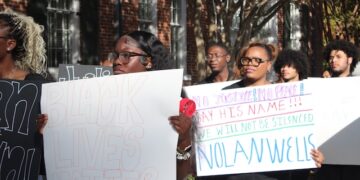
Norwood’s first amended complaint included other claims of race-based discrimination that were not in the original lawsuit. One new example involved an alleged dispute over DeVries not allowing an employee to display with a Black Lives Matter flag, while other employees were able to display Pride flags and Blue Lives Matter flags.
“During the training, DeVries acknowledged making different decisions concerning Blue Lives Matter and Black Lives Matter flags,” the first amended complaint said. “DeVries stated that she ‘wasn’t really happy with the reason’ for those decisions and had needed to ‘own that (she) had messed up.’”
The first amended complaint rearranged, shortened or refocused certain sections of Norwood’s original complaint, including the section titled “Two-Tier Pattern: Favored Respondent Findings, Softened Plaintiff’s Claims and Conflicted Review.”
This section outlined Norwood’s work as an investigator and the opposition she claimed to have faced when trying to approve a finding, dealing less with her specific claims of race- and sex-based discrimination. This section used a multitude of examples throughout Norwood’s career to support her claims.
This section was retitled “Investigative Opposition and Continuing Control over Norwood’s Work” and focused primarily on two examples, one of which was not mentioned in the original lawsuit.
The complaint also includes a new section titled “Student Advocacy and Threat to Norwood’s Teaching,” where Norwood claims that her position as a teacher was threatened by DeVries when Norwood revealed that was helping one of her students get access to campus resources after claiming she was sexually harassed.
“Immediately after that account, DeVries stated, in substance, that if Norwood’s adjunct teaching created conflicts, they might need to rethink her teaching arrangement,” the first amended complaint said. “The statement concerned continued teaching, rather than merely how Norwood should handle Student A’s particular matter. Given its timing and DeVries recurring approval role, Norwood understood the statement as a warning that assisting students with sex-based harassment concerns could jeopardize her compensated teaching.”
Norwood said she chose what to amend in the lawsuit by prioritizing what she wanted the court to address.
“A complaint is not someone’s entire story,” Norwood said. “My decisions about what to include or leave out were about focusing the complaint on the matters that I am asking the court to address based on the records I have in my possession. Each version of the complaint had a job. The first amended complaint needed to clarify my claims.”