
















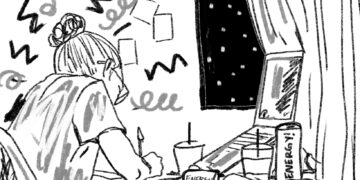












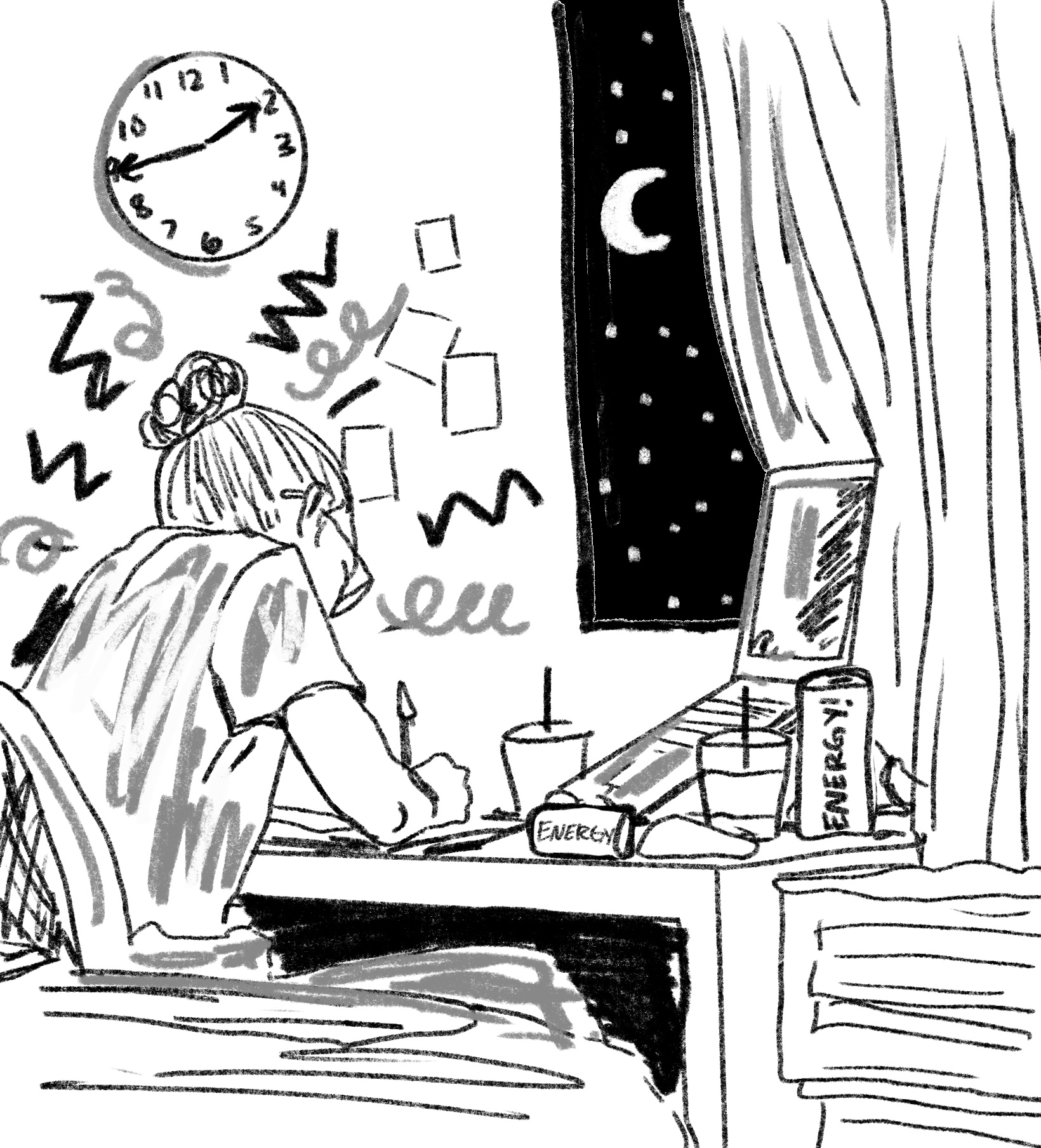
“I slept two hours last night” has become the most overused flex on campus. We glorify the 2 a.m. study grind, conflating physical exhaustion with academic success. Library marathons after dark have turned into an odd sort of status symbol.
Suffering through a four-hour cram session, however, is hardly a badge of honor; it is simply inefficient studying and, quite frankly, a waste of time. Our campus culture has a toxic relationship with productivity.
Harmful peer pressure associated with this study grind creates a feedback loop in which students feel guilty for getting a full night’s sleep. When you walk into the library and see hoards of students skimming over textbooks and writing pages of equations on whiteboards until midnight, your healthy boundaries can start to feel like laziness. We have allowed a performative culture of exhaustion to redefine what hard work actually looks like.
Why do we fall into this trap? Spending five straight hours staring at highlighted notes creates a false sense of security known as recognition memory. It allows us to perform “academic theater,” in which we convince ourselves that because we suffered at a desk for so long studying, we must know the material sufficiently.
In reality, human cognitive capacity drops off sharply during uninterrupted study marathons. Years of research on the serial position effect show that our brains primarily retain information presented at the very beginning and end of a learning session. When you cram continuously for hours, that massive middle chunk of time becomes a retention dead zone where barely any information sticks.
Trying to power through by sacrificing sleep only makes matters worse. During deep sleep and REM cycles, your brain consolidates memories. It transforms short-term recall into permanent knowledge.
According to studies published by the National Institutes of Health, sleep deprivation severely impacts neuroplasticity and memory retention. By cutting your sleep in half to study longer, you are actively destroying the neural pathways you spent all night trying to build.
Cognitive research has shown time and again that self-testing forces the brain to work harder, solidifying concepts far better than long hours of passive skimming. Rereading a textbook chapter at midnight is passive familiarity rather than active recall.
Breaking this habit requires abandoning time-based metrics for structured studying. Techniques like studying in focused 25- to 45-minute bursts separated by short breaks create multiple memory anchors while preventing mental burnout. Paired with active retrieval methods like flashcards or practice testing, you can achieve a far better exam score in a fraction of the time.
We should stop validating the late-night, four-hour study sessions and instead treat rest as a strategic necessity rather than laziness. Consistently choosing eight hours of sleep and brief, focused study intervals will always outperform a late-night library marathon.
True academic success doesn’t depend on how much you suffer, but instead on how effectively and efficiently you learn and apply the material.
Vidya Adlakha is a senior biological sciences major from Ocean Springs, Miss