





















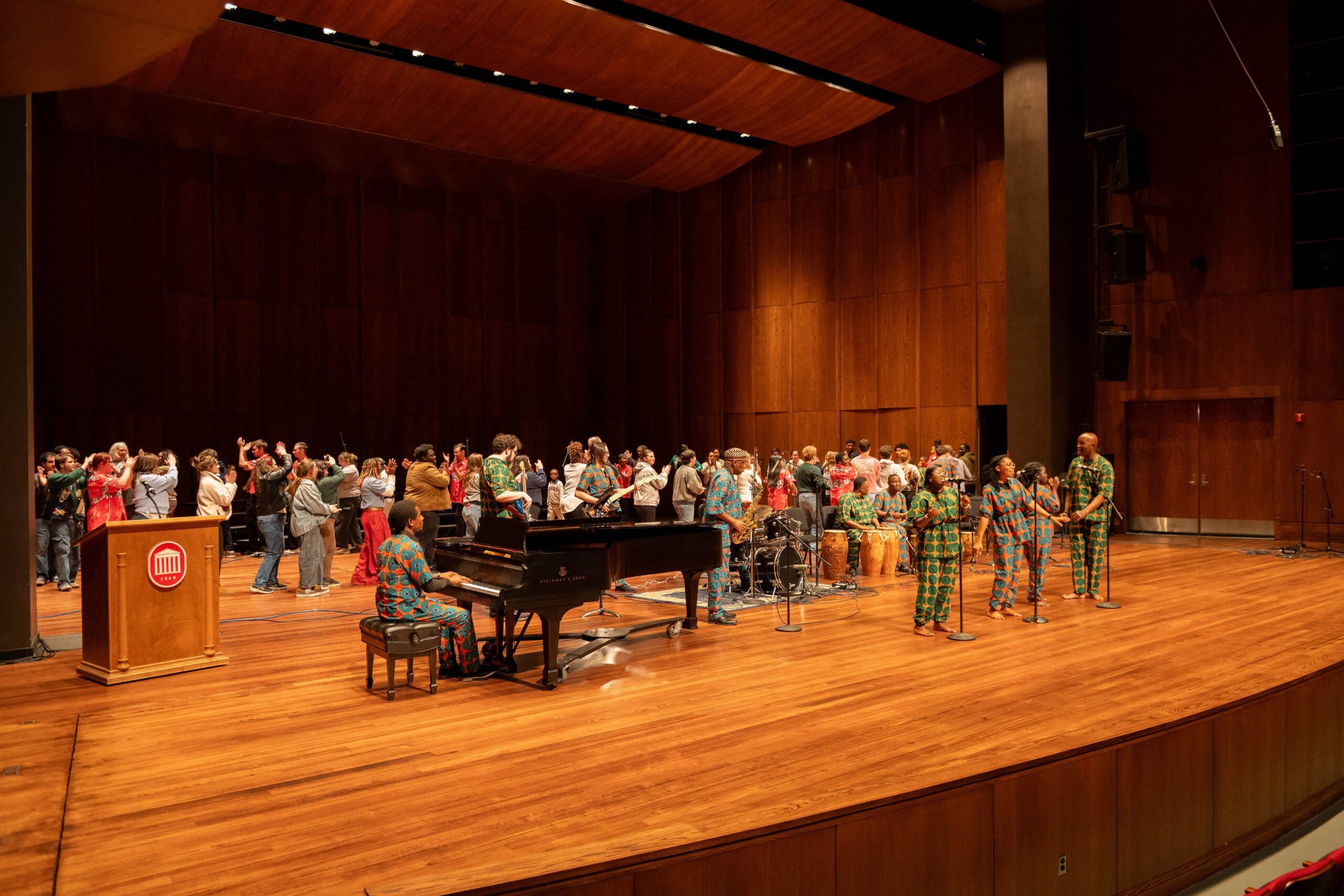
The University of Mississippi held a Black History Month concert at the Gertrude C. Ford Center for the Performing Arts on Tuesday, Feb. 24, titled, “Sublime Artistic Creativity Transcending Boundaries.” The lineup was curated by Professor of Music George Dor to feature experienced and diverse musicians.
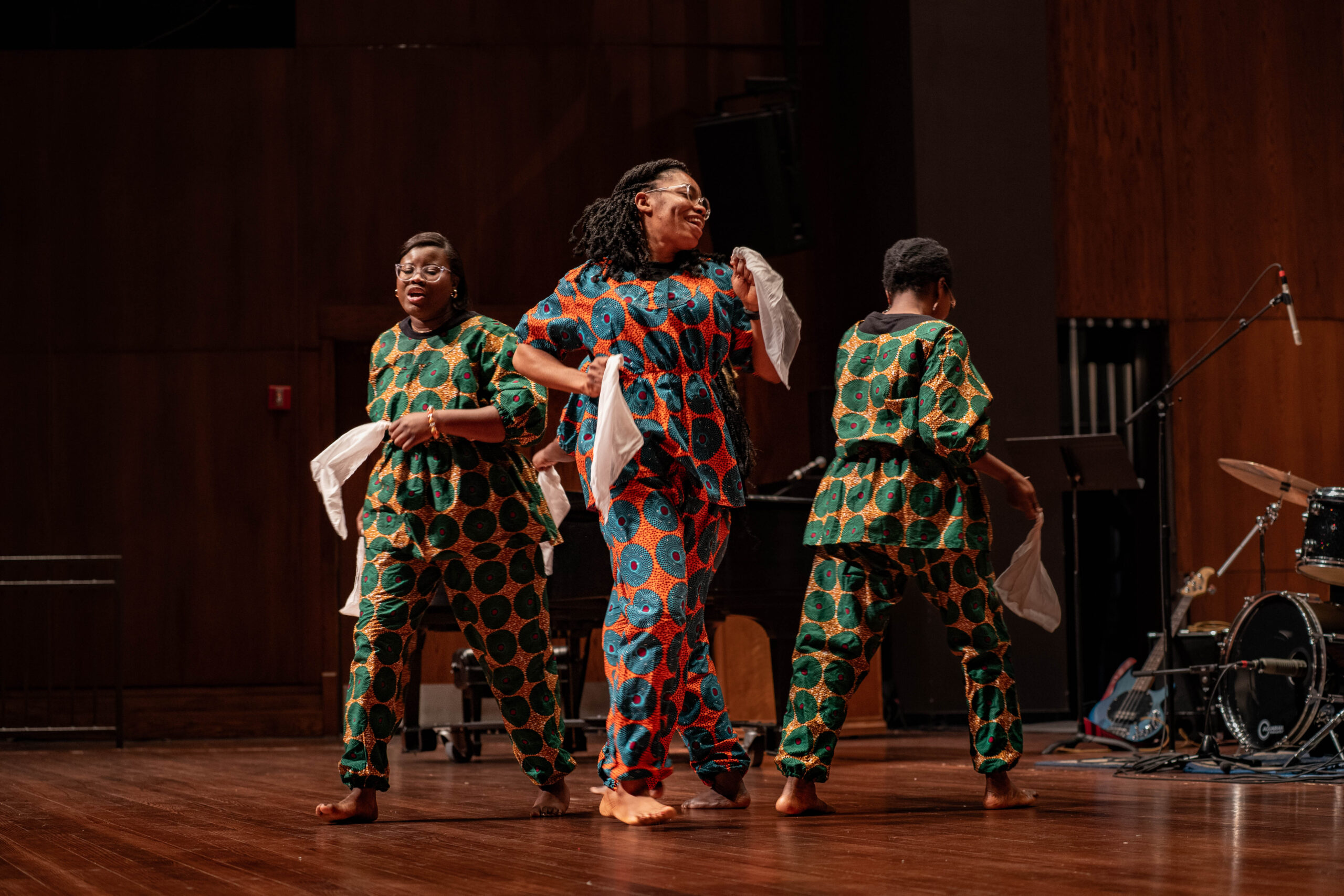
The concert featured three UM musical groups: the steel orchestra led by Professor of Music Ricky Burkhead, the gospel choir led by Honesty Shaw and the African drum and dance ensemble led by Dor, a Ghanaian native.
Two special guests, Professor of Music and Director of Steelpan Studies at Northern Illinois University Liam Teague, who performed with the steelpan, and his son, Jaden Teague-Nunez, who played the steelpan and piano.
Teague is a renowned composer, arranger and steelpan performer from Trinidad and Tobago. He has performed across the globe, playing with multiple Grammy Award winners such as Paquito D’Rivera and Dave Samuels. He has won many awards, including the Hummingbird National Medal, which is a national honor of Trinidad and Tobago.
Dor is the chair of ethnomusicology at UM and teaches world music courses. He founded the African Drum and Dance Ensemble in 2003 and the annual Black History Month concert in 2005.
“When I came to the University of Mississippi in 2001, I realized they were observing Black History Month activities and the music department was not contributing anything,” Dor said. “I said, ‘How can you celebrate anything without music?’ … Any celebration … goes back to music, given that Black musicians have contributed so much.”
Senior management major Jamieson Hendrix said the annual performance has a deeper impact than just being an annual performance.
“I feel like it’s a very good stepping stone for those of us in the Black community that get to see what all our country is about,” Hendrix said.
Dor said music is not an added feature to celebration but its foundation, shaping national traditions, public ceremonies and cultural identity while reflecting the lasting influence of Black artists across generations.
“You come to listen to music coming (from) originally internationally, so you see a representation of something from Africa, something from Black North America, something from the Caribbean,” Dor said. “We’re talking about the musical genres themselves drawn from different regions of the global African community.”
Brandon King, a junior accountancy major, also emphasized the importance of music and musical culture.
“I think it is very important to show the different types of instruments and different music that the culture has,” King said.
Dor’s goal was to showcase how traditions connect people across continents while reflecting campus diversity. By highlighting music rooted in different parts of Africa, he wants the performances to create space for cultural exchange and shared understanding among the community.
“We all have a wonderful community,” Dor said. “We have a good representation of international communities. We have a good population of African Americans, we have Caribbeans, we have Asians. So the idea is to support one another and acknowledge the contributions of one another to make our community.”
The vibrant musical culture was alive during the drum and dance ensemble performances of “Love Your Neighbor As Yourself,” during which the performers invited the crowd to join them on stage to dance if they felt moved. More than half of the attendees joined the ensemble on stage to celebrate the music.
Support from the university goes far past the students. The faculty has been a staple in the support system for Dor and his efforts. All former chancellors and provosts during Dor’s tenure at UM have come to every concert to support the community.
“They are doing it because the welfare of all of us concerns them, so if something is going on to celebrate, they just want to take some time off at times and come and support the music department,” Dor said.
The artists invited to perform each year share their support for the university music community. Finding these musicians, Dor said, is carefully planned to benefit students and faculty alike.
“Normally, we look for someone whose expertise matches the group we are featuring in a particular year, so that person can come and collaborate and have a master class so that the music department community can benefit from the experience and expertise,” Dor said.
In the past, the department has welcomed expert artists such as Corey Kitchens, Kirk Whalum and Angela Brown, along with other accomplished Black performers representing a range of genres and styles.
“They are well-renowned, reputable performers, so if you are someone who just wants to appreciate talent, it’s not only talent but how you develop your talents to the utmost points,” Dor said.
The visiting artists are selected not only for their performance ability, but also for their willingness to mentor students and engage with the department beyond the stage. Rather than limiting their visit to a concert, the music department structures each appearance as a residency, allowing students to learn directly from the artists’ experience and training.
By pairing public performances with educational events, the department aims to make the experience both celebratory and instructive.
“It’s to acknowledge the history, then to give a Black performer (an opportunity) as a guest artist to come and perform to inspire us to learn from them, and then just appreciate their creativity,” Dor said. “Beyond that, they come over to celebrate genres that the Black race has contributed to.”
Dor emphasized that while the celebration may hold particular meaning for some, its message is universal.
“Of course, if you are an African American, your pride may be there, but even if you are not African American, we all belong to humanity,” Dor said.