
























The Mississippi primary election on Tuesday, March 10, will determine which candidates from each political party appear on the midterm ballot for U.S. House and Senate seats. Among those candidates is Cliff Johnson, a clinical professor of law instruction at the University of Mississippi School of Law, who is running as a Democrat for Mississippi’s 1st Congressional District.
Even with a local professor in the race, many UM students are unaware of the upcoming election. Between a lack of information and registration constraints, many are prepared to miss voting in the primary election altogether.
Student voters who are registered in Lafayette County, such as Will Grem, a freshman psychology major from Oxford, still feel uninformed about the upcoming election.
“It’s not that I don’t want to do research or don’t want to get out,” Grem said. “It’s mainly because I am just too busy to know when it is actually happening.”
Lauren McKay, a junior dietetics and nutrition major from Wiggins, Miss., said that she did not realize there was an upcoming election but is not registered in Lafayette County, anyway.
“I feel like I don’t really pay attention to state news,” McKay said. “I’m not registered in Lafayette County. I am still registered in my hometown.”

A fight for turnout
With the primary scheduled for the Tuesday of the university’s spring break, many students will be away from Oxford when the election takes place. That timing compounds the issue of traditionally low turnout for primary elections, according to Emily Ommundsen, an assistant professor of political science at the University of Mississippi.
“In midterm years, turnout is lower than in presidential years. And then, across both of those, turnout in primaries is lower than in general elections,” Ommundsen said. “This year, we are in a midterm year and a primary, so we can expect turnout to be quite low compared to those other styles.”
By adding spring break to the mix, student participation becomes even less likely. Students who are registered in Lafayette County but are traveling for spring break had to request an absentee ballot well in advance if they plan to vote. Mississippi allows absentee voting in limited circumstances.
“It is possible as a college student to get an absentee ballot, but it’s hard, and it requires students to do some advanced planning,” Ommundsen said.
Jeff Busby, the Lafayette County circuit clerk, confirmed this notion. Although absentee voting for the upcoming primary election has been open for nearly 40 days, his office reports that only approximately 140 people out of 38,000 registered voters have cast absentee ballots so far, indicating a light turnout for this primary. Outside of presidential elections, Busby estimated that only 5% of the university student population votes in statewide and local elections.
“The only one that the students really focus on, which is kind of sad, but it is the truth, is the presidential election,” Busby said.
Busby hopes that his office will eventually close the gap and reach young voters through its social media efforts.
“A lot of people, unless you’re really tuned into the news, don’t even know there are midterms going on,” Busby said. “That’s what we fight as a clerk’s office. We want to get the word out.”
Similarly, Ommundsen highlighted the lack of campaign exposure as a cause for the difference in turnout for presidential and primary elections. Whereas presidential election campaigns feel impossible to ignore, statewide elections do not garner the same attention.
“There are more advertisements that people are exposed to on TV, social media, radio, basically everywhere,” Ommundsen said. “Campaigns are just not as robust for the lower level of elections.”
Registration barriers
In addition to a lack of media focus on primaries, structural barriers make it difficult for college students to participate in Mississippi’s local elections.
Nevaeh Dominguez, a senior multi-disciplinary studies major from Palm Beach, Fla., is one of many students not planning to vote in the primary.
“I think it’s a mix of not knowing and not being registered here,” Dominguez said. “I always go back to Florida when I’m not in school, so I haven’t changed my registration.”
According to data provided by Deputy Circuit Clerk Chyna Sinervo, there are 2,608 active registered voters between the ages of 18 and 22 in Lafayette County. Over 22,000 students are enrolled at the university’s Oxford location.
Mississippi does not offer online registration and requires voters to be registered at least 30 days before an election.
“Most college students probably couldn’t tell you when that election is,” Ommundsen said. “By the time we start getting close to the election, if you only learned about it a week or so before, you’ve already missed the deadline to register to vote.”
Voter-education efforts
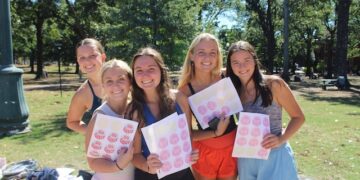
Shanika Ward, the co-president of the League of Women Voters of Oxford/North Mississippi, seeks to improve young voter turnout by running voter education workshops, campus registration drives, candidate forums and voting simulations.
“Election dates vary and can be confusing,” Ward said. “We focus on removing barriers to participation by simplifying complex election information and ensuring students and young voters feel confident, prepared and informed before they enter the voting booth.”
Ward hopes students understand why their participation in primaries matters. She emphasizes students’ ability to create local policy change in areas of funding, education, housing and more.
“Primaries determine who appears on the general election ballot,” Ward said. “If you do not vote, then your voice is missing at the most influential stage of the election process.”
As young voters consistently do not show up to the polls over time, Ommundsen explained, elected officials shift their policies toward the voters who do show up.
“If those elected officials are aware that younger voters aren’t participating at the same rate as older voters, those elected officials are less incentivized to gear policy goals towards younger voters,” Ommundsen said. “We tend to see policy focus more toward older voters, partly because they have higher turnout rates.”
Busby reinforced the idea that statewide elections mean more for students’ daily lives than do federal elections.
“That voting block could make a big difference and have a huge voice,” Busby said. “In a college town like this, the students could change everything.”
What would it take?
One student who does plan on voting is Mason Johnson, a sophomore public policy leadership major from Laurel, Miss., who stressed that students need to participate in elections if they want a say in the political landscape of the state.
“You really can’t complain or call for action if you’re not taking the steps that you can do as a citizen to make change happen,” Johnson said.
Many students indicate they would be more likely to vote in local elections if there was more information available to them beforehand.
While Grem said that he would vote if elections were “more publicized around town,” McKay just wants to see representatives making more of an effort to get in touch with young voters on social media.
Kamryn Billie, a sophomore social work major from Clinton, Miss., found out about the upcoming election only because she happened to glance at a Snapchat advertisement telling her to “get out to vote.”
“During these smaller elections, they don’t push for the vote as much,” Billie said. “They feel forgotten.”
To increase young voter turnout, Ommundsen said that Mississippi could look to other states’ more flexible absentee voting and registration processes.
Nevertheless, the easiest fix answers the calls of the students.
“If this were more widely known about,” Ommundsen said, “we would probably see turnout increase.”
Primary election polls will be open from 7 a.m. to 7 p.m. on March 10. For more information about voting processes and where to vote, visit the Lafayette County website.