


























No. 8 Ole Miss beat No. 7 LSU in one of the biggest college football games of the year. The Rebels played a complete game from top to bottom. A significant reason for that success was the offense’s ability to spread the ball around and the defense finding its rhythm.
Last week against Charlotte, Ole Miss over-relied on quarterback Trinidad Chambliss, running back Kewan Lacy and wide receiver Deuce Alexander. They constantly forced the ball to Lacy and Alexander, and while they won handedly, it was not as pretty as it could have been.
All three of those playmakers are still phenomenal and were vital in defeating LSU, but the real story of this game was that several other offensive players made impactful plays too, plus the defense stepped up to earn the Landshark moniker.
Throughout the first half, the Rebels were making play after play. The defense looked like a completely different unit from the last two games against Louisville and Charlotte. In the first half, the Rebels held LSU to only 117 total yards, while they held Charlotte to 118 total yards in Week 2 in the first half.
The Rebel defense hurried LSU quarterback Sam Leavitt four times and sacked him once. Defensive tackle Will Echoles finally showed why he is considered one of the best defensive lineman in the country, with a quarterback hurry along with a sack and three tackles for loss.
He was a dominant force in the middle that finally showed up when it mattered, and Leavitt did not have much time in the pocket.
If this defense can become a unit that can win games for the Rebels, that would be a welcome surprise.
The secondary improved their communication efforts as well, hardly giving up any explosive plays. Leavitt’s pass game has not been off to a great start this season, and he certainly did not look his best against Ole Miss, though he scrambled well and extended drives.
Safety Sharif Denson was instrumental in his Rebel debut in limiting Leavitt.
The secondary played well and relied on each other. Trusting the other 10 players on the field subconsciously is a difficult task, but one that can help Ole Miss on the road to playoff hopes and championship aspirations.
Golding added on the praise for the secondary in his postgame press conference and outlined the changes they have made and their improvement in this game.
“I think for the most part they did a really good job,” Golding said. “I’m very proud of them. There’s lots of checks and things like that and it wasn’t always perfect. We knew it wasn’t going to be perfect going in.”
One of Leavitt’s biggest plays of the night through the air was a 26-yard back shoulder fade to Winston Watkins Jr. in the back of the end zone. Watkins was in one-on-one coverage with defensive back Jaylon Braxton and Watkins simply made a better play. There was not much Braxton could do about it.
The Ole Miss defense looked impressive against the Tigers and showed they can support the offense in close games.
On the offensive side, wide receiver Traylon Ray and tight end Caleb Odom each made huge catches. Ray had a 21-yard touchdown catch where he split two Tiger defenders to get into the end zone. On a momentous third and nine, Chambliss found Ray to keep the drive alive early in the first quarter and later reconnected to sustain a scoring drive at the end of the second half.
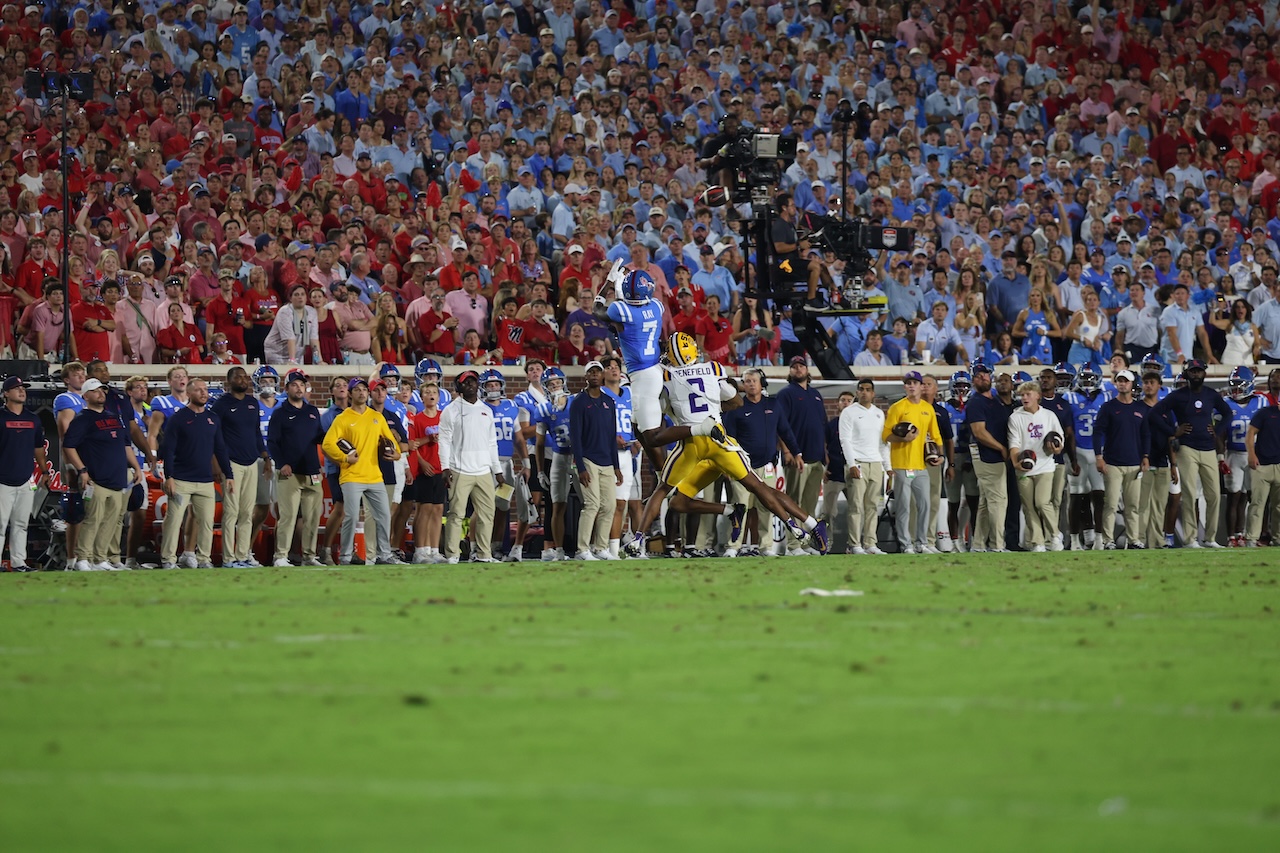
Ray accumulated six catches for 96 yards and one touchdown to finish the half. More surprisingly, Alexander only caught three passes for 33 yards by the end of the first half. He connected with Chambliss and nabbed a 20-yard pivotal touchdown catch with 11 seconds left in the second quarter that reestablished a 17-point lead.
Odom made a name for himself when he caught a 30-yard pass and proceeded to bull rush multiple LSU defenders and drag them to the five-yard line. Lacy finished off that drive with a rushing touchdown, but Odom kept the two-minute drive alive with a 12-yard catch on third down.
Lacy only carried the ball six times in the first half, one of the lowest totals of his career. He had 35 yards and a touchdown, but the Rebels did not need him to be a workhorse back in this game. Instead, players like Ray and Odom stepped up, making Ole Miss a very dangerous team to play.
Lacy also had less of an impact because he was injured during the game. He exited the game in the second half and JT Lindsey took the lion’s share of the running back snaps after his injury.
Lindsey performed adequately, rushing for 20 yards on four carries and an eight-yard reception. He also had a couple crucial plays. He took a direct snap to convert on fourth and one and scored a two-point conversion.
Golding discussed Lacy’s injury postgame, but also highlighted that they felt no need to push Lacy since Lindsey was playing well.
“He banged up his shoulder. They X-rayed him, but it was negative. He was going to try and power through it, but at that point JT (Lindsey) was playing really well,” Golding said.
This is exactly what championship teams are made of. Even when one of the best players in the country goes down with an injury, it does not mean that the offense is going to shift into unproductiveness.
If teams know they could overload the box to prevent running room for Lacy and cover Alexander tightly, it would force Ole Miss to use other playmakers. However, this game differs from Charlotte and Louisville because it showed that those other players can step up and make big plays.
It is a lot harder trying to stack the box against Lacy when you have three or four dangerous receiving threats in Odom, Alexander, Ray and Horatio Fields that can enable Chambliss to pick you apart.
Fields had a quieter day with a few good catches, but nothing quite as flashy as the other three players. He finished with five catches for 52 yards. Still, he has proven to be valuable through three weeks.
That said, the Rebels are not infallible. The defensive line’s pressures forced Leavitt to make mistakes, but they also were not always able to contain him when the offensive line started breaking down.
Golding discussed the defensive line’s motivation for this game and their game plan on how to stop a dual-threat quarterback like Leavitt.
“We weren’t going to win this game with sacks,” Golding said. “We were going to win it on scramble yards. They did a good job for the most part containing across the pocket and I thought they did a really good job on the run game.”
He had multiple circus-like scrambles behind the line of scrimmage that, while it may have only gone for a few yards on the stat sheet, prevented the Ole Miss defense from being perfect. Entering the second half, Leavitt utilized his legs even more, scrambling for a touchdown and keeping the Tigers in the game.
Leavitt’s rushing touchdown came after Chambliss threw an interception. Tiger defenders hit him while he threw it, but regardless it was an extremely errant pick.
While Chambliss is known for his pinpoint accuracy and steady decision making, this throw demonstrated that the expectation for a player to embody a Heisman contender every single play can be draining and unrealistic. Chambliss still had a productive game with 363 passing yards and two touchdowns.
He made an electric play to Ray where he avoided four pursuing LSU defenders and tossed the ball for a 19-yard gain. This was reminiscent of a similar play during the Sugar Bowl last year where he flipped the ball to Lacy.
He is also productive in the tensest moments. Late into the fourth quarter, Chambliss kept the ball himself and raced into the end zone for a 14-yard rushing touchdown.
The defense then stood strong to end the game. Defensive end Kam Franklin broke up Leavitt’s pass, allowing Braxton to pick it off and seal the win. This was embodiment of a team victory where every player relied on each other. Chambliss helped lead the offense to multiple scoring drives, while the defense was stalwart in the most important moments.
Ole Miss escaped a showdown of built-up emotions, pure hatred and a revenge vendetta by relying on every individual player. Everyone acted as part of one team. While some parts shone better than others, this was definitely a complete game from all aspects.