




























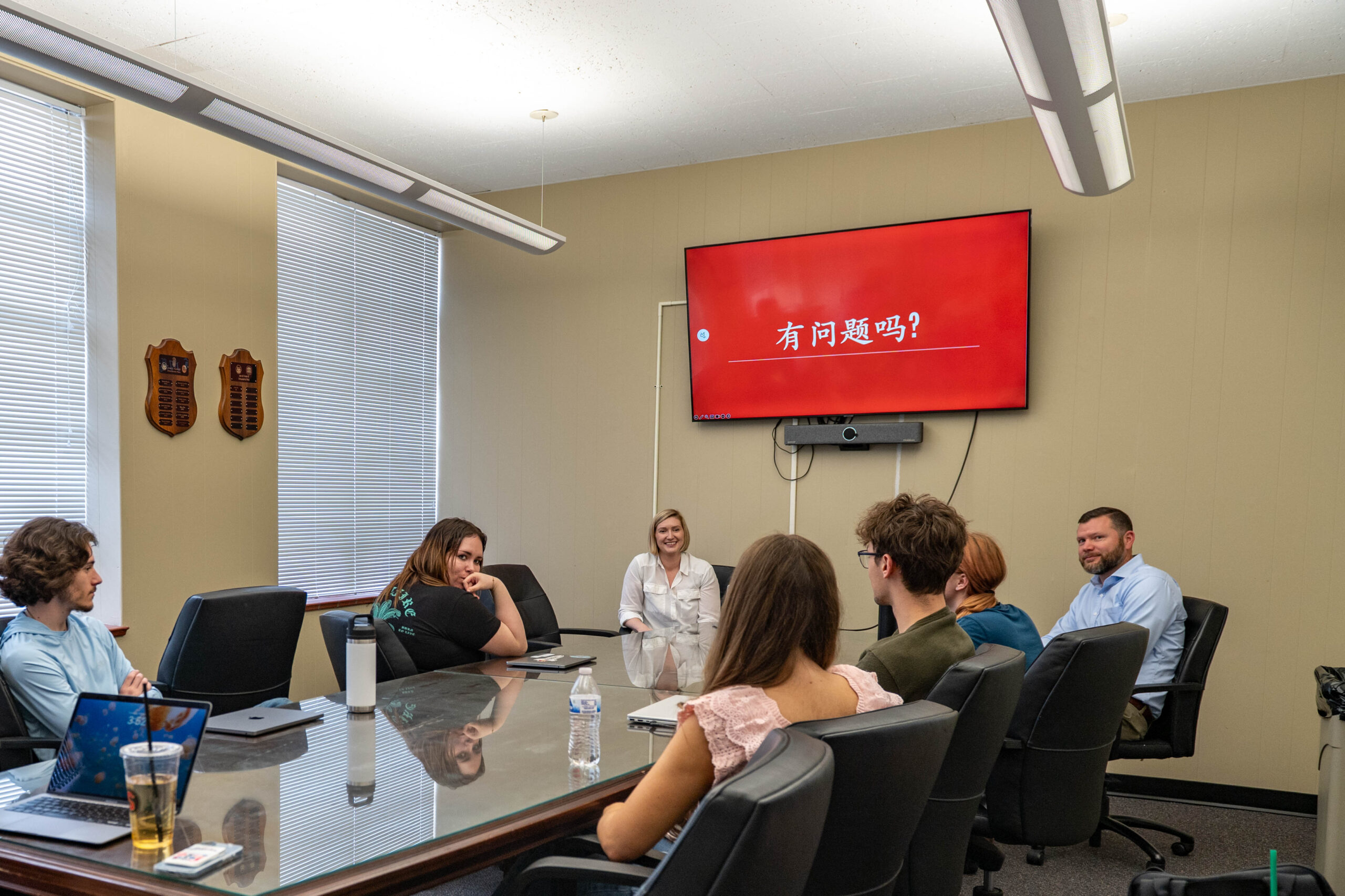
The Center for Intelligence and Security Studies (CISS) hosted Senior Master Sergeant Amanda Scurry of the Maxwell-Gunter Air Force Base on Thursday, Feb. 19, as part of its monthly National Security Talk series.
CISS hosts a monthly National Security Talk — an hour-long lecture and discussion, where students can converse with a guest speaker regarding the focal national security topic.
These conversations are open to all University of Mississippi students and are not limited to those studying intelligence and securities studies.
Scurry is an instructor in the Senior Non-Commissioned Officer Academy of Maxwell-Gunter Air Force Base in Montgomery, Ala.
As a Mandarin translator with 19 years of experience in the National Security Agency and the Air Force, Scurry led a discussion on China’s military and economic strategies, how those strategies impact international relations and why China’s position matters to the United States and its military.
The speaker gave the caveat that her opinions were her own and do not represent the Air Force or National Security Agency.
Scurry talked extensively on China’s current military position and how their strategies depend on long-term plans. She outlined how China operates on a five-year plan framework.
“We in the U.S. think of planning by election terms. You think a president has four to eight years, and that’s (when) they’re going to accomplish whatever goals they will accomplish,” Scurry said. “You have one party (in China). It’s an authoritative government. You have one president, Xi Jinping, and he is in charge of that party. So basically, he can set a roadmap for the next 20-to-50 years, however long he’s gonna be in power.”
Scurry also outlined China’s strategy called the Belt and Road Initiative. She described the initiative as how China spreads its influence to surrounding countries by providing infrastructure and emergency assistance.
“(The Belt and Road Initiative) is a global infrastructure network that was launched in 2013 by Xi Jinping, and it funds all types of infrastructure projects — ports, airports, railways, energy projects, all across Asia, Africa, Europe. Over 140 countries participate in this program,” Scurry said. “Think of the game Risk, where you’re placing your pieces everywhere, it’s giving them footholds. And critics like us will say, though, that this gives (China) a lot of soft power. This gives them a lot of leverage.”
Finally, Scurry tied her conversation back to what China’s position means for the US.
“Everyone (China has) a partnership with, they’re influencing,” Scurry said. “Just like where we have a partnership we influence. For the longest time we have been the standard, the big moral power. We promote democracy. We promote human rights.”
Savannah Abbott, a senior Chinese and psychology double major from Lake Havasu City, Ariz., participated in the group conversation following Scurry’s presentation.
“I wanted to come to this talk because … Scurry has 19 years of experience as a Chinese translator — a career path I am extremely interested in,” Abbott said. “I also wanted to hear what she had to say on the Taiwan-China conflict, as I have been to Taiwan numerous times, and it is a topic I am very passionate about.”
John Hamil, a sophomore international studies major from Farmington Hills, Mich., attended the talk to learn more about China’s presence in the international community.
“I went because China is a topic that gets discussed frequently and I wanted to get a better understanding of the situations from a professional,” Hamil said. “I really enjoyed Sergeant Scurry’s presentation – it really put into perspective just how much China’s military strength has grown relative to America’s position in East Asia … It really provoked some questions about the future of American foreign policy in the region.”
Many of the students posed questions on the conflict between Taiwan and China.
“Personally, I don’t think (China) will invade the way we think they will invade. They want Taiwan to survive,” Scurry said. “They want to control them. I think they would take a more nuanced approach … and try to get Taiwan to want to reunify with China.”