


























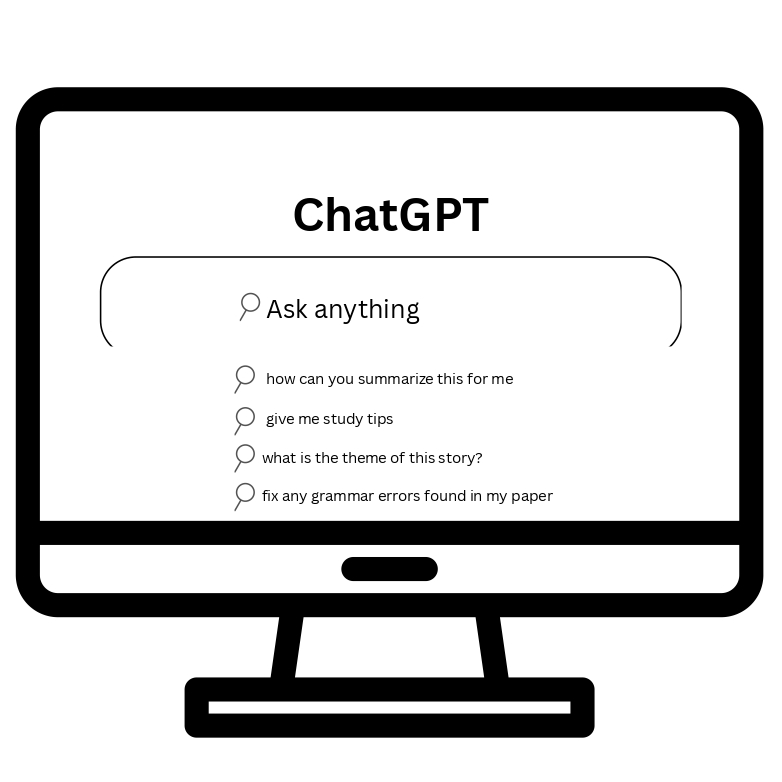
As artificial intelligence grows in popularity as a tool for completing assignments, instructors are adjusting their classroom policies to accommodate for the continued use of it by students.
According to a 2024 survey conducted by the Digital Education Council, approximately 86% of college students use generative AI for their classwork. The use of AI by students greatly varies. Sixty-nine percent of those students surveyed said they used AI to search for information, while 24% said they used it to write first drafts.
Professors have varying strategies when addressing this situation with their students.

Dawn Denham teaches WRIT 101 and WRIT 102 at the University of Mississippi and allows her students to use AI on her terms. She teaches them a variety of AI tools that they are encouraged to use, but if they use AI in a way that she deems as inappropriate, she believes there is cause for discipline.
For instance, Denham would allow AI to be used as a research or revision tool. However, if a student were to write an essay mainly using AI, she would deem that use insufficient and would issue a failing grade.
“I see the advent of AI in our classrooms the same way I looked at plagiarism: Students don’t come into my classes trying to deceive; they don’t know how to summarize and paraphrase effectively enough, so they take a short cut,” Denham said. “I turn this into a teaching opportunity.”
Other professors have also taken a similar approach to Denham’s, allowing the use of AI in selective capacities. Chair and Professor of Criminal Justice and Legal Studies Wes Jennings has integrated AI into his classroom. He notes, however, that AI should not be used as a crutch for students but as a tool.

“I do allow for AI use,” Jennings said. “But only when it is acknowledged, transparent and limited to support work rather than replace it. I see value in preparing students for a world where AI will be part of their professional lives. At the same time, I also emphasize that their own critical thinking and originality are of central importance.”
The implementation of AI in the classroom is a balancing act between responsibility and over-reliance. Jennings is a firm believer that AI can provide benefits to students and their work but only when it is used with care and consideration. He wants students to be ready for future technological innovation, while also maintaining student integrity in writing and analysis.
Some professors are more hesitant about what positive effects AI could have on the general student body. Joshua First is an associate professor of history and international studies, and his thoughts on AI range from the theoretical and philosophical possible consequences of its creation to its practical application in society.
First also allows AI use, like many UM professors, though he requires communication and transparency from his students when it is used.

“(Students) cannot use AI to generate text that (they) will use and pass off as (their) own. That is a pretty clear incident of plagiarism,” First said. “But if (students) want to use it to generate some ideas that will then cause (them) to write a paper that is entirely (their) own, what I require (them) to do at that point is to cite the model that (they) used and the prompts that (they) used.”
This policy requires accountability and honesty from First’s students and treats AI similarly to any other external source used when writing a paper. While this is his policy this semester, First was open that he may adjust his policy next semester and in subsequent years. The future of AI is still uncertain and the long-term effects of its use in the classroom is unknown. With this in mind, First is treating this semester as a trial run to see how his students and their works fair under this policy.
It is unknown which classroom AI strategies will prove most effective in addressing student AI use, and that determination will take time. For now, professors and administration will work with available resources and past strategies for navigating unprecedented technological innovations.