







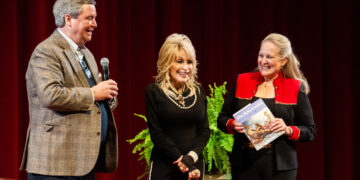

















Mississippi history took center stage on Thursday, March 19 as Brett Kenyon, better known online as “Papa Mississippi,” delivered the keynote address at the University of Mississippi’s Voting Summit.
UM’s Center for Community Engagement and its Voting Engagement Ambassadors organized the biennial summit and invited Kenyon to speak. The event aims to promote voter registration, education and participation.
Kenyon’s videos on Mississippi history and culture have gained him over 110,000 followers on TikTok. Ami Ba, a voting engagement ambassador and junior public policy leadership and economics major, felt Kenyon was the perfect pick to deliver the keynote speech.

“When you look at who follows him, it’s young and old,” Ba said. “It’s people of different backgrounds and faiths, and I believe that’s a really inspirational thing. I believe the power of his voice and his love for our state was inspiring, and that’s why I reached out to him.”
Kenyon, who was born in Pittsburgh, Pa., moved to Mississippi in 2003 and fell in love with the state. As Papa Mississippi, Kenyon broadcasts stories and information about the Magnolia State in hopes that Mississippians and non-residents alike will gain a greater appreciation for the state.
“I hated the state always being a punchline,” Kenyon said. “There are so many things that Mississippi does that people don’t know about — that we’ve given the world.”
Kenyon framed the struggle for voting rights in an arc similar to a trilogy series, with three main acts: early success, subsequent voter restriction and a final victory.
Kenyon said the struggle for voting rights in the state saw initial victories — an often neglected piece of history.
“After the Civil War, we were the most democratically progressive state in the entire nation. … Voting was open to anybody that wanted to vote,” Kenyon said.
According to a report by the Mississippi Free Press, revisions in 1867 to voter registration requirements in Mississippi helped enfranchise Black men, and nearly 97% of eligible Black men had registered to vote by 1868.
Shortly after this first act of the voting rights trilogy, Kenyon said, those victories were squashed.
“We had kind of that downward turn, where folks that saw their power threatened were like, ‘We’ve got to restrict who can vote and who can’t vote,’” Kenyon said.
This second act in the trilogy delivered a huge blow, but it set the stage for a greater victory in the third act.
“The darkness of that time just illustrates the heroes and the joy and the victory of that third act, where what happened (in Mississippi) led to change that impacted the entire country,” Kenyon said.
In his keynote address, Kenyon said that change was the Civil Rights Act, which was passed after violent attacks on activists in Mississippi who participated in the “Freedom Summer.”
Amelia Samples, a sophomore music major from Memphis and a Papa Mississippi fan, heard about the keynote from Kenyon’s social media. Samples credits Kenyon for expanding her knowledge of the state where she goes to college.
“I’ve just gotten a lot of good information on Mississippi, voting and different histories that I wouldn’t have known without following him,” Samples said.
Kenyon’s address gave her and other fans an opportunity to learn about both topics for an hour — much longer than his short-form videos. Samples was shocked to learn Mississippi’s disenfranchisement laws served as a model for legal discrimination outside of the U.S.
“I don’t think I even really knew about the Mississippi Plan and the fact that the Nazis took inspiration from that,” Samples said.
Learning about the state’s complicated history left Stella King, a freshman physics major from Brandon, Miss., with a stronger conviction to vote in local elections.
“There are so many other elections, whether that’s local elections or Senate elections or House seats,” King said. “It’s a democracy. … You really have to be able to incorporate all of those things for it to work — not just presidential elections.”
Kenyon hopes more young Mississippians feed their appetite for change in the state by using their voice and their vote.
“You get the folks involved that are fresh out of college, that are full of energy, that want to prove something,” Kenyon said. “I think it’s only gonna take a few victories like that; that’s gonna change things.”