
























A screening of “Everlasting: Life and Legacy of Medgar Evers,” a documentary chronicling the advocacy and work of Civil Rights leader Medgar Evers, was held on April 14 at the Overby Auditorium.
Medgar Evers was a pioneering civil rights activist who served as the first NAACP field secretary in Mississippi. Evers organized voter registration drives, led boycotts, spoke against racial injustice and investigated racial crimes.
The event, presented in partnership with Mississippi Public Broadcasting and Center of the Study of Southern Culture, featured both the screening of the film, which premiered in September last year, and a post-screening panel discussion with community leaders, filmmakers and members of the Evers family.
The documentary examines Evers’ civil rights work and the personal dimensions of his life, including his relationship with his wife and children.
His daughter, Reena Evers-Everette, reflected on the balance between family life and activism. Her father’s commitment to justice, she said, extended beyond public service to the values he instilled at home.
Evers-Everette described how her parents’ relationship shaped the family’s resilience despite constant threats. She noted that her father’s mission was rooted in a love for all people.
“The love resonates throughout this film, and it’s the love that resonates about our family and the dedication to life,” Evers-Everette said during the discussion. “What my mother realized and fell in love with was the special man that my father was … His love of people was his mission in life.”
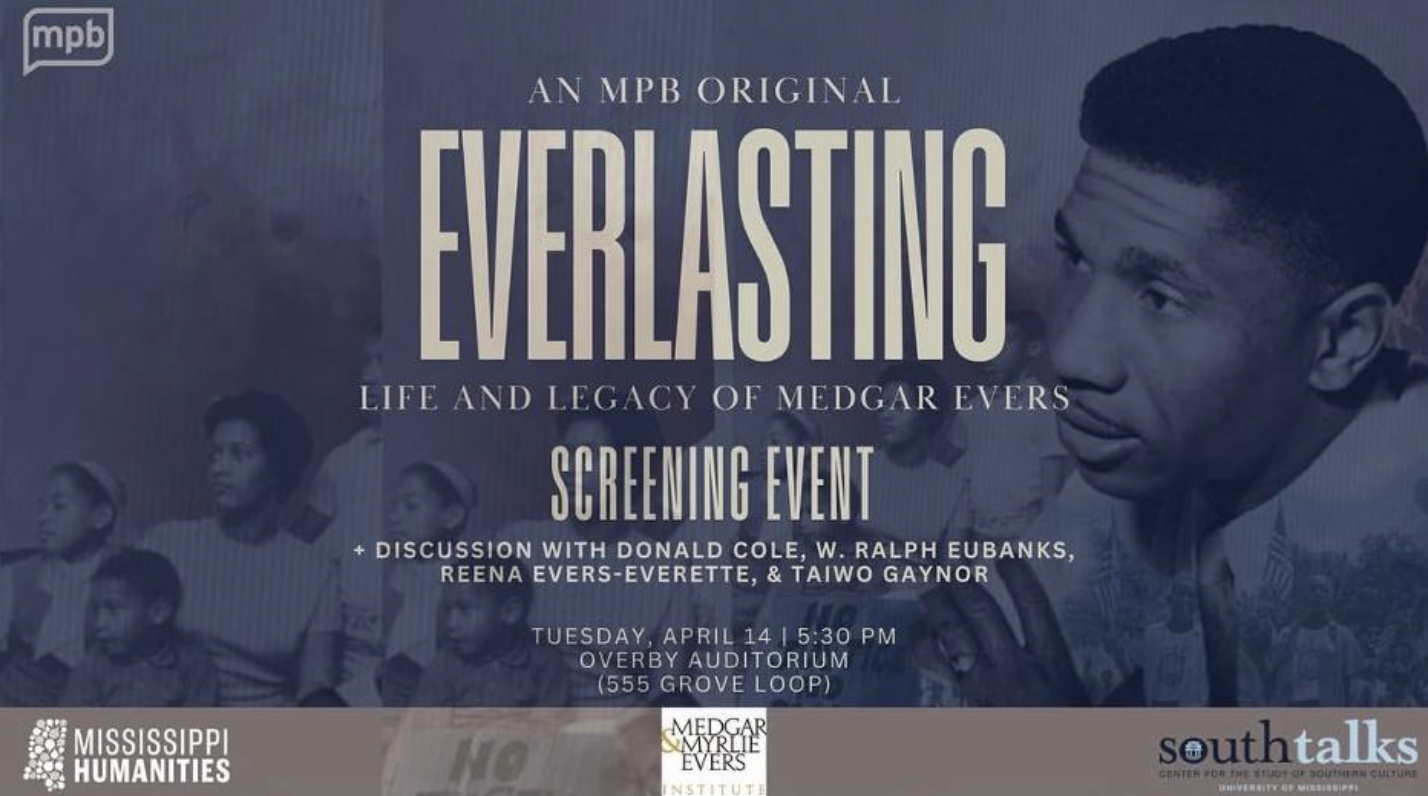
The panel also included Ralph Eubanks, faculty fellow for the UM Center for the Study of Southern Culture; Donald Cole, assistant professor of mathematics at the University of Mississippi, originally from Jackson, Miss.; and Taiwo Gaynor, the film’s director.
Eubanks shared personal reflections on growing up in Mississippi during the civil rights era and recalled the night of Evers’ assassination, describing the confusion and fear he experienced as a child and the lasting emotional impact it had on his family and community.
“Out of the confusion was the question of how someone could be disliked so much,” Eubanks said, highlighting the difficulty of understanding racial violence at a young age.
Gaynor discussed the challenges of capturing such a significant life story. He explained that the project relied heavily on firsthand accounts from individuals who knew Evers personally, aiming to preserve authenticity and historical accuracy.
“We only really wanted to speak with people who actually knew him,” Gaynor said, noting the extensive research and collaboration involved in the film’s production. “There is so much that cannot fit within even two hours.”
Audience members, many of them students, engaged the panel with questions about activism, education and the relevance of Evers’ legacy today. Triniti’ Crowley, a sophomore elementary education major from Terry, Miss., posed a question to the panel on student expression.
“How can young Black students effectively use their voices in today’s political climate, where many feel silenced or uncomfortable expressing their views?” Crowley said.
Evers-Everette responded to Crowley’s question with succinct advice.
“Use your voice,” Evers-Everette said. “Use it strategically in writing, in speech, in music, but make sure the message reflects what truly matters to you and creates positive impact.”