





















The University of Mississippi is continuing its technological developments as part of Project Encompass, the university-wide initiative to modernize campus systems.
Charlie Miles, a classroom technology specialist at the university, explained how this innovation process comes to life.
“Every summer, we do a classroom technology project where (there are) submissions sent to a committee about rooms with deficiencies that are needing upgrading,” Miles said.
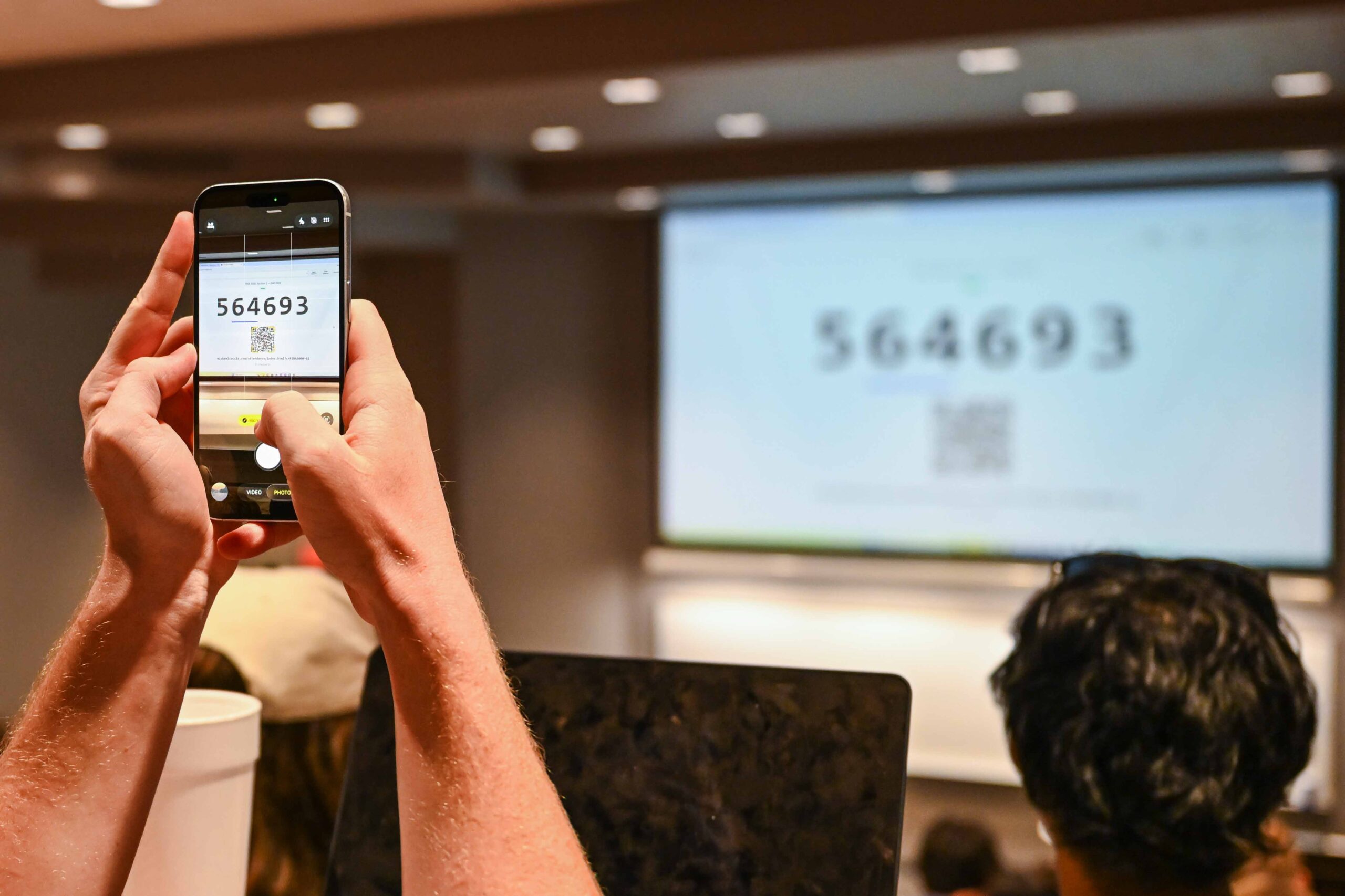
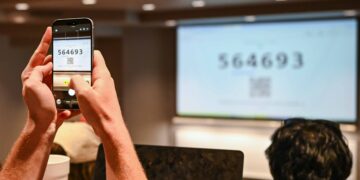
Student scans a QR code for attendance in Lamar Hall on Aug. 31. Photo by Gavin Gallegos
Funded by the Office of the Provost, one of the biggest implementations to classroom technology has been the addition of new 86- or 98-inch interactive televisions.
“They have a Windows VC module inside to use apps, including Whiteboard, on the Android side, but they can also be used as a regular Windows 11 PC,” Miles said.
Bruce Newell, who serves as an assistant director of instructional technology, spoke about an additional software that has been implemented called Ninja.
“(Ninja) is a remote management software on all the computers in the classroom that allows (the Office of Information Technology) to support classrooms remotely,” Newell said.
Rather than waiting on the arrival of tech support, students and professors can now request virtual classroom technology assistance through this messaging software.
Newell explained the reason behind these advancements.
“The technology in the rooms are being updated for professors to be able to give them the tools that they need to deliver the message for the students to have a better understanding,” Newell said.
Another change to classroom technology has been discarding the use of ID scanners and using QR code kiosks to register attendance for class. This addition has received mixed reactions from the student body. In order to be counted as present for some classes, students must scan the QR code with their phone instead of scanning their student ID like in previous years.
“I know that there’s a lot of people that took advantage of (the scanners), that would go in and scan their card and then leave,” Samantha Morris, a senior integrated marketing communications major from Madison, Miss., said. “I know this (change) is definitely helpful for the teachers, but as a student, I really did appreciate and like the scanners.”
Other students who noticed this change explained the struggles that they previously had with scanning their ID cards.
“Sometimes (the ID) would scan, sometimes it wouldn’t, so (the ID scanner) was a little bit faulty. I like this new system better because it’s easier,” Jake Somma, a junior accountancy major from New Canaan, Conn., said.
Miles offered an optimistic view for the university community regarding recent changes.
“Anything that’s new is going to be harder to navigate than something you’ve been using,” Miles said. “Change is always bumpy at first.”
The university’s transition from myOleMiss to Ellucian Experience was part of this initiative. According to Newell, the need for more modern software sparked the decision to make the switch.
“(MyOleMiss) was built on an older platform called SAP, and we were told that SAP was losing support. That’s why we went with Experience to do the job of SAP to now have constant, updated support,” Newell said.
Making such a complex change, Newell said, is not easy to do.
“The challenges that we have are (getting) it all put together and ready to roll out, because it’s a huge process in which pieces have to fall in line for it to be successful,” Newell said.