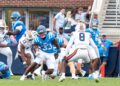


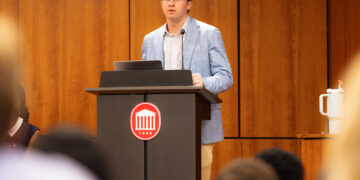




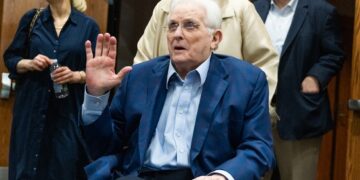
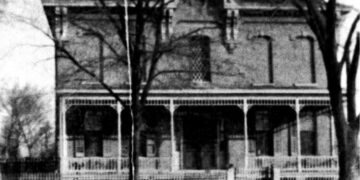















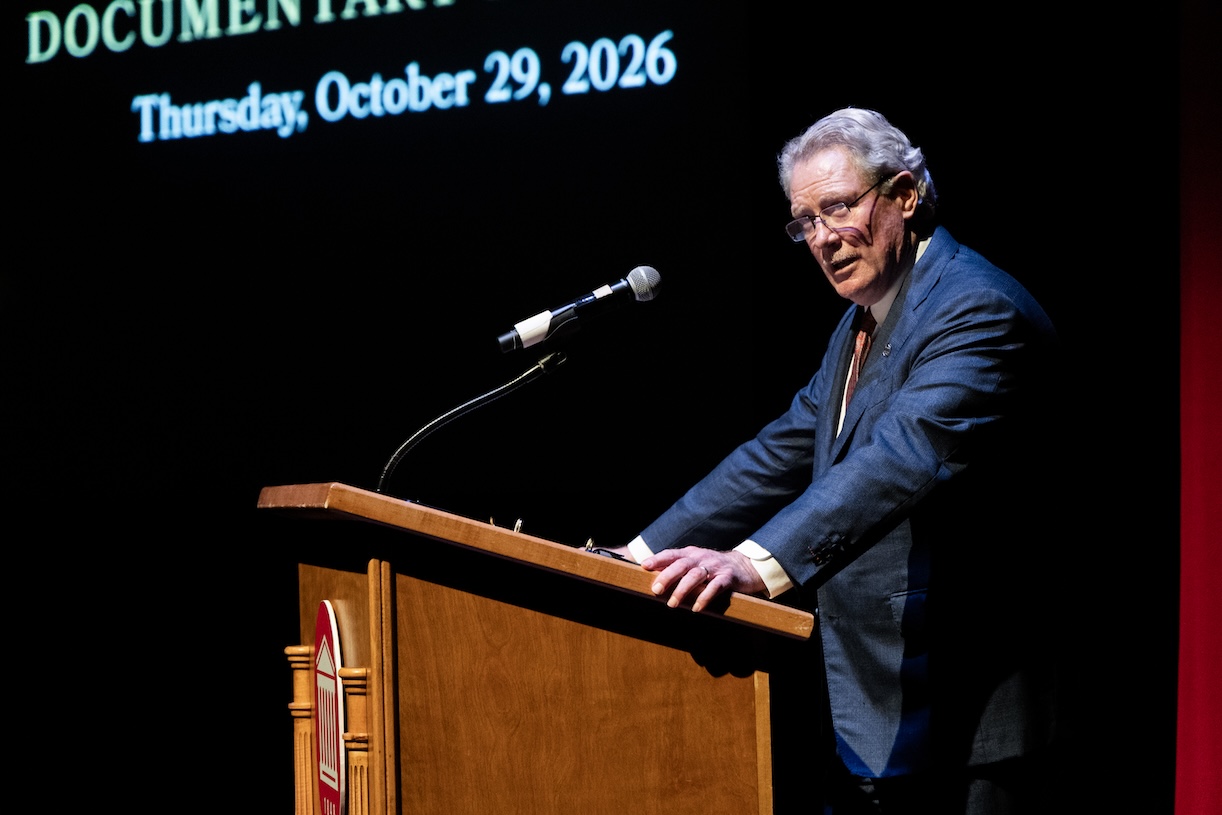
Former University of Mississippi Chancellor Robert Khayat took center stage Thursday evening, Oct. 29, as university leaders, alumni, friends and supporters filled the Gertrude C. Ford Center for the Performing Arts for the premiere of “The Chancellor: The Robert Khayat Story,” a documentary examining his leadership and accomplishments that helped reshape the university.
Directed by David Crews, the film chronicled Khayat’s journey from professional football player and law professor to the university’s fifteenth chancellor, a position he held from 1995 to 2009.
Using interviews with 83 individuals, including Eli and Archie Manning, Neil White and Morgan Freeman, archival footage and personal reflections, the documentary explored Khayat’s 14-year chancellorship, fundraising efforts and commitment to institutional change that helped elevate the school to a nationally recognized public university.
In a pre-recorded speech prior to the film showing, Khayat reflected on his longstanding relationship with the university, recalling June 2, 1956, when his older brother drove him from their home in Boston to Oxford as an 18-year-old student.
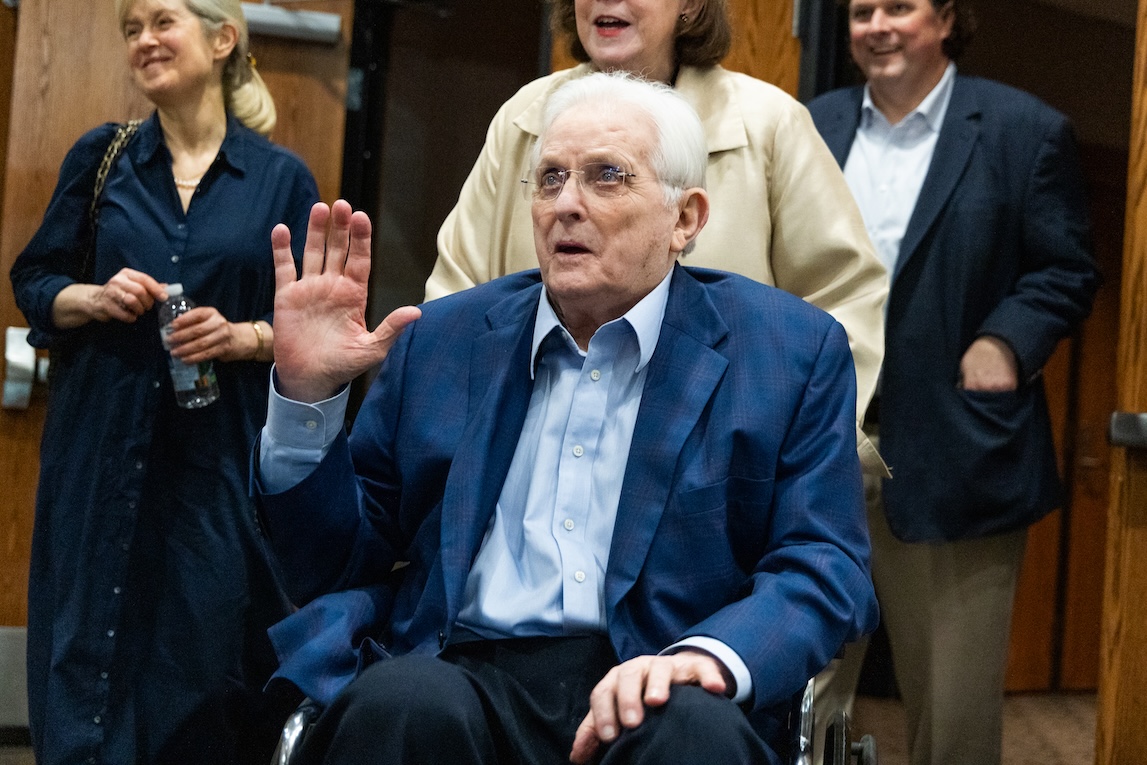
“How can I begin to imagine the remarkable 70 years that would follow?” Khayat said.
Crews described the documentary as an effort to capture the character, leadership and accomplishments that defined Khayat’s career. He emphasized the importance of teamwork in both the production of the film and Khayat’s approach to university leadership.
“Robert changed the culture and trajectory of this university,” Crews said. “He made the University of Mississippi one of America’s finest universities.”
Legendary American actor and honorary alumni to the university, Morgan Freeman, shared his memorable impressions of Khayat over the years.
“The fact that Robert was a team player all his life is meaningful in his accomplishments,” Freeman said.
“The Chancellor” recounted Khayat’s unusual, yet rewarding, turn of events that preceded his appointment as Chancellor of the university. In 1993, Khayat sought the University of Mississippi’s position for dean of the law school but was rejected by a faculty vote. The experience was particularly painful, and he later described it as one of the lowest points of his life.
When Chancellor Gerald Turner departed for Southern Methodist University in 1994, Khayat’s name emerged as a candidate for the university’s highest administrative position. The following year, he became chancellor.
“Just the idea that the law school rejected him as the dean, and then not too long after that he became chancellor of Ole Miss, is one of life’s great ironies,” Charles Overby, chairman and founder of the Overby Center for southern journalism and politics, said.
The film also highlights one of Khayat’s greatest accomplishments, the banning of the Confederate flag on the university campus in 1997, which sparked tremendous controversy at the time. Khayat believed the institution needed to be evaluated based on its academic substance and contemporary accomplishments, rather than symbols associated with its complex racial history. Despite extreme backlash from both students and alumni, Khayat knew it was the best way to move the university and the state toward a brighter future.
During his years as chancellor and now, Khayat is known for his attention to detail as well as his remarkable ability to build relationships with donors and create lasting friendships.
Khayat’s colleagues described him as an inspiring fundraiser and visionary leader. His monumental capital campaigns generated over $600 million in private support for the university, contributing to major developments including the Croft Institute for International Studies, the Sally McDonnell Barksdale Honors College and the Gertrude C. Ford Center for the performing arts.
Richard Scruggs, University of Mississippi school of law, made humorous comments in the film regarding Khayat’s sincere and ambitious approaches when fundraising money.
“You admire him, you respect him and you really just can’t say no to him,” Scruggs said. “My ankles are still sore where he turned me upside down and shook me for every penny he could get at.”
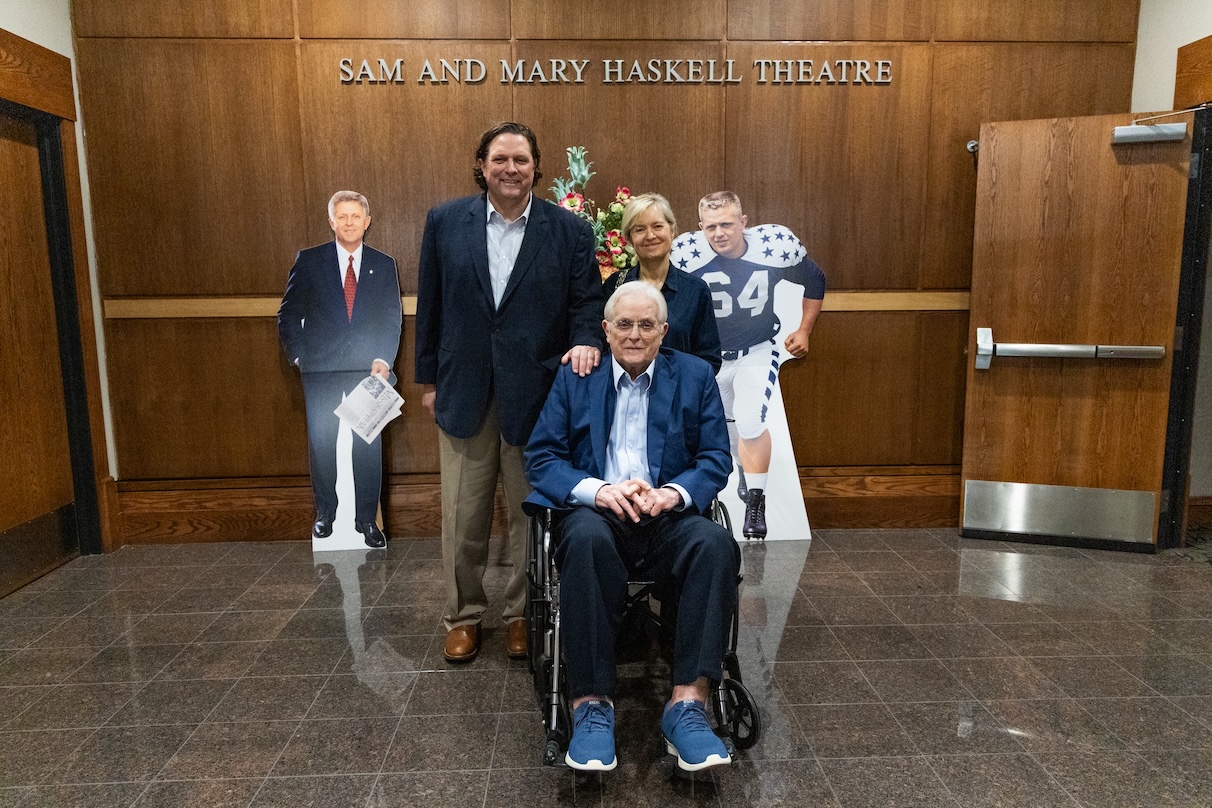
For the students who attended the premiere, the documentary offered an opportunity to learn more about leadership decisions and challenges the university faced, including those that continue today. Andrew Waller, a freshman public policy leadership student from Oxford, expressed his interest in seeing how Khayat navigated those challenges.
“I was definitely interested to see how he led,” Waller said. “I know that he definitely faced some big challenges while he worked here as chancellor. So I was interested to see that on the big screen.”
For freshman forensic chemistry major Zoe Bierhanzl, from Vienna, Va., attending the event gave her an opportunity to connect what she learned in the classroom with the people and events that shaped his legacy. As a part of her honors class, Bierhanzl read Khayat’s book, “The Education of a Lifetime,” and looked forward to seeing those stories come to life.
“I’m looking forward to hopefully seeing the people that he was talking about in the book, and actually seeing their face and hearing their voice,” Bierhanzl said. “I feel like putting a face to the name of what we read is going to be really interesting.”
The event concluded with a special performance of country music artist Marty Stuart, a five-time Grammy Award winner and longtime friend of Khayat. Stuart surprised attendees by bringing American singer and songwriter Connie Smith to the stage to perform a final song.
Khayat ushered in one of the university’s great turning points. The mark he left as chancellor is not only remembered with his major fundraising and academic expansion, but also his diligence to improve every part of campus. Friends and colleagues recounted seeing Khayat picking up litter and pulling out weeds across campus.
“The Chancellor” reflected on a period of substantial institutional change while recognizing the people who helped make that progress possible. Crews gave attendees and the entire university a window into the honorable life of a now 88-year-old champion of the University of Mississippi.