


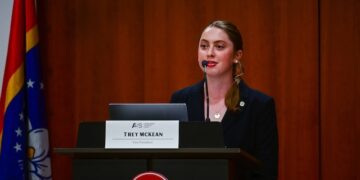

























The University of Mississippi Department of Sociology and Anthropology hosted Claire Whitlinger and Gary Alan Fine for an open discussion on the politics of the Jim Crow-era South on Wednesday, Oct. 14.
Whitlinger, the Herman N. Hipp associate professor of sociology at Furman University and founder of Furman’s Intergroup Dialogue Program, and Fine, the James E. Johnson professor of sociology emeritus at Northwestern University and current visiting scholar at Emory University, led a talk in Lamar Hall on the legacy of Mississippi Congressman John Rankin.
John Rankin was a Democrat from Mississippi’s first congressional district who served in the U.S. House of Representatives from 1921 to 1953. A hardline segregationist, Rankin also supported many economically progressive reforms, namely the creation of the Tennessee Valley Authority.
Representative Rankin’s papers are currently housed in the J.D. Williams Library at the university. Whitlinger and Fine are currently co-authoring a paper on Rankin’s legacy. Both Whitlinger and Fine have dedicated much of their academic work to studying complex reputations and public memories. They have worked together over the past decade to research Southern politicians in the early twentieth century.
“We’ve been all over the South writing a series of articles within the archives — three in Alabama, multiple in Virginia, Tennessee and South Carolina — and now, I’m just happy to be back in Mississippi,” Whitlinger said. “Today, Rankin is known as having a very naked reputation — vocal anti-semite, fiercely anti-Black, anti-communist, everything awful you can think of someone saying.”
Fine acknowledged the glaring flaws in Rankin’s character while pointing out some of his other policy achievements as evidence that historical reputations are never as clean as one singular narrative might indicate. Rankin was a headstrong supporter of the GI Bill and the Tennessee Valley Authority, two transformative pieces of legislation for the South.
These complicated views are what Fine and Whitlinger find so fascinating. Coupled with the multiple impressions of Rankin offered by the archives, Rankin’s constituents obviously viewed him differently than his colleagues in Washington.
For this type of in-depth critical analysis, the curation of the materials within the archive — what has been selected as well as what has been lost — proves quite intriguing, almost as much as Rankin’s character itself.
When sifting through these collections of institutionalized memories, Whitlinger describes becoming an ethnographer, searching for oral histories and turning her gaze to more contemporary sources. She created her own archive of personal materials to gain a deeper understanding of her subjects.
“It looked really messy,” Whitlinger said. “My methodology has always been to start from the textual and visual data and use them to guide my interviews so I can then fill in the sort of motivations and the pieces that I don’t have quite nailed down in the multimedia archive.”
Toward the end of the discussion, attention turned to the present moment and how modern-day figures will be preserved decades from now. If the congressional record was altered in the past to preserve a certain image of a politician — which the researchers said Rankin did — how will politicians today work to curate their own images?
“I’m thinking about Sen. (John N.) Kennedy’s Instagram account where he talks to his dog,” Whitlinger said. “He’s the same person at home as he is on the (Senate) floor, right? … For people working in politics, our views of them become flatter thanks to social media. … The public would not like you if you were a different person in politics than you were personally.”