





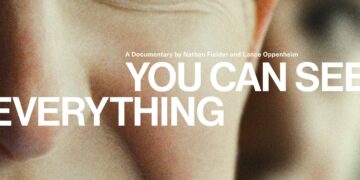
























Nathan Fielder and Lance Oppenheim’s documentary film about Elizabeth Holmes, “You Can See Everything,” was theatrically released on Friday, Oct. 16. The release was on a scale seldom seen for documentary films due to its high ticket sales.
The nearest showing was at the Paradiso theater in Memphis, and the first three days were nearly all sold out. However, with a comedian as meta as Fielder hosting the documentary, a director as talented as Oppenheim and a subject as strange as Holmes, it was no wonder this Paradiso theater was packed on a Sunday afternoon.
The film serves somewhat as a manifesto for the “Fielder method.” The method relies on Fielder’s awkward presence, which seems to open people up to show sides of themselves they would normally never feel comfortable showing on camera. Fielder also is not afraid to blurt out questions people would usually keep to themselves, which leads to some of the film’s best interactions.
In Comedy Central’s “Nathan For You” and HBO’s “The Rehearsal,” Fielder perfected this method, which is shown in its highest form in this film with Oppenheim’s creative choices and Holmes’ reality-bending personality. The complex nature of Fielder’s work is exemplified by the bewildering relationship between Holmes and her husband, Billy Evans.
Holmes, who was sentenced to federal prison in 2022 for defrauding investors through her blood testing company Theranos, shows a lack of remorse and self-accountability. Her mind clearly does not operate in a rational manner. However, Evans’ narcissistic personality makes it even harder to judge Holmes and her intentions.
This film, above all, asks if objective reality is really possible. Using Amanda Seyfried — who played Holmes in the limited series “The Dropout” — as a stand-in for Holmes, Fielder reenacts baffling, off-camera encounters with the couple.
Audience members are left asking themselves how much they can trust these reenactments, which are scripted entirely based on Fielder’s recollections. In his non-reenactment conversations with Seyfried, Fielder includes a moment when he questions his own memory of a conversation with Holmes in a way that could change its implications.
A questionable aspect of the film is that Fielder seemingly only had surface-level knowledge of Holmes’ crimes prior to meeting her. Much of the first half of the film deals with whether or not Holmes is a pathological liar. Holmes, for her part, makes the unbelievable claim that she has never lied in her entire adult life. Fielder pushes back on this but fails to do the same when Holmes briefly explains why she believes she is innocent.
Holmes tells Fielder that her blood testing machine, the “Edison,” has the capability to run hundreds of different blood tests. Fielder entertains the idea that, maybe, Holmes never lied to investors because she was actually telling them that the machine had the theoretical capability to run these tests but could not for the time being. This is a demonstrably false narrative; Holmes was sentenced to 11 years in prison because she falsely represented her machine’s capabilities and accuracy.
Some may argue that Fielder feigned naivety in an attempt to display how egregious Holmes’ lies could get. After all, the case has already been litigated, and this documentary is clearly not aimed at proving or disproving Holmes’ innocence. Still, as someone who has long followed Holmes’ case, it is unsatisfying to see no pushback against Holmes’ pleas of innocence.
One person in the film, however, does seem to grasp the full weight of Holmes’ crimes. Seyfried balances revulsion for, and empathy toward, Holmes. In fact, Seyfried acts as an excellent stand-in for the audience throughout the second half of this film. In a room full of strange people — Fielder included — Seyfried is refreshingly normal.
Still, the film would be nothing without the Fielder method. Fielder’s ability to disarm Holmes and Evans is shocking and leaves the audience with a mess of ethical considerations and conflicting emotions to deal with. Oppenheim’s direction, which uses extremely up-close shots of the film’s subjects, captures the vast array of emotions and internal dialogue shown simply by how people move their faces.
An argument could be made that this film is Fielder’s magnum opus. Personally, though, I hope this is just the beginning of what Fielder can do to examine reality and the human condition when he is given incredible subjects and support.