





























With college basketball season just a few weeks away, the transfer portal craziness has settled down — although, following the NCAA’s 5-for-5 eligibility model, which allows student-athletes to play for five seasons instead of four, several players who previously ran out of eligibility are now pursuing a return to college basketball despite appearing in NBA Summer League and G-League games.
Ole Miss Men’s Basketball and head coach Chris Beard needed a strong portal class following the program’s second-to-last-place finish in conference play last season. With 15 players on the roster — two of whom have not yet been cleared to play due to eligibility concerns — will the team have what it takes to compete this season?
Scoring was a problem last season, and the most obvious issue with last year’s portal class was the lack of proven offensive talent. Guard Kezza Giffa was the only incoming transfer to average double figures the season before (14.6 points per game at High Point in 2024-25).
Though some players can be expected to make jumps in performance across seasons, especially in a new environment — and some did, with guard AJ Storr averaging 15.5 points per game for the Rebels — it is unrealistic to assume that a roster of mediocre scorers will magically be able to put up enough points to compete in the SEC.
Until recently, this year’s portal class, though talented, seemed to lack a top-end scorer. Seton Hall transfer point guard Budd Clark averaged 12.7 points and 4.9 assists per game last season. Though undersized at 5 feet 10 inches, he is a knockdown mid-range shooter and has beautiful footwork, along with one of the smoothest spin moves in the game. He is also a talented defender — he averaged two steals per game last season. However, he is at his best in the role of floor general rather than go-to scorer.
Pittsburgh transfer forward Roman Siulepa averaged 10 points and 5.5 rebounds per game last season as a freshman, but the strength of his game is primarily his defense and rebounding. He led the ACC in offensive rebounds per game last year. He is mostly a threat in transition, when his athleticism is on full display. Many of his baskets came on sharp cuts to the basket or dump-offs in the low post and are not necessarily reflective of a polished offensive skillset.
Transfer forwards Dasear Haskins (11.1 points and 6.4 rebounds per game) and Santiago Trouet (8.1 points and 6.1 rebounds per game) will also be contributors. Haskins has shades of former Rebel guard/forward Dre Davis with his long limbs and combination of physicality and finesse in the low post and along the baseline. He can also shoot the 3-pointer when necessary.
Guards Ilias Kamardine and Patton Pinkins will return for the Rebels this season. Kamardine ran the offense last season and, though he lacks burst, is an excellent finisher and a solid shooter, even when contested. Pinkins, a true sophomore, was most impactful from beyond the arc last season — he shot 42.2% from three — and will hope to round out the rest of his game this season.
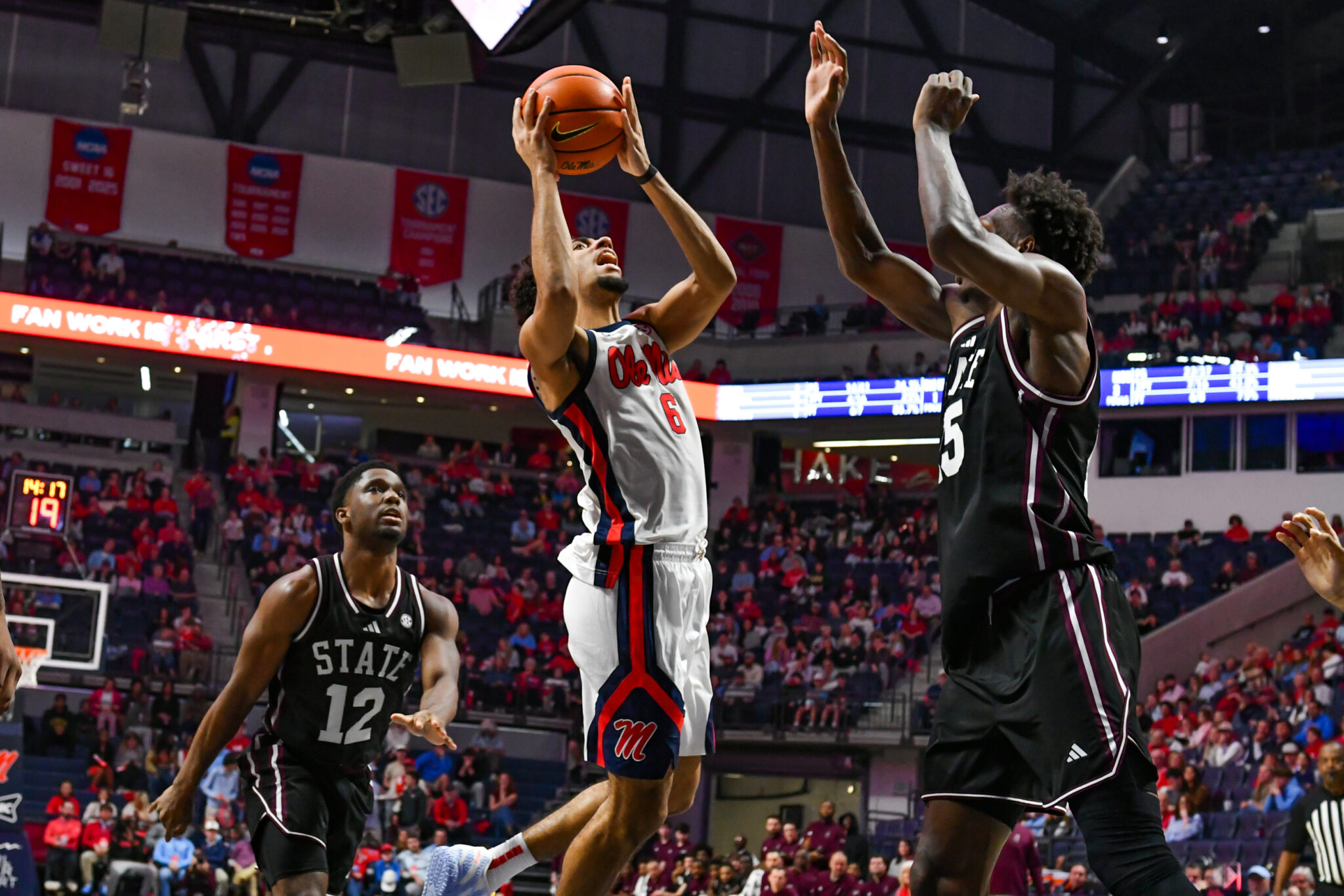
Though all of these players are talented, Ole Miss still lacked a player to fit the mold of an elite bucket-getter who could take over a game — that was, until former FIU guard Corey Stephenson committed to the Rebels.
Stephenson averaged 18 points and 6.4 rebounds per game for the Panthers last season. He is a masterful scorer at all three levels; he shot nearly 40% from three in 2025-26, and his highlight reel is full of slam dunks.
His level of competition raises some questions — FIU competes in the Conference USA — but Stephenson had exceptional performances against Power Four teams last season. He scored 25 points against LSU in November 2025 and scored 23 against Miami a month later.
However, Stephenson’s eligibility is in question. After going undrafted in the 2026 NBA Draft, Stephenson signed an Exhibit 10 contract with the Detroit Pistons and played for the Pistons in the 2026 NBA Summer League.
Considering the SEC’s recent ruling which forbids players who competed in any professional capacity to return to the conference, Stephenson’s eligibility may be in question. However, there has not yet been a definite ruling on his situation specifically.
Assuming Stephenson is allowed to play, all the pieces should fall into place for the Rebels. Stephenson will carry the brunt of the scoring while Kamardine and Clark help run the offense; Clark should flourish in the non-primary scorer role. Siulepa, Pinkins and Haskins will give the Rebels speed, height and motor on the wings.
Trouet and 7-foot center Stefan Cicic should form a tall frontcourt which, regardless of its offensive output, should serve to protect the rim — and this is to say nothing for 7-foot-1-inch center Micah Handlogten, who also has eligibility concerns.
The Rebels also brought in a trio of high school recruits who could make an instant impact. Guards Jaron Saulsberry and Yohance Connor are four-stars recruits according to ESPN, and forward Daniel Patton is a three-star recruit according to 247sports.
The transfer portal has caused less emphasis to be placed on high school recruiting, but these three could still carve out roles for themselves, as Pinkins did last season — though, admittedly, class of 2025 forward Niko Bundalo, who was Ole Miss’ highest-rated recruit ever, averaged only 3.2 minutes per game last season.
Beard also recruited former Australian professional Ben Henshall, who averaged 8.9 points per game for the Perth Wildcats of Australia’s National Basketball League last season. Henshall has excellent size at 6-feet-5-inches; last season, Kamardine, a former French professional, slotted in as an immediate starter, so hopefully Henshall’s professional experience will offer him a similarly smooth transition into college basketball.
The other two players on the roster, guard Zach Day and forward Christian Brown, will mainly serve as depth pieces.
The team’s ceiling will depend on Stephenson’s eligibility. If Stephenson can average around 14-15 points per game, and three other players can regularly put up double digits, this team might have what it takes to climb back to the top of the SEC.
However, even if Stephenson is ruled ineligible, this team’s floor, it seems, should still be higher than it was last season. Excluding Stephenson, the Rebels have four rostered players who averaged double figures in college basketball last season and a few others who were just at the cusp.
The team should be athletic enough to fight for rebounds, push the pace in transition and wear out other teams. It is fair to be cautiously optimistic about Rebel basketball this season.