


























When Associate Professor of Chemistry and Biochemistry Ryan Fortenberry wants to explain entropy, he does not just lecture — he flips upside down to make the concept stick.
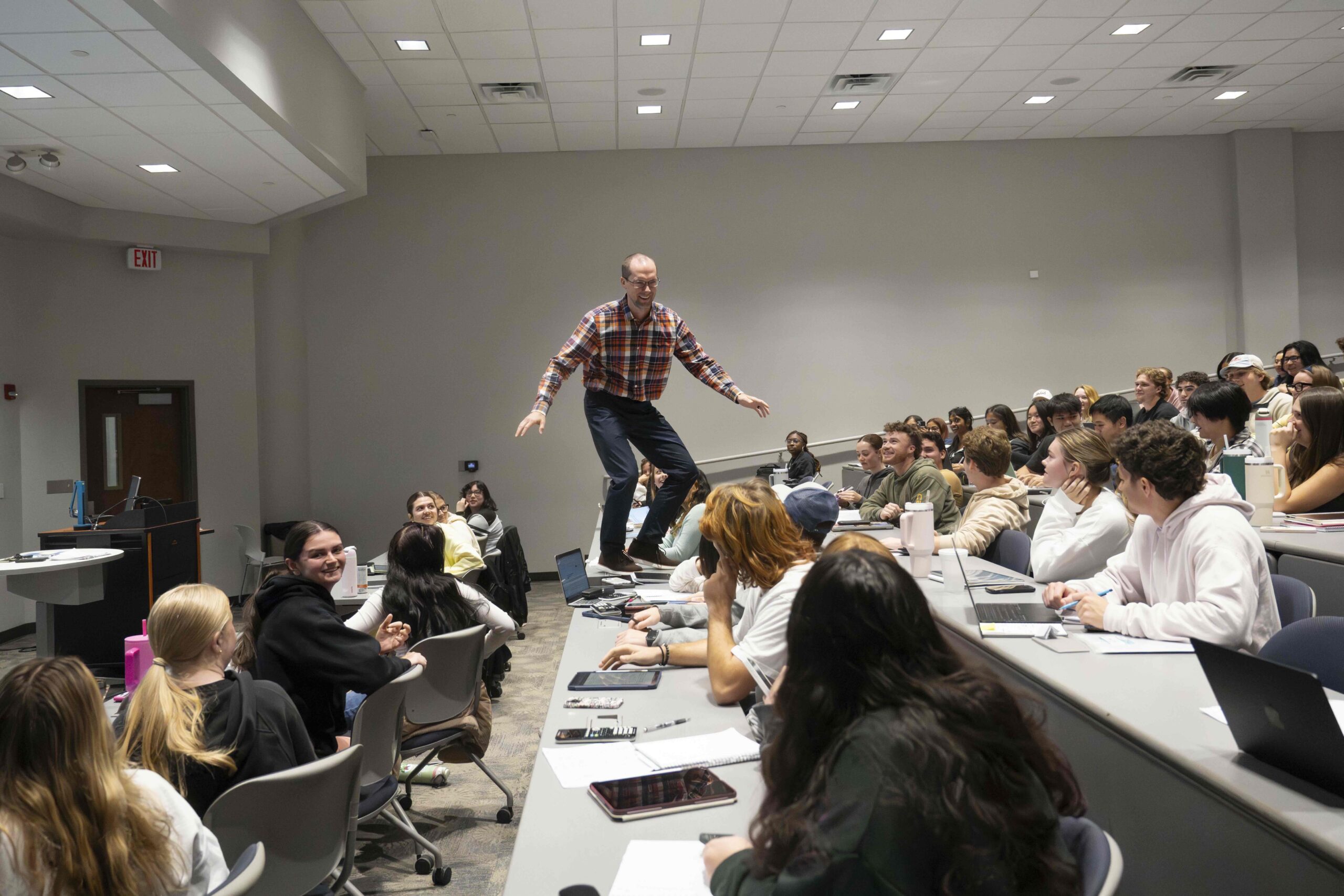
Fortenberry explains to his class how this topic was “very upside down” to him. In the midst of describing that as entropy increases, order goes down, he positions himself into a headstand to help his students better connect to the concept he is teaching.
“Hopefully me doing a headstand or jumping on a table and walking across students’ desks will help them remember what I’m trying to say,” Fortenberry said. “The number one thing I want for my students is for them to grow their problem-solving skills, and I will transcend boundaries to teach them to solve problems and become successful human beings.”

This method of teaching is often how Fortenberry runs his classes, sometimes doing flips or headstands to help students feel more engaged and open up to the idea of resetting their brains through fun analogies.
“When my daughter was one (year old), I started doing yoga, and through developing my body with yoga, I learned how to do a headstand,” Fortenberry said. “One day I just realized I could make this an analogy, because why else would anyone ever do this in class?”
The Clinton, Miss., native was surrounded by teaching from a young age, as his father, grandfather and great-grandfather were all educators.
His journey to chemistry and biochemistry was one with many twists and turns. During his undergraduate years at Mississippi College, he studied mathematics and later earned his master of science degree in communication also at Mississippi College. At the time, he wanted to be a science journalist, working as the editor of the Mississippi College school newspaper his senior year.
Combined with his passion for science, his undergraduate research with Professor of Chemistry and Chemical Engineering David Magers at Mississippi College showed him the opportunities the world of science could give him.
“(Magers) showed me that we could take all of the things I was learning in my math classes, pack that into computer programming and actually answer problems in the real world,” Fortenberry said. “I decided that was what I wanted to keep doing.”
While pursuing his PhD at Virginia Tech, Fortenberry realized he enjoyed space and the study of things beyond the earth. He latched onto researching astronomy and astrophysics.
After earning his PhD, Fortenberry worked for the National Aeronautics and Space Administration (NASA). He subsequently worked at Georgia Southern University for five years before returning to his home state to teach at the University of Mississippi.
“Mississippi to me is just one big small town,” Fortenberry said. “I have lived in Virginia, California and Georgia, and while I enjoyed living in those places, being back home is where I really feel like I’m finding connections with the people around me.”
During his time at Georgia Southern, Fortenberry wrote a textbook, “Complete Science Communication: A Guide to Connecting with Scientists, Journalists and the Public,” inspired by a communications class his students were required to take. He used a journalistic style to write scientific information.
“Once your audience has that trust in you, then you kind of get away from having to be the expert who has all the answers, and then you’re just getting to tell a fun story,” Fortenberry said.
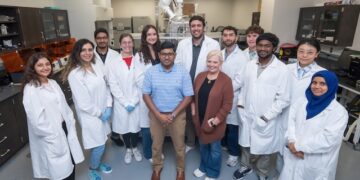
Through his research group, the Computational Astrochemistry Group (Fortenberry Lab) at UM, students can research astrochemistry and explore resources to project their careers post-graduation.
“Seeing these young people who have a real passion for something that they don’t yet know what it is, and then taking that and showing them their capabilities through their love of knowledge and learning is a really rewarding experience for me,” Fortenberry said. “It makes me really happy to see them grow and go on to do things that they maybe wouldn’t have done without me.”
Tori Gallagher, a senior forensic chemistry major from Doylestown, Pa., enjoys the energy Fortenberry has brought to her physical chemistry class this semester.
“You can really tell he loves teaching by how much energy he brings to the classroom, rather than just putting up a PowerPoint and leaving us to fend for ourselves,” Gallagher said. “He doesn’t just want you to learn the material — he wants you to understand it. And although we might not think it’s as cool as he does, he definitely appreciates the effort from everyone.”
Gallagher believes Fortenberry’s gymnastic abilities help him better engage with his students.
“The most interesting thing I’ve seen him do is definitely a headstand,” Gallagher said. “Not many professors will and are willing to do that in front of their whole class and do it so well. Like seriously, he does it perfectly every single time.”
Fortenberry hopes to continue teaching in his home state, showing the world the intellectual talent and curiosity that Mississippians have to offer. Outside of the classroom, he spends time with his wife and two children, attending many sporting events. He also enjoys being outdoors, having climbed to the highest elevation points in 48 states. He plans to conquer the highest point of Illinois, but he will stop at 49, as he will not ascend the peak of Alaska due to high cost.
“What I really hope I can do is show students from small towns that they can do big things in the world of science — no matter where they come from,” Fortenberry said.