

























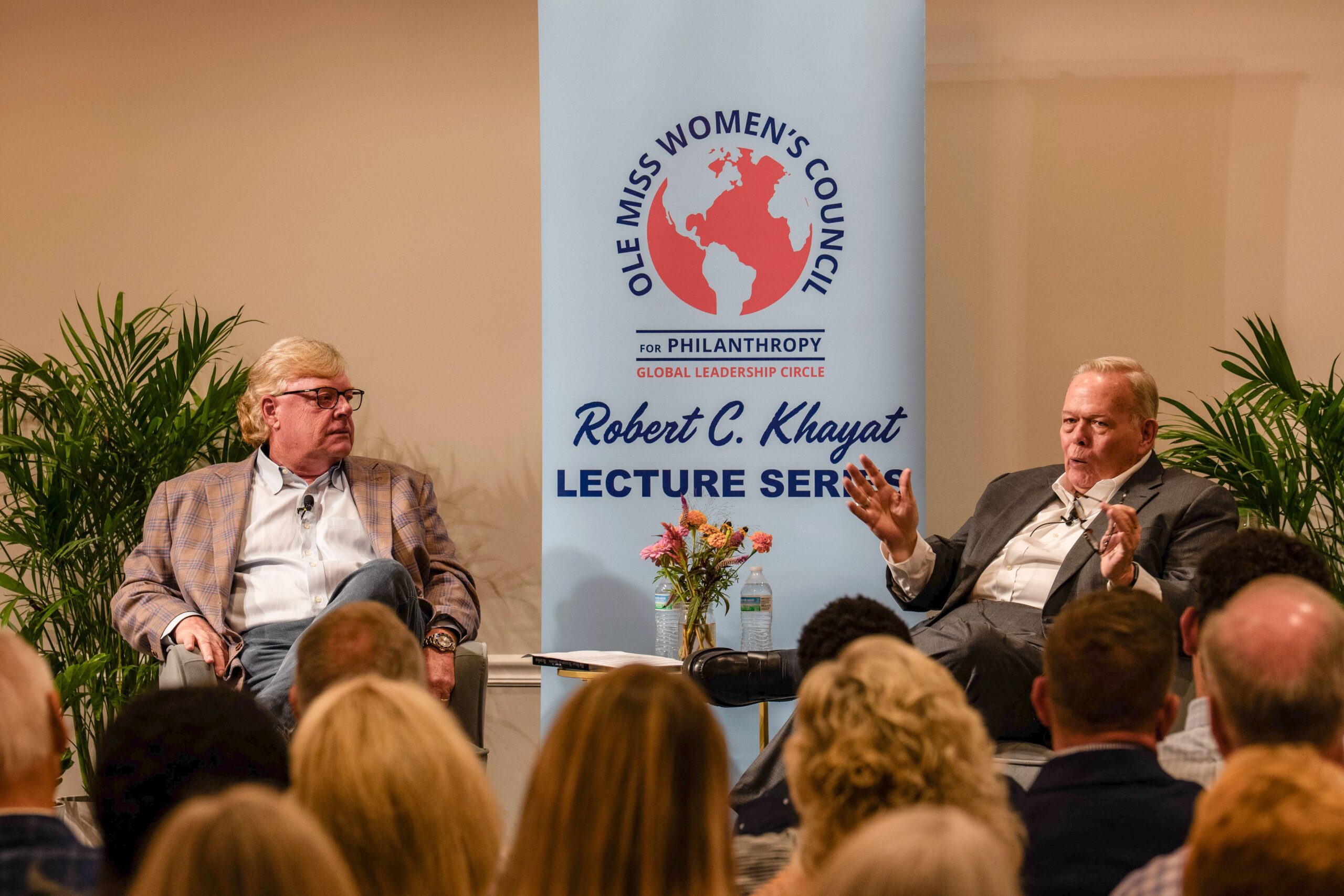
Beloved former University of Mississippi Dean of Students Sparky Reardon sat down with Middle College High School football coach Bill Courtney, whose efforts to improve the Manassas High School football team inspired the film “Undefeated,” for a reflective conversation about his new memoir, “The Dean: Memoirs and Missives,” on Thursday, Aug. 28 at The Inn at Ole Miss. This event was a part of the Ole Miss Women’s Council for Philanthropy’s Robert C. Khayat Lecture Series.
Approximately 300 friends, family members and students — former and current — gathered to honor Reardon’s legacy and hear stories from his years at the university that will continue to shape generations of students.
“The impact that Sparky has left on the University of Mississippi is something that’s going to be felt for generations, even after all of us are gone,” Daneel Konnar, a UM alumnus, said while introducing Reardon and Courtney.
Reardon’s career at the UM spanned 36 years, 14 of which he served as the Dean of Students. He retired from the university in 2014.
Reardon earned his Bachelor of Arts in 1972 and his Doctorate of Philosophy in 2000, both from UM. He also received his Master of Education in 1976 from Delta State University. As an undergraduate at UM, Reardon served as the sports editor and managing editor of The Daily Mississippian and vice president of his senior class.
Courtney reflected on the influence Reardon has had on his own life.
“He’s my friend, but I almost have too much reverence for him to call him my friend,” Courtney said. “He’s been a mentor, he’s been a confidant, he’s been an inspiration and he is my friend.”
Reardon spent over a year and a half writing “The Dean: Memoirs and Missives,” using the process to reflect on his long and rewarding career at the university.
“When I look back on everything that was given to me, people who supported me, the opportunities I was given, I realized how blessed I was,” Reardon said.
Though many people might view the Dean of Students’ role as primarily focusing on daily operations and staff communication, Reardon’s position extended far beyond the student handbook.
“Every day I collaborated with CEOs, doctors, lawyers, educators, engineers, senators, ministers and yes, even criminals,” Reardon read from an excerpt in his book about his time as Dean of Students.
But for Reardon, some of the most meaningful and difficult moments of his career came from the responsibility of helping students through their college experience, and more significantly, disciplinary matters.
“I always viewed student discipline matters as both the best part of my job and the worst part of my job,” Reardon said.
Reardon dealt with a variety of issues, from alcohol consumption and stealing to illegal marijuana growth and mattresses thrown from windows. As his book explores these sometimes funny, often outrageous memories, he reflects on how difficult it could be to handle every situation.
“Justice might be blind and, while on a college campus, one might need to be nearsighted or farsighted,” Reardon said.
Although every situation had a unique response from both him and the university, there were guidelines for disciplining students.
“We had a process where if a student took responsibility for their actions, then it was left up to us to issue a sanction,” Reardon said.
Although he has received praise for his personality and leadership throughout his career, Reardon remains humble when reflecting on his rewarding years at the university.
“I just came to work and did what I did, and I don’t deserve all this,” Reardon said. “I loved every second of it.”
His humility followed him through many experiences — joyful, challenging and everything in between. Reardon stayed true to his values, always keeping students at the forefront of his mind.
“There were no right answers; there were no wrong answers,” Reardon said. “You just took care of what was brought to you, and something just kicked in.”