



























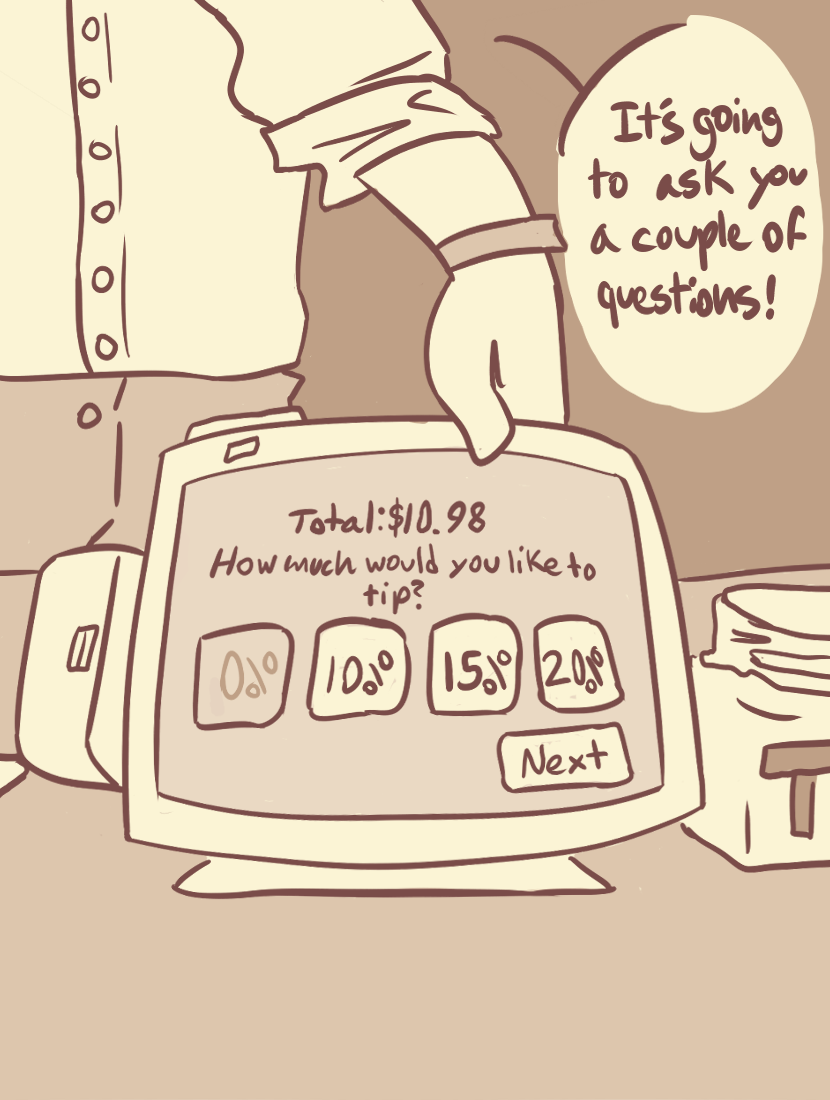
Tipping has become integral to the American dining experience. Roughly 72% of U.S. adults claim that tipping is expected more frequently than five years ago, according to the Pew Research Center.
“Tipping is taking over America,” M.K. Berger, a barista at Heartbreak Coffee and junior dietetics and childhood nutrition major at UM, said.
Tipping has been a part of the American dining experience since the early 1900s. U.S. Congress later solidified this norm as a “tipping credit” in the 1960s, allowing employers to pay employees below minimum wage if they receive tips, particularly affecting those in the food industry. While tipping is crucial for some professions, understanding tipping etiquette is important for deciding on appropriate gratuity amounts.
Dylan Kerr, a Kosciusko, Miss., native who has been serving at Bouré for more than three years, shed light on his experience in the food service industry.
“I think social norms play a lot because here in America, it’s kind of baked into your dining experience,” Kerr said.
Kerr shared that he has experienced various stances on tipping culture throughout his food service experience.
“I have had people from other countries come in and have a conversation with me about tipping culture here, and they’re kind of shocked as to the reality of it. I think if you’re fairly personable and as long as you’re not an a–hole, then people kind of treat you right,” Kerr said.
Tips contribute significantly to Kerr’s earnings as a server. Much of his income relies on the generosity of patrons.
“I would guess that per year I probably make more than some teachers, which is crappy in my opinion,” Kerr said. “I should not be making more than teachers.”
In Oxford, where a significant portion of the population consists of college students and young professionals, the dynamics of tipping can vary drastically by age and class.
“It sucks to be guilt tripped into tipping, and it’s not something I want to put a set price on, but at the same time, it’s how I pay my rent,” Berger said.
Employers in Mississippi are bound to federal tip guidelines, meaning they can pay employees as little as $2.13 per hour if their total earnings from tips and wages reaches the minimum wage of $7.25 per hour.
Brandon Baxter, a former UM student and customer at Heartbreak Coffee, stresses the importance of tipping for workers.
“Well, it’s mostly young folks like us who are making a living from these jobs. So, tipping really helps out. Personally, whenever I’m out and about, I’ll tip because I know what it’s like to be in that position. It feels like it’s just how things are set up here,” Baxter said.
In the U.S. the standard tip for dine-in service is roughly 15-20%, and for other service-based industries, it can be even less.
“I’ve never had a student leave me nothing, but college kids aren’t great tippers,” Seth Parenteau, a senior journalism major from Ocean Springs, Miss., said.
Parenteau, a food service worker at McCormick’s Bar and Grill at the Ole Miss Inn, believes college students’ financial straits may dictate the amount they tip.
“If you’re going out to eat, already that’s a little bit of a luxury,” Parenteau said. “When you’re a broke college student, you don’t have that extra cash to be like, ‘Oh this is great service let me pay them more.’ You just leave them what you can.”
Like many service workers, Parenteau says that working in the industry has changed his perspective on tipping workers.
“It’s kind of like ‘The Wizard of Oz’ — that illusion has been broken. Now having worked the server life, I do always try to tip the minimum 20%. But in a place like YaYa’s where I’m not necessarily getting the full sit-down service, I may think twice,” Parenteau said.
YaYa’s is a popular frozen yogurt spot on the Square.
Meanwhile, UM sophomore finance major Katie Garner questioned the necessity of tipping in certain situations.
“If they’re outside taking my order, then yes. But if they’re just behind the register or making wages at a fast food restaurant, then no, they don’t deserve it,” Garner said, “I think if we raised the minimum wage, we wouldn’t have to tip.”
Having experienced life as a food industry employee, Paenteau does his best to tip what he can.
“Now, having worked within the industry, even if the service is absolutely awful, leave something because you never know what that person is dealing with,” Parenteau said.