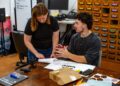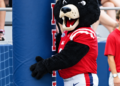




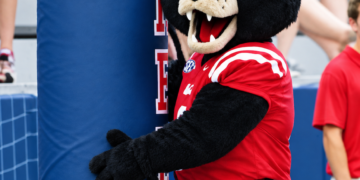




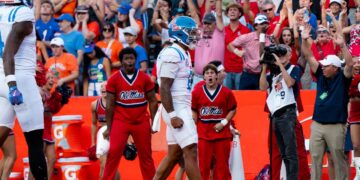


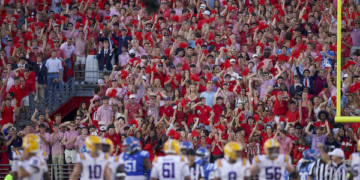











Whether the stands are filled with 68,000 fans in Vaught-Hemingway Stadium or shoulder-to-shoulder in the Gillom Center, the Ole Miss game day experience is more than what is seen on the field or court. Every song cue, timeout and light show are the result of weeks of planning from the Ole Miss game day staff and marketing team — processes most fans have never seen.
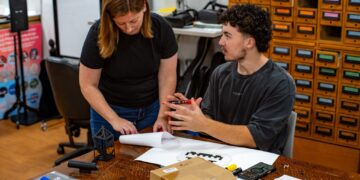
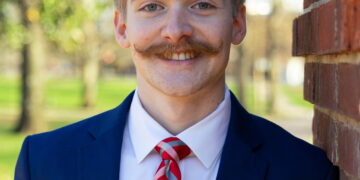
“Anything you see that is not the actual game itself — me or my staff have a hand in that,” Associate Athletic Director for Marketing and Fan Experience Josh Bender said in an interview with The Daily Mississippian. “We can’t expect fans to scream for three hours straight, so we build in peaks and valleys to keep engagement growing throughout the game.”
Preparation for each sport’s season begins long before the first game. The staff prepares by making a map of recognitions, sponsorships, in-game promotions, TV timeouts and communication with networks. They sort each moment into time slots to determine when high energy is needed and when low energy is acceptable.
For football, kickoff must be electric, but the crowd cannot be burnt out by halftime. For other sports like volleyball and basketball, the same blueprint applies, albeit on different scales.
“Our philosophy doesn’t change,” Bender said. “We want everyone walking away saying it was a great environment. Whether it’s Gillom, Swayze or Vaught-Hemingway, we want to entertain fans.”

One of the most hotly debated parts of any sporting event is the music played during pauses in action. The music selection is steered at appeasing everyone in attendance, which includes fans, event staff and players.
“We are not playing for one group,” Bender said. “We’re trying to play music that 68,000 people like. Our goal is that nobody walks away saying, ‘This music sucked.’”
The feedback on music comes from players, more than 20 student interns, staff members and peers across the industry. The team makes sure to monitor trends at other venues to see which songs hit crowds across the country. Yet players are perhaps the most important, Bender says, because their demeanors are infectious.
“A huge one for us is the players,” Bender said. “If players are hyped, fans pick up on that.”
Some of the most entertaining moments of the football season were the drone and laser shows during the Florida game, which took weeks of technical preparation. Ole Miss hired technology company Image Engineering to execute the field-wide display, installing laser mounts on the west side of the press box.
“They were with us until 1 a.m. the night before the game,” Bender said. “They were gridding the entire field, making sure the lasers were mapped correctly. Once it was ready, we just hit play.”
The drone show required even more logistical considerations. The Federal Aviation Administration (FAA) prohibits drones from flying over people, so Bender’s team needed to find a location where no pedestrians would be underneath the drones. The south end of the Manning Center parking lot and practice fields were the only viable option.
“There are so many pedestrian paths and roads on the north end that it’s impossible to shut down,” Bender said. “The south end gives us controlled space where no one can get underneath the drones.”
Football games require the most coordination; smaller venues, like Swayze and The Sandy and John Black Pavilion, are more advantageous due to their smaller size, which forces closeness among fans. Fans are so near to the court they often get the sense that they are an active part of something rather than simply a passive observer. The team aims to ensure fans enjoy all the high-energy moments Ole Miss games provide.
“I really like the atmosphere of smaller venues,” Amanda Miranda, a sophomore psychology major from Brandon, Miss., said. “It is very cute and interactive with the fans. The energy is very high, and the students especially make it really fun because they are always very passionate about Ole Miss sports.”
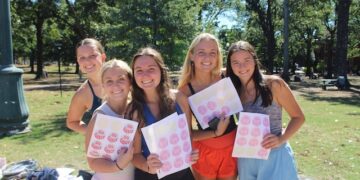
Promotions, giveaways and themed nights also help attract fans to games, especially for sports which fans might not normally consider attending. Landon Gilmore, a sophomore media and communications major from Brandon, Miss., attended his first Ole Miss volleyball game in part because of a giveaway.
“I have never been to a volleyball game before the Texas game,” Gilmore said. “The marketing of the giveaway of the beer mugs was what got us to come to the game.”
For many students, these targeted efforts introduce them to new sports on campus and keep game days fresh throughout the season. Increased attendance and excitement will give teams a stronger home advantage, and they will perform better; teams that perform better will attract more fans.
“We want to make sure we give our teams the best home advantage possible,” Bender said. “And we want every fan — first-timer or lifelong Rebel — to walk away saying they had a great time.”