
























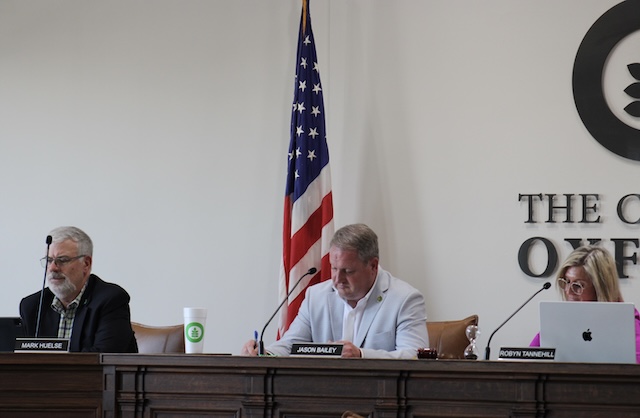
The first reading of an ordinance that would change the designated assembly area for large-group events or demonstrations from the Square to Bramlett Pavilion 0.9 miles away on University Avenue was postponed at the Tuesday, April 7 Oxford Board of Aldermen meeting.
Oxford Police Chief Jeff McCutchen, who presented the ordinance at the meeting, requested to postpone the first reading of the ordinance to the first board of aldermen meeting in May on May 5 at 5 p.m., due to concerns from the public.
“We had planned to present the changes this evening for the first reading, but we’ve received some comments over the last few days. So what I’m asking for you guys (the board of aldermen) is to allow us to push this to the first reading in May,” McCutchen said. “We can research these issues and then come back and prepare a document where everybody has an opportunity to express their concerns. We can research those concerns and then give you some proper feedback.”

The first reading is a formal introduction of a city ordinance presented to city officials; the first reading informs the public of the proposed ordinance and serves as an initial step in city procedure. Following the first reading, the board of aldermen would hold a second reading, which would include public debate.
A few hours before the board of aldermen meeting, the UM College Democrats released a joint statement on Instagram criticizing the ordinance. The statement was signed by other campus organizations, such as the Community Alliance Network, UM Environment Coalition, UM Forward, UM Ground Game, UM Southern Progressives Alliance and UM Students for a Democratic Society.
“We are deeply concerned and disappointed by the board of aldermen’s consideration of this proposed city ordinance, which will effectively curtail the Oxford public’s right to gather in a place of prominence and exercise their First Amendment rights,” the statement said. “It is particularly concerning that this proposal has been introduced less than two weeks after the third No Kings day of action, during which hundreds of citizens gathered at the steps of the Oxford City Hall to express their disapproval of the current presidential administration.”
Community members gathered in front of the Lafayette County Courthouse for a third No Kings protest on Saturday, March 28.
McCutchen cited concerns for safety, space and traffic flow as the catalysts behind this ordinance.
“When we reach those critical masses, we routinely overflow into the sidewalks or the city streets, and this has led to access issues for both the individuals who want to gather but also to those citizens who are using the downtown facilities and businesses,” McCutchen said. “Our intent in making these changes is not to limit expression on or near the Square. … It is intended to tailor our ordinance to contain reasonable measures that have nothing to do with the expression or messages of those who want to assemble.”
The joint statement recognized OPD’s concerns but re-emphasized the importance of the First Amendment right to assembly.
“We acknowledge that the Oxford Police Department has a responsibility to maintain public safety and traffic flow; however, we do not believe that these goals justify the city abandoning its commitment to upholding citizens’ First Amendment rights to gather in public spaces as they choose,” the joint statement said.
According to the ordinance, any public demonstration with more than 50 people in attendance is considered a large assembly event. For all public assemblies and demonstrations, organizers must obtain a permit from the Oxford Police Department.
The ordinance specifies that the following should be included in permit applications moving forward:
- Estimated attendance, which the Oxford Police Department or its representative shall consider, but which may be adjusted based on the experience and assessment of the Oxford Police Department
- Requested location and duration
- Description of activities
- Any anticipated need for traffic control, street closures or public safety support
The city shall review applications using objective, content-neutral criteria, including:
- Public safety considerations
- Traffic and pedestrian flow
- Emergency access requirements
- Impact on businesses and public infrastructure
- Past experience with similar or comparable assemblies
If the guidelines outlined are violated, Section 9 of the ordinance specifies offenders will experience revocation of permit, removal from the event area and “any other remedies available under applicable law.”