
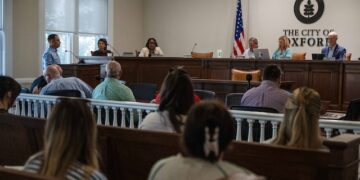
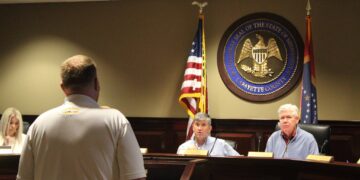
















Former University of Mississippi employee Lauren Stokes spoke about her controversial job termination during a UM American Civil Liberties Union event on April 7 at the Robert C. Khayat Law Center. Her appearance followed the dismissal of her lawsuit against Chancellor Glenn Boyce by a federal judge on March 16.
Stokes was fired from her position as executive assistant for the vice chancellor for development at the university on Sept. 11 after she reposted an Instagram post to her private account criticizing conservative activist Charlie Kirk on the day of his murder at Utah Valley University.
The university issued a press release shortly after Stokes’ firing on Sept. 11. In her court testimony on Feb. 13, Stokes said the press release made her job termination “newsworthy” and left her feeling “utterly condemned.”
“We condemn this action, and this staff member is no longer employed by the university,” Boyce said in the email. “All of us have a responsibility to take seriously our commitment to upholding a civil and respectful campus environment.”
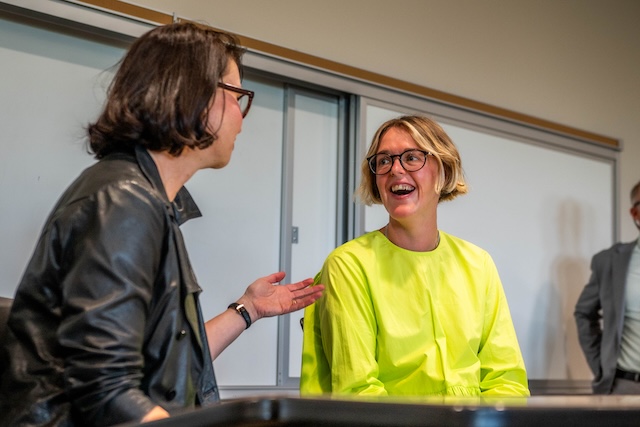
As for Stokes’ return to campus as an event speaker, UM Director of News and Media Relations Jacob Batte said, “As a public institution of higher education, the university supports the right of student groups to host events and invite speakers and guests to campus to express their views.”
Much of the conversation at the ACLU event concerned the First Amendment and freedom of speech, with Stokes arguing that her being fired from the university was in violation of this right.
“You can hate what I said,” Stokes said. “I totally understand if you do. That’s the joy: You can hate it. That’s fine. I can not like what you say, but we can say it. And if two sides can’t say something, then that’s not free speech and that’s also not democracy.”
Stokes’ attorney, Alysson Mills, shared their plan to appeal the ruling that dismissed Stokes’ case to the federal Court of Appeals for the Fifth Circuit and her hopes for the outcome.
“We expect to have a lot of people speaking in support of us,” Mills said. “I’m hoping that we will have a lot of conservative voices. I do not think this is controversial at all. I think the First Amendment is where we ought to agree, and I think there will be a lot of strange bedfellows in court — and I’m looking forward to that. I want to win because Lauren (Stokes) does not deserve this, and no one who is an employee of … any public institution deserves this, but I am mindful that we’re going to have to fight for it.”
Mills referred to the ruling dismissing Stokes’ case against Boyce as the heckler’s veto.
“This is a very important story to tell,” Mills said. “It’s not just about Lauren (Stokes). It’s about what happens when an institution picks a point of view and starts picking winners and losers and communicates to the entire campus, ‘If you say this, you’ll be fired, too.’ It’s very scary.”
Following Kirk’s assasination, at least 27 faculty members faced scrutiny from U.S. colleges and universities regarding comments made about Kirk. At least six sued their institutions of employment for violating their First Amendment rights, according to reporting by The Chronicle of Higher Education.
Three professors who sued their institutions were later reinstated to their positions following their lawsuit.
University of South Dakota art professor Michael Hook was fired after calling Kirk a “hate spreading Nazi” in an Instagram post. After being suspended by USD, Hook sued the university and was reinstated by a South Dakota district court judge.
Darren Michael, an associate professor of acting and directing at Austin Peay State University, was fired after posting a screenshot of an article with the headline, “Charlie Kirk Says Gun Deaths ‘Unfortunately’ Worth it to Keep 2nd Amendment.” APSU suspended Michael with the intention to terminate him, leading Michael to sue. APSU settled with Michael, paying $500,000 and allowing him to return to his position.
Florida Atlantic University finance professor Rebel Cole was placed on administrative leave after responding with threats to an X user celebrating Kirk’s assassination, saying “we are going to hunt you down.” After being placed on leave, Cole sued FAU and was reinstated.
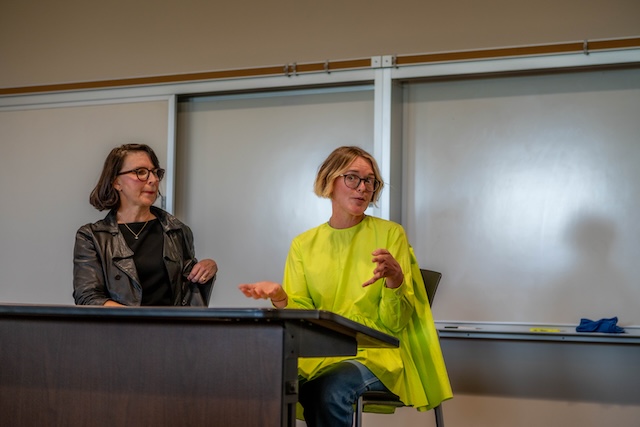
“Unfortunately, (Stokes’ case) is more important now, because the judge basically poured it out. This is, to my knowledge, the only Charlie Kirk case that has been totally dismissed,” Mills said. “We’re the first Charlie Kirk case to hit a federal court of appeal, and it’s the Fifth Circuit.”
Stokes talked about the ramifications of her case on other university employees.
“We now know I can’t post anything privately, which means any phone call you have, any text you send, anything you post privately, if you’re talking with a friend and they’re recording you, any of that can be used to fire you,” Stokes said.
Stokes shared her frustration with how the university handled her situation.
“I know there were outside voices that were happening, but there’s always going to be outside voices with any decision anyone makes, whether or not you’re the leader of the university — and when you let that change your decision, you’re for hire,” Stokes said. “I believe in integrity, I believe in empathy, and I don’t think that either of those things was shown on the day that they fired me. It breaks my heart because it truly means that everyone here can go for anything at any time.”
Stokes has dealt with many struggles since she was fired, including being doxed and threats to her place of business — Tarasque Cucina, the restaurant Stokes owns with her husband, John, and which catered the event.
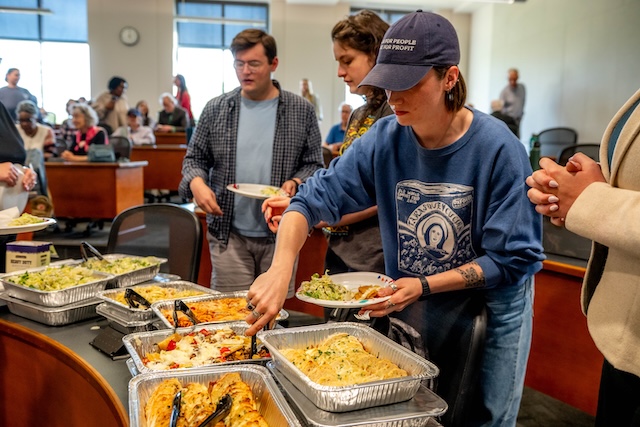
Tarasque temporarily closed, and Stokes and her husband had to leave town due to these threats. Tarasque has since reopened, and Stokes began promoting it again on social media.
Stokes does not regret sharing the Instagram post that led to her job termination or feel that she did anything wrong
“If you’re going to go down, go down for believing in free speech and not being a racist,” Stokes said. “Those are not controversial.”
Stokes encouraged students and other event attendees to stand up for important issues.
“Keep using your voice,” Stokes said. “Keep speaking up. The whole point right now is people don’t want people speaking up. They want silence. The more people who are silent, the less change will happen. As someone who has been through a doxing — God forbid that happens to you — but it’s going to be okay. Your community will lift you up. Also, get outside. The second you want to reply to someone online, you should get off your phone and please go outside and do something nice for someone else.”
Vice President of the UM College Democrats and senior public policy leadership major Calvin Wood attended the event to support Stokes and her case.
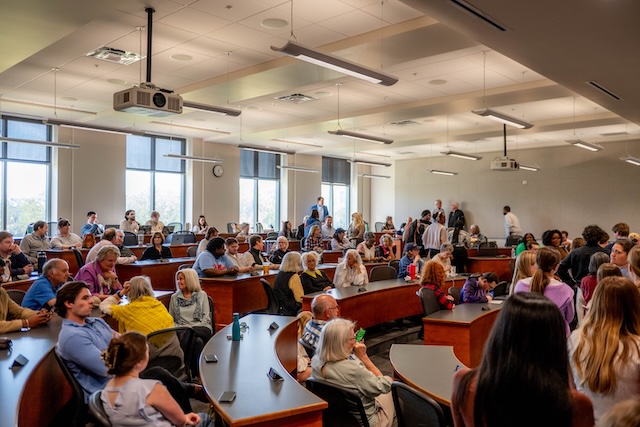
“I thought this was amazing,” Wood said. “It was so good to see so many people show up in support and to really hear directly from Lauren (Stokes) and Alysson (Mills). It’s cool just to hear their reflection on it all and what the next steps are.”
Wood was one of seven witnesses, including UM students, faculty, staff and Stokes herself, who testified on Stokes’ behalf in the U.S. District Court for the Northern District of Mississippi on Feb. 13.
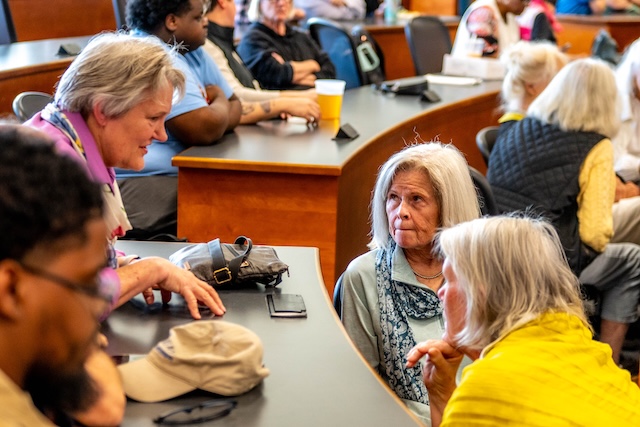
Madisyn Donley, a third-year law student and president of the UM chapter of the American Civil Liberties Union, reached out to Mills following the court ruling and requested she and Stokes speak on campus. Donley was happy that the speakers agreed and found the event to be successful.
“I think it went really well,” Donley said. “Everyone was pretty respectful, at least from what I saw. Having a full room was more than we asked for, and people enjoyed (Stokes’) food and getting to support her business, too. Her story needs to be told, no matter who’s listening.”