


























The Lafayette County Planning Commission voted 3-0 to recommend that the Lafayette County Board of Supervisors approve a four-acre dirt mining operation on Lafayette County Road 418 in the community of Fudgetown on Monday, April 27.
Two members of the five-person commission were absent.
The Lafayette County Zoning Ordinance defines dirt mining as the extraction of dirt, sand, gravel or other materials from the ground, which the ordinance said is subject to Mississippi Department of Environmental Quality (MDEQ) requirements.
The board of supervisors is scheduled to consider the project during its meeting on May 18.
A three-generation farm family in the area — Celeste Jordan, Courtney Rogers and Jordan Daniels of Fudgetown Farm — opposes the operation, and residents of the Yocona Ridge neighborhood have signed a petition opposing the dirt mine.
The dirt mining operation would sit diagonally across from the farm that Jordan and her family have owned for more than 30 years.
“I like the peace, the quiet and the tranquility,” Jordan said. “When I bought this farm, I never would have imagined that any kind of business like this would be located next to my farm.”
The proposed dirt mine would be located on four acres of a 165-acre property owned by CR 418, LLC, which leases the property to local excavator contracting company Ste-Bil Grading, Inc. CR 418, LLC is jointly owned by Ste-Bil Grading, Inc.; JWM Development, LLC; and Lonesome Oaks, LLC. The 165 acres are zoned A-1 Rural Agricultural, but on Monday, the planning commission approved a conditional-use permit that would allow the commercial dirt mining operation on four acres.
“The Highway 7 expansion is a huge accomplishment for the city and the county, but as anyone who has driven it has seen, it is going to require a ton of dirt,” McCurdy said. “We bought 160 acres and are going to be able to contribute some of the dirt to make the highway possible.”
Surface mining refers to removing the top layer of soil, vegetation and rock in order to access usable dirt and clay beneath.
The Lafayette County Zoning Ordinance defines surface mining as the “extraction of minerals, including dirt, soil, sand, gravel or other materials from the ground or water or from waste or stock piles or from pits or banks or natural occurrences by methods including but not limited to, strip, drift, open pit, contour or auger mining, dredging, placering, quarrying and leaching and activities related thereto, which will alter the surface.”
Dr. Eric Richardson shares a property line with the proposed location of the dirt mine. He also opposes the operation.
“It would sit directly across from the front porch of our house,” Richardson said. “This is in between two people’s houses that have been there for decades. It’s outrageous that the planning commission could even allow a dirt pit in between two homes.”
A public hearing about the proposed dirt mine operation was held by the planning commission on March 23, but action was tabled when commission members asked the developers to specify where on the 165-acre property the mine would be constructed.
After the developers identified the four acres on which the dirt mine would operate, the planning commission did not allow a second public hearing on the matter before the vote on Monday, April 27.
“I don’t understand how they can make a proposal and not have a public hearing concerning it,” Daniels said. “That would be the law, I would think. I also think it’s a contradiction to the zoning ordinance. It’s inconsistent with their own rules.”
According to the Lafayette County Zoning Ordinance, a public hearing must be held for all conditional uses of land.
“The fact that the development company gets to go back in and talk with them ought to enable the neighborhood to come back and have another chance to speak,” Richardson said. “It’s outrageous to me that the development people are going to be there, they’re going to get to directly communicate with the planning commission, and yet we’re not going to have that opportunity.”
Jordan worries that the planning commission’s approval of conditional use of the four acres could pave the way for more dirt mining on the 165-acre property.
“When they get these four acres, it opens the door for them to get another four acres and then another four acres,” Jordan said. “They’ll end up stripping all of the dirt off the top down as deep as they need to go.”
The owners of Fudgetown Farm, a property which cultivates produce and includes a nursery, believe that the dirt mining operation would impact their business and the natural environment of their community.
“We have events on the farm regularly, and a part of the appeal to coming out to the farm is getting to see the countryside,” Daniels said. “When you start dropping commercial and heavy industrial activity throughout the countryside, it loses its appeal.”
Richardson believes that having a dirt mining operation next to his home will lower his property value and could impact his animals.
“Surface mining can include lots of different types of activities,” Daniels said. “They have verbally said that they intend to dig up dirt and then haul it off to use for construction purposes.”
Details of the dirt mining operation are not described in the Ste-Bil conditional use permit application.
“Without any conditions placed upon approval of their application, (developers) can really expand (surface mining) as much as they’d like to,” Daniels said.
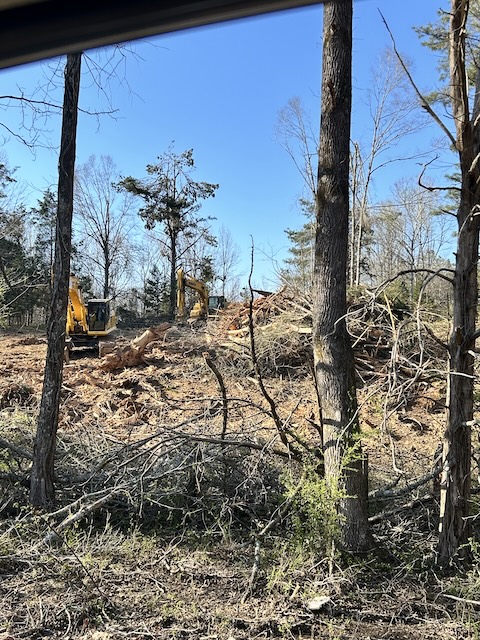
Daniels claimed that the developers began work on the property prior to the planning commission holding a public hearing on the matter on March 23, which was also before the commission granted the conditional use permit.
“One week before the public hearing, when this was first to be heard, they brought in two large excavators to the property in question,” Daniels said. “They trespassed on the neighboring property to get the excavators there, tearing down his fence and gate.”
Dennis Goldman, the neighboring property owner, did not respond to requests for comment.
Owners of Fudgetown Farm worry that the dirt mining operation could cause environmental problems such as erosion and air pollution from the dust that the mining would produce.
“It’s not just the dust that would be created from the dirt mining,” Daniels said. “That property in particular is right along Burney Branch Creek, which feeds directly into the Yocona River. Contamination of the waterways and disruption of the ecosystem is a huge threat to some of the best farmland we have in the county.”
MDEQ requires dirt mining operations to follow extensive environmental regulations relating to stormwater management, erosion control and maintenance of safe distances from bodies of water. McCurdy emphasized that the dirt mine would comply with all environmental regulations.
“The contractor will operate 100% by the book, fully compliant with all laws and regulations. If they don’t, just like anyone else, they will get shut down,” McCurdy said.
McCurdy was fined $14,000 by MDEQ in 2022 for failure to maintain erosion control, implement stormwater prevention plans and maintain weekly inspections in the Highlands subdivision east of Oxford on Highway 6. In 2020, he was fined $6,275 for failure to maintain large stormwater drainage in his developments.
An increase in traffic is a concern for the Fudgetown Farm family, as well. The two-lane County Road 418 has become increasingly congested in recent months due to the closure of other roads in the area while a bridge is being repaired on County Road 418.
“This is a farm-to-market road,” Jordan said. “It’s not meant for the type of traffic that (dirt mine) would bring.”
A dirt mining operation would require heavy machinery entering and leaving the property several times a day, which Daniels believes would make the road dangerous.
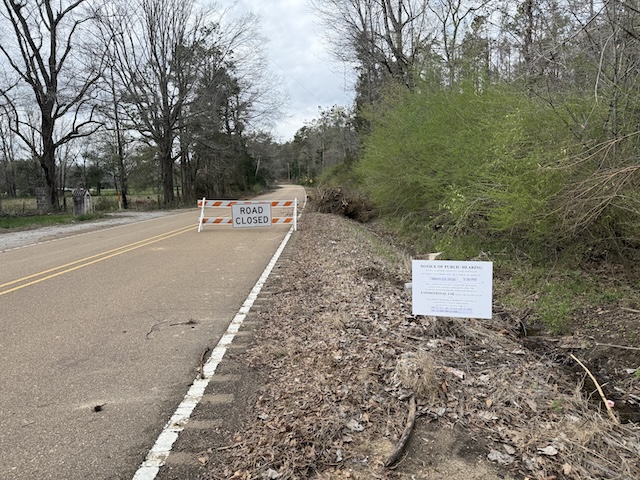
The family first heard of the dirt mining operation in February when a sign placed by Lafayette County notified residents in the area of an impending public hearing.
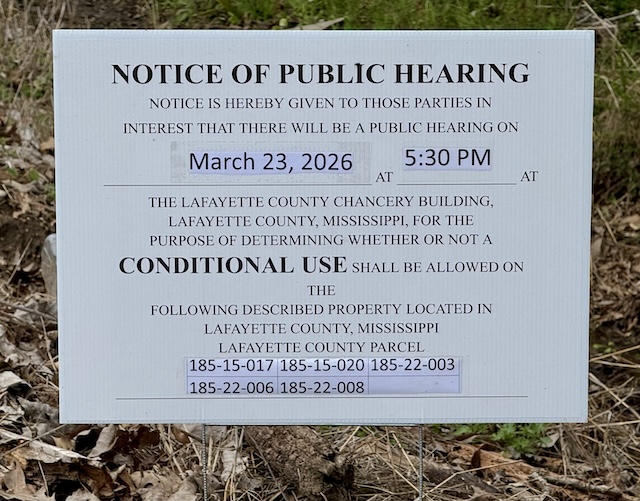
Daniels said the sign was located on a closed road and was slanted in a direction so that it was not easily visible to passersby.
“I literally had to search for the sign,” Daniels said. “The road is closed. Nobody is going to drive down that road and see that sign. We didn’t even see it until we went looking for it, meaning they didn’t notify the public that this was happening.”
Richardson said that without Daniels, he would not have known that the sign was there.
The planning commission then tabled the public hearing until March 23, placing a new sign next to the closed road sign.
“It is completely inadequate how they handle not just this notice, but all of their notices,” Daniels said. “They’re not circulating these notices in a local paper of record.”
The Lafayette County Zoning Ordinance dictates that a notice for hearings should be published in an official newspaper at least 15 days before the hearing takes place.
“Notice of such hearing shall be given by publishing a notice to all interested persons
one time at least 15 days prior to the date fixed for said hearing, such notice to be published in an official paper or newspaper of general circulation in the County, specifying the date, time and place for said hearing,” the Lafayette County Zoning Ordinance says.
A search of the Oxford Eagle database did not reveal a public hearing notice concerning the dirt mine. The Lafayette County Planning Commission did not respond to inquiries about the public notice.
Editor’s note: An earlier print version of this article included incorrect information about ownership of the property where the proposed dirt mine would be located. The names of owners have been corrected, and we regret the error.