

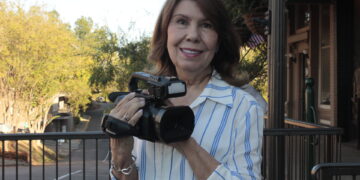











Local filmmaker and artist Deborah Freeland has spent decades preserving Oxford history and art through her photography and films. Her latest project highlights another piece of Oxford’s rich artistic culture.
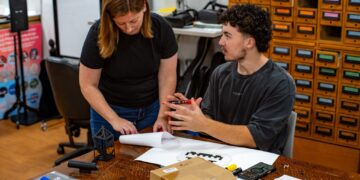
For over a year, Freeland has been documenting the creative process of sculptor Bill Beckwith.
Beckwith, a nationally recognized sculptor based in Taylor, Miss., was commissioned by the city of Oxford to craft a bronze statue in May 2025. The statue honors Larry Brown, an Oxford native who was most known for his literary works including “Joe” and “Big Bad Love.” Brown also worked as an Oxford firefighter before becoming a full-time author.
Freeland began photographing and filming the project in spring 2025 and has followed Beckwith’s sculpture from its earliest stages through its completion. The project has taken her from Beckwith’s studio to the University of Mississippi Archives and Special Collections and ultimately back to the heart of Oxford, where the bronze statue of Larry Brown now sits in Morgan Family Park.
Freeland said the documentary was not just about the statue, though.
“This documentary involves local music, local writing, local art, local photography and local storytelling,” Freeland said. “Altogether, it makes one documentary for one theatrical story.”
The first half of Freeland’s documentary explores the relationship between Beckwith and Brown, and the cultural environment of that time period.
“The first part is basically about the times … when Bill knew Larry,” Freeland said. “They were actually friends, which makes it an even better project.”
In the second half, Freeland dives into Beckwith’s craft.
“Bill is a fantastic sculptor,” Freeland said. “In fact, he may be the greatest living sculptor in America.”
Freeland’s documentation follows the process from its armature (which is like a sculpture’s skeleton) to its casting and, finally, the sculpture’s installation and dedication. At times, the timeline of Freeland’s documentary meant waiting for a phone call from Beckwith.
“If something was about to happen, like they were going to make the mold or pull the mold off, then he would call me, and I would throw the camera in the car and run out there,” Freeland said.
The statue is rich with symbols of the life Brown led. It honors Brown’s identities as both a local writer and firefighter, depicting him in his firefighter’s uniform while reading a book. In fact, Brown began writing while working shifts at the Oxford Fire Department. Adding to the sculpture’s symbolism, Morgan Family Park, where it currently stands, sits on the site of the former fire station where Brown worked.
“Larry was a fireman before he became a writer, and he started writing in the firehouse at night,
waiting on a call,” Freeland said. “Where the (Morgan Family Park) is, and where (his statue is) looking, is the old firehouse that was torn down.”
Freeland’s connection to the project and the subject is more complex than her passions for history and art.
“I’ve known Bill (Beckwith) since graduate school, over 50 years,” Freeland said. “Plus, I knew Larry, and I was around during those time periods, so I know what to look for.”
Freeland graduated from Northern Illinois University in 1974. She originally envisioned herself becoming a painter, but career paths for women in the arts were difficult to obtain at the time.
“(Film and photography) wasn’t available,” Freeland said. “I have a master’s in art. Most women in those days went into education, it was unusual that I didn’t.”
After graduate school at the university in 1976 where she earned her master’s degree in art, she worked in the university’s Archives and Special Collections, where she observed historic photographic techniques including glass plate negatives, ambrotypes and tintypes.
Her career shifted toward photography and filmmaking when she participated in a project in Belize when she was sent to document the construction of a road that University of Mississippi students were working on.
Freeland later served as editor, director and videographer for “Thinking of Home: Faulkner House and Rowan Oak,” a documentary film about famous writer William Faulkner and his home that aired on Mississippi Public Broadcasting in 2019.
Freeland said her creative process involved more rabbit holes and less rigid planning.
“You start with an idea, and then one idea trips over the next, and then leads to the next, and then leads to the next,” Freeland said. “Once you get a flow going, it just takes on a life of its own.”
Her creative process is also why Freeland said she is rarely struggling for a new project.
“I’m never between projects,” Freeland said. “They just line up.”
Looking forward to the future, Freeland said inspiration for new projects often grows out of films on which she is already working.
“Sometimes people come to me, and sometimes it’s just my own idea. It’s often a spin-off of what I’d already been working on,” Freeland said.
The documentary on Brown’s statue is anticipated to be completed by December. For Freeland, the project represents more than the simple creation of a statue. It’s another opportunity to document the artistic community of Oxford that is often overlooked.
“I think the arts in Mississippi don’t get enough credit,” Freeland said. “There’s a huge art culture right here in Oxford — not just writers, but also visual storytellers.”