





























Award-winning author Kiran Desai shared insights about her new novel “The Loneliness of Sonia and Sunny” at Square Books on Tuesday evening. The event put Desai in conversation with Sheila Sundar, associate professor of English and creative writing at the University of Mississippi.
“The Loneliness of Sonia and Sunny” is her first novel since 2006 and has been in the works for nearly two decades. The book centers on two Indian immigrants navigating themes of family and love across decades.
“Perhaps I first began this book all the way back when I was a student in Bennington, Vt., working in the library during winters and summer breaks, and experiencing both painful loneliness and also writing my very first stories,” Desai said.
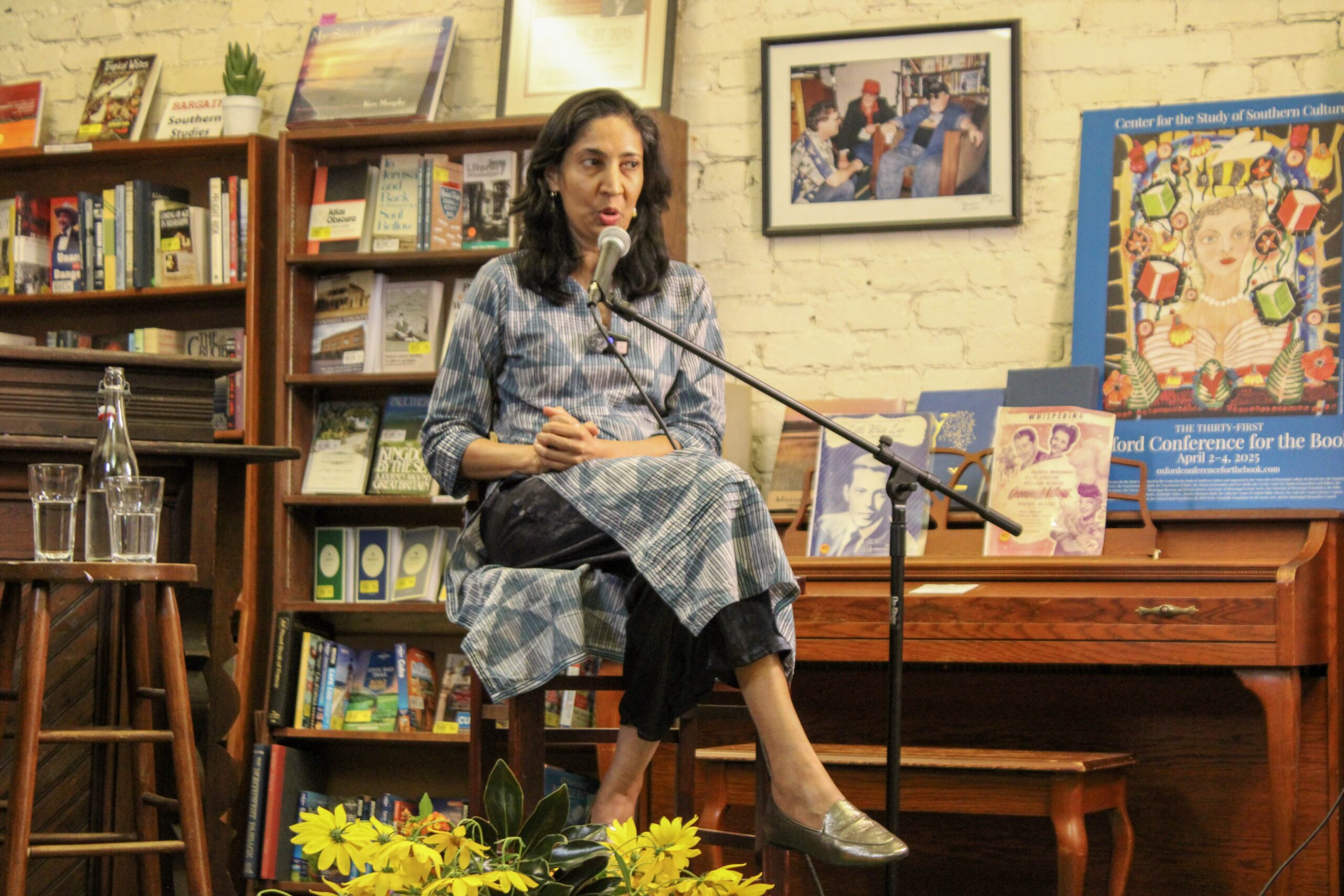
Photo by Reagan Kurtz
With this novel, she wanted to write a modern romance that included the messiness of modern-day society. It is concerned with class, race, nationality, history and all of the things that keep people apart.
“In terms of great divides between nations, the rage between nations, I chose to see it as a kind of loneliness, the huge class divide,” Desai said. “The sort of promise and failure of feminism as a kind of loneliness.”
Desai grew up in Delhi and spent the early years of her life in Punjab and Mumbai. She left India at age 14, living in England for a year before coming to the United States.
Desai published her first novel, “Hullabaloo in the Guava Orchard,” in 1998, later winning the Betty Trask Award. This prize, awarded by the Society of Authors, recognizes new novels by citizens of the Commonwealth of Nations under the age of 35.
Her second book has become her most widely acclaimed novel. “The Inheritance of Loss,” set in the Himalayas, explores identity and cultural clashes. It won the Man Booker Prize as well as the National Book Critics Circle Award in 2006.
The Booker Prize is one of the most prestigious literary awards. Its single annual winner receives 50,000 British pounds, or about $67,245, as well as international publicity. This novel has already been shortlisted for the 2025 Booker Prize.
Desai’s novels explore themes of immigration, class, race, belonging and deeply personal stories that tug at readers’ hearts. This specific novel focuses on the idea of loneliness.
“I’m not quite sure that the idea of the love story came first or the idea of loneliness came first, but I did want to explore the theme of loneliness in our globalized world,” Desai said.
Desai created countless drafts of this novel, spending long periods in isolation and writing notes that allowed her manuscript to be more than 5,000 pages.
“I can see where I’ve lifted this kind of story from here, that from there and then pulled it all together,” Desai said.
Desai wrote this book through a different process than her previous works, finding herself taking bits and pieces of her journals and past writings to create this large manuscript. She wanted to distinguish this novel from her others.
“‘The Inheritance of Loss’ is a much more political book, and this time, perhaps, it gave me the confidence to write a love story, and to write … about the grandparents, parents, Sonia and Sonny, and to really go to that far more vulnerable place,” Desai said. “The conversation two people have alone in a room, and those very private, quiet moments and those domestic details, and it was far more challenging, because their vulnerability makes the writer vulnerable, as well.”
Desai emphasized the importance of family and the absence of loneliness in her own childhood, a theme common to many Indian families and stories.
“You cannot just leave those voices out, because even if they’re absent and the family is dysfunctional, as is, you know, Sonny’s family and so is Sonia’s,” Desai said. “The absence is so present that you just can’t not include that.”
She also drew inspiration from her mother, Anita Desai, who is also a writer. The pair travel together, often finding the same details in their books, connecting them beyond a typical mother-daughter relationship.
“My book opens on this veranda my grandparents own that is also the veranda that has appeared in (my mother’s) work,” Desai said.