

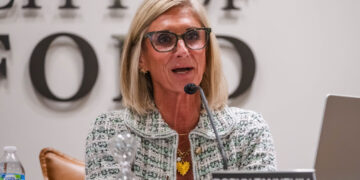




























Next spring, Republican primary voters will find an alternative to U.S. Sen. Cindy Hyde-Smith on the ballot. Dr. Sarah Adlakha, a physician, author and real estate developer, is mounting a primary challenge to the incumbent.
Adlakha says Hyde-Smith represents the “ineffectiveness” of Congress.
“As far as ineffectiveness with our senators and Cindy Hyde-Smith in particular, she’s consistently ranked. There’s a ranking called the Center for Effective (Lawmaking). They do rankings every year on how effective senators are,” Adlakha said.
The Center for Effective Lawmaking is an independent collaboration between the University of Virginia and Vanderbilt University intended to promote productive legislation and to inform the efforts of good governance partners. Using the Library of Congress to track all legislation, the organization ranks elected officials in the House, Senate and certain state legislatures based on their contributions.
Hyde-Smith is ranked 46th out of the 49 Republican Senators on legislative effectiveness in the rankings of the Center for Effective Lawmaking.
“(Hyde-Smith) is consistently ranked in the bottom five of Republican senators. In 2023, she was ranked dead last,” Adlakha said. “You can see that in her record. She hasn’t written and passed one substantive piece of legislation since she’s been there.”
Hyde-Smith was appointed to her seat in 2018 by Mississippi Governor Phil Bryant when U.S. Senator Thad Cochran resigned due to health issues. Hyde-Smith has since won the 2018 special election to fulfill the rest of Cochran’s term, as well as the 2020 election for her seat.
The Center for Effective Lawmaking shows that while Hyde-Smith has sponsored 18 substantive bills for the current 118th Congress, only one went to committee and one went beyond that, with zero of her bills becoming laws. A bill is considered “substantive” if it is “neither Commemorative nor Substantive and Significant,” meaning that it is neither symbolic nor significant enough to be considered a notable vote by outlets like Congressional Quarterly Weekly and Project Vote Smart.
The Daily Mississippian reached out to Hyde-Smith’s Oxford office, but a representative declined to comment.

Primarying an incumbent
In Adlakha’s assessment, Hyde-Smith’s inefficiency in listening to her constituents’ concerns has created a weak point for her.
“A pretty regular message that I’ve gotten from a lot of people is there’s just not a lot going on,” Adlakha said, referring to conversations she has had with potential Republican primary voters across Mississippi. “I think one of the biggest complaints most people have that I talked to when I asked about our legislators, and what do (they) think are some of the deficiencies, is (that) nobody can ever reach her. She doesn’t do town halls. She doesn’t talk to her constituents.”
This perceived opening has resulted in a different type of campaign from Adlakha — that she thinks she can win, regardless of institutional support.
“I absolutely think I have a chance to win because getting out in front of people and getting out and listening to what is going on in people’s everyday lives … it’s difficult for one person to cover. I mean, geographically, we have a pretty big state, and so it’s hard to get to all these places, but it’s worth it,” Adlakha said. “And whether or not I have someone’s endorsement, I don’t think endorsements go as far as they used to in politics.”
President Donald Trump has endorsed Hyde-Smith for her 2026 re-election bid for Senate.
In terms of listening to constituent concerns, Adlakha pointed to routine agriculture bills, which do not require much legislative innovation, that Hyde-Smith was responsible for passing in the Senate but did not.
“So, big committees for her, she’s on the agriculture committee, right? The farm bill hasn’t been passed in … seven years. They’re supposed to pass the farm bill every five years, so it’s two years overdue,” Adlakha said.
On the issues
Politically, Adlakha holds popular Republican views, considering herself a constitutionalist and “America First” supporter, not unlike Hyde-Smith. Adlakha is a proponent of fiscal conservatism and focusing on domestic issues.
“I’m a fiscal hawk. I’m definitely for stricter fiscal policies. I’m definitely an America First girl,” Adlakha said. “Our senators are guilty … of funding overseas conflicts, overseas aid, when we have plenty of need here in our own country. And so when I look at fiscal policy, I think that kind of ties into all policies. I mean, whether we’re talking about health care, immigration, illegal immigration.”
Immigration, in particular, is a key concern of Adlakha’s.
“If you look at the I-10 corridor coming through Mississippi, from Louisiana to Alabama and the amount of human trafficking, sex trafficking, drug trafficking that goes through that corridor and then … winds its way up into all of our highways and interstates into our state. We might as well be a border state, because there’s so much going on right now,” Adlakha said. “Being able to not only secure that border, because there’s criminals coming across the border, but even if they’re not criminals in the sense of violent crimes, we have people coming in here illegally who are using our resources.”
Adlakha also believes that fixing government inefficiency in the Senate does not just involve effective legislation, but also empowers state legislatures.
“Whenever we’re talking about federal laws, the Constitution gives us liberties, right? It gives us individual liberties. It’s not there to provide overreach or limitations in what we can do, and whatever is not included in the Constitution, according to the 10th Amendment, goes to the people in the states, right?” Adlakha said. “I’m a constitutionalist by nature, so I’m definitely for smaller federal government, and I believe that we need more states’ rights rather than federal interference in our lives.”
In Adlakha’s words, part of this “overreach” involves government subsidies, which she opposes.
“So there’s a lot of things that are going on right now in the federal government that they have their hands in. … They’re subsidizing certain industries, certain people, certain groups and certain companies, kind of creating a monopoly effect and taking that power away from the states,” Adlakha said.
Adlakha supports term limits for congresspeople, which she thinks will address some of the government inefficiency.
“I’m not looking to become a career politician. I’m just not looking to play this game, this political game. I have a very clear reason for why I’m running. I have very clear ideas of what I’d like to do. And one of the things that’s really important to me is term limits,” Adlakha said. “And I think you’d see a far different country and a far different party, probably both parties, if we had term limits, where people weren’t just going in there and saying, ‘Okay, who do I need to appease? Who do I need to endorse? Whose pocket do I need to get into to fund my next campaign?’”
The outsider
Adding term limits would attract those not looking to make a career out of politics, but those aiming to make a change, in Adlakha’s view.
“I think you’d see people who (are) not career politicians stepping into office more frequently, just like President Trump, right? I mean, this is a man who came from the real world, built businesses, created jobs. He wasn’t a career politician, and he stepped in, and he’s really shaken things up and I think that’s great. I think that that’s what we need,” Adlakha said. “We need people to come in there and say, ‘Okay, the country’s failing.’ You know, our national debt is almost, it’s about to pass $38 trillion. We’re doing something really wrong, and nobody’s doing anything to stop it.”
Adlakha’s real life experiences are what she hopes to bring to Washington.
“I have, like most people in Mississippi, been required to live within my means, right? I don’t come from the government. I don’t think our leaders in Washington understand what a budget is or how to balance a budget. So I’ve spent my life not only balancing my family’s budget, but also running businesses, working on real estate developments. … In the real world, I have come under strict deadlines. … I’ve never had to miss a payroll. I have always figured out how to get my employees paid,” Adlakha said.
Primary voting
Her hope is that students will seize the opportunity to vote in the primaries in order to make their voices heard early in the election cycle, particularly bearing in mind that the Republicans have an advantage in the state.
“One of our campaign messages is getting younger students out to vote. … I think when you’re talking about changes that are being made in legislation today, a lot of times you’re not going to see the effects of that for many years. … You might only be 18, 19, 20 years old, (but) it’s going to have a big impact on the kind of world you’re living in in 10, 20, 30 years,” Adlakha said. “Especially in a primary in a state like Mississippi that is more than likely going to elect a Republican senator in 2026, you need to be looking at which Republican senator you want in that spot.”
Adlakha wants students to understand the primary vote as a question of representation. She challenges young voters to look at Hyde-Smith’s record when considering who they want to represent them.
“It’s going to be important for the younger generation to see that and to say, ‘Who do I realistically want to be my senator? Who do I want representing me?’” Adlakha said. “And looking at the policies, looking at Cindy Hyde-Smith’s record, what are the things that she voted on, what are the things that she’s done? What are the things that have enhanced our lives here in Mississippi? I personally think there aren’t too many that you’re going to find.”
Editor’s note: Prepping for Primaries is a series featuring candidates for the 2026 Senate election in Mississippi. Vidya Adlakha, daughter of Sarah Adlakha, is an opinion writer for The Daily Mississippian. As part of the Prepping for Primaries series, it is the duty of The Daily Mississippian to offer a platform for all candidates. Vidya Adlakha’s views and connection to Sarah Adlakha are in no way reflected in this article, nor do they represent the views and opinions of The Daily Mississippian. Interviews with other candidates will be featured in future editions.