


























The University of Mississippi Libraries Department of Archives & Special Collections is collaborating with Rowan Oak, the historic home of William Faulkner, to reconstruct the author’s 1962 library through a comprehensive digital project. The reconstruction will include detailed descriptions of each book in Faulkner’s library at the time of his death.
This digital mission is a major collaborative effort between Rowan Oak curators Bill Griffith and Rachel Hudson and UM faculty Michelle Emanuel, professor and head of metadata and digital initiatives, and Jennifer Ford, professor and senior curator of manuscripts. The project recently expanded to include various Faulkner scholars, including his biographer Joseph Blotner, further strengthening its scope.
The project began in 2023 but did not become publicly accessible until 2025. The idea to create a digital library emerged early among collaborators and clarified the project’s direction and growth potential.
“Bill (Griffith) and Rachel (Hudson) had conducted a review of the books a few years before that were in Rowan Oak, because the majority of the collection was there at the time of (Faulkner’s) death,” Ford said. “I was on a trip to England and was in some of the homes of writers like (William) Wordsworth and the Brontës (Charlotte, Emily and Anne), and I saw in some cases how they had the actual books of those authors.”
The digital library is designed to engage scholars, students and the general public, creating multiple uses of the collection.
“We want this site to be something for everyone so that anybody can find something of interest there,” Ford said.
The project will continue as researchers and collaborators refine the library’s details. Plans to expand the project include a 3D view of the library as well as continuing to publish contextual essays that provide insight into the books and selected objects in the Rowan Oak collection.
“We are comparing records against Joseph Blotner’s catalog, and we’re doing extensive, detailed cataloging, recataloging of what is there and capturing anything unusual about them, scanning the covers and any annotations,” Ford said.
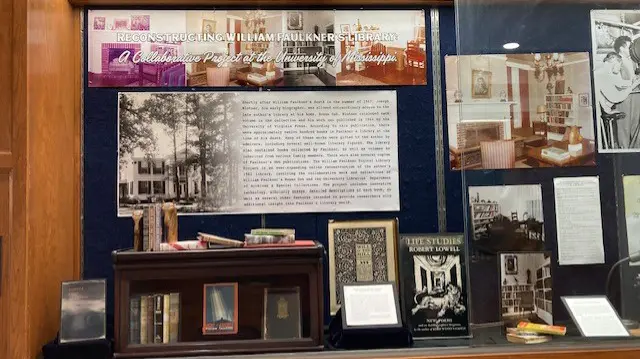
However, Faulkner’s library has not remained the same since 1962, as books have shifted locations and usage over time. When comparing the original 1962 catalog to today’s collection, these changes offer important insight for researchers.
“We know where the books were in 1962 because Blotner tells us, but they move over time, so a book that was in the office in 1962 could have been of more interest to Faulkner because he had fallen from his horse and wasn’t moving around a lot,” Ford said.
There is also a notable variety in the library, from unexpected authors like the Brontës and Agatha Christie to George Gershwin. Collaborators will continue to expand upon these findings and find their significance in Faulkner’s life.
“The books themselves, as objects and artifacts, are so important, and we wanted to get people interested in the objects, not just for the wonderful intellectual content and the association with Faulkner, but also the objects themselves,” Ford said.
A university class focused on Faulkner’s works, ENG 460, got involved with the project this spring, marking an important step in the project’s ongoing development.
Hannah Putna, a junior creative writing major, is taking the Faulkner capstone course while also working at Rowan Oak, giving her a direct connection to the academic and archival sides of the project.
“I think it’s really exciting because there’s nothing anywhere about what books he had, and then with the contextual essays, we get to see more about why these books were in his house and whether or not he might have read them,” Putna said.
The library not only gives students an avenue to learn about Faulkner and his personal life, but it also is a source for their own scholarly goals.
“I am going to be writing a contextual essay on (‘The Age of Reason’ by Jean-Paul Sartre) and Faulkner’s ownership of that book,” Putna said. “Already in my research, I’ve found that Sartre has written multiple essays on Faulkner, but there’s nothing about Faulkner reading Sartre.”
A great deal more can be learned about Faulkner through this project.
“After he won the Nobel Prize, he was gifted a lot of books, so it’s interesting to see the literary climate during that time,” Putna said.
The project connects Faulkner’s history to the present day to add relevance for those who may not initially be interested in him.
“Rachel (Hudson) posted this story on Instagram the other day for Rowan Oak of (Faulkner’s) copy of ‘Wuthering Heights,’ so knowing that he owns that book and he had a couple of books by the Brontës might make someone think that’s relevant to today,” Putna said.