






















Each spring, the University of Mississippi’s student body selects the peers they wish to lead the Associated Student Body. Candidates go all out for campaign season, printing countless custom stickers, posting promotional content on social media and promising policies guaranteed to snatch the student vote.
A chaotic horse race erupts, coming down to who can form the most photogenic “core four,” win the Greek vote and spend campaign season politicking at as many parties as possible.
The campaign craze, however, seems to exist in a politically obsessed microcosm. In this year’s elections, approximately 10% of the campus body actually cast a ballot for ASB president, begging the question: Does the average student actually care about who runs the student government?
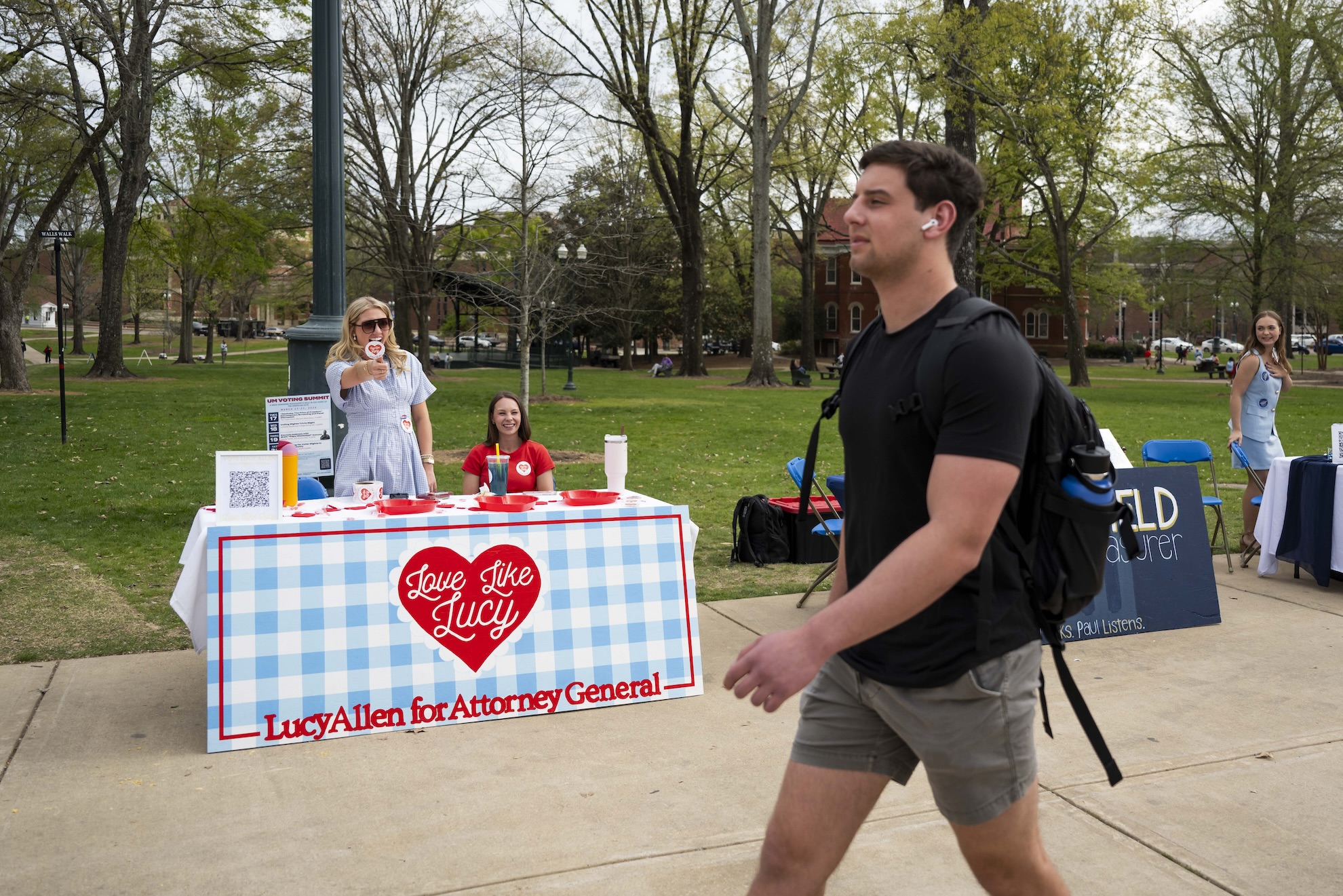
Out of this year’s record enrollment of 28,405 students, only 2,878 even voted in Tuesday’s presidential race between OC Williford and Jalon Hightower, where Williford ultimately won the election with approximately 76% of the vote.
Turnout was only slightly higher than in the 2025 ASB presidential race, where 2,638 students cast a ballot for ASB president, roughly the same proportion of the student population.
For many students, campus politics is just not interesting enough; the abysmally low turnout Tuesday night reflects that.
This, to be fair, does not represent the views of all students. Lilly Bilbo, a sophomore international studies major from Carrollton, Ga., offered her perspective on ASB elections.
“I think voting is necessary, and there needs to be more voters,” Bilbo said. “What is happening on campus reflects what is happening in the U.S. as a whole. People aren’t going to the polls and exercising their constitutional right.”
It makes sense that the voter turnout problem for ASB might play out for real-world politics as well. The United States, on average, has far lower voting turnout rates than other developed nations, hovering at 60% for presidential elections and 40% for midterm elections, according to the United States Election Project.
Narrowing back down to our campus, a glaring disparity that reveals something unsettling about voting culture is the difference in turnout during the homecoming and ASB election seasons. In the 2025 homecoming queen race, 4,075 total ballots were counted, according to the official ASB website.
While personality elections are an exciting way to bring students together, they are largely popularity races that have no implications on the everyday priorities of most students. It strikes me that 1,437 fewer people voted for their future student president than homecoming queen.
“Homecoming ballots are easy. You just pick the people,” ASB president-elect OC Williford said to The Daily Mississippian. “Student government can really require reading platforms, understanding roles, watching videos, comparing candidates, which obviously takes a lot more effort.”
Jalon Hightower, who lost his Tuesday election bid for ASB president against Williford, has his own theories.
“Policy is boring, especially campus policy,” Hightower said. “What I have learned is that I have to create a campaign and policy platform that is digestible to students. One way we can change that is how we communicate with students.”
Hightower and Williford point to a problem that exists throughout politics, and that is making policy platforms accessible to the people they are meant to affect. That is, after all, the prerogative of any politician: convince the voter.
For voters to be convinced in the first place, they must be willing to vote. Looking forward, ASB leaders and average students should both be motivated to increase voter turnout, student participation in ASB events and greater discussions of current issues by all students.
This is a daunting task, but who better than UM students to confront it?
I have full faith in the ability of next year’s ASB leadership and even more in the passion that drives service-minded students. This commitment currently remains solely within ASB leadership; however, it should exist throughout the campus body.
It is our duty as students to vote in ASB elections. Our vote is our campus destiny, and each time we abstain, we revoke it.
Lenora Collier is a sophomore international studies major from Hattiesburg, Miss.