































In February 2023, Emily McDougal, mother of a toddler, was moving. Again.
As Oxford housing costs increased over the years, McDougal found herself consistently priced out of rentals in the city and forced to move on a yearly basis since 2019.
“The lowest rent was $1,200 a month, and I wasn’t even making that much money a month,” McDougal said. “I’m a college graduate but struggled to find jobs.”
McDougal is not alone in the struggle for affordable housing in Oxford. As both the population of the city and the student population at the University of Mississippi have continued to grow, more strain is put on the housing market, especially through the emergence of short-term rentals.
Short-term rentals have gained popularity as visitors flock in to watch Ole Miss Football in the fall or shop on the Square in the spring. Rentals of any residential housing unit or accessory building for a short period of time, typically less than 30 days, qualify as short-term rentals.
It is a lucrative business practice for many property owners, but these short-term rentals increase market prices and diminish long-term rental availability.
What the current market looks like
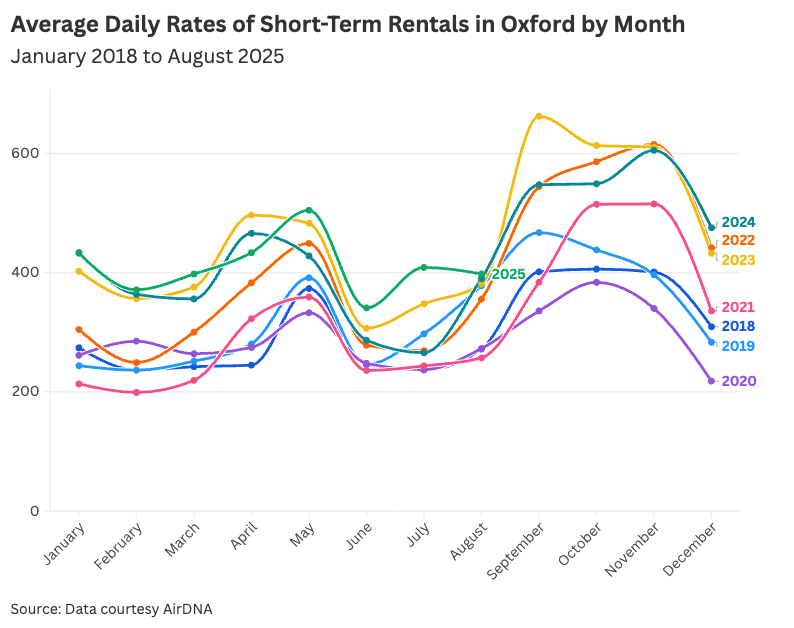
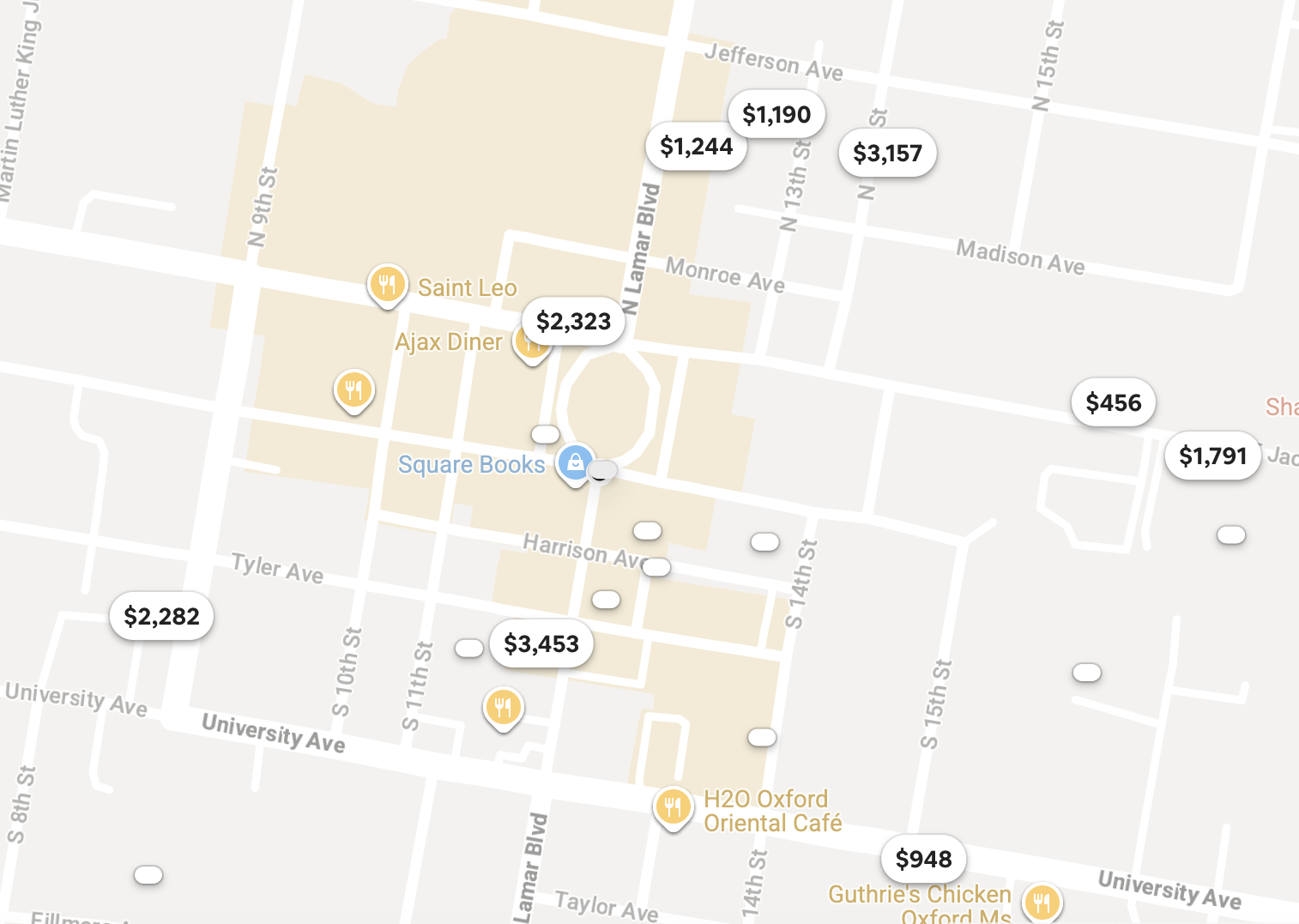
As of September 2025, there are more than 1,300 Airbnb listings and 680 VRBO listings in Oxford.
The short-term rental management company with the most listings in Oxford is Velvet Ditch Villas, according to AirDNA. Velvet Ditch Villas founder and CEO Ashley Freeman manages more than 130 short-term rental listings. Her business started as a way for her to afford living in the city.
In 2014, Freeman listed her five-bedroom house in Oxford on Airbnb to increase her income as a single mother. In that year alone, she made $25,000 from renting it out during football weekends and graduation.
While some Oxford homeowners still rent out their primary residence, Freeman says the majority of the properties she manages are owned by people whose primary residence is not in Oxford.

“Expectations have changed so much for these travelers and renters,” Freeman said. “They don’t want to go into a house that’s got personal items or things in the closet. They want to come into a place that’s serene, peaceful and decluttered. That changed the game for a lot of homeowners here in Oxford that were just trying to make an extra buck.”
Additionally, in some cases, people will purchase properties to curb visit costs. Freeman said this is especially common among the parents of students at the University of Mississippi.
“There’s these parents that come in that won’t have a place to stay when they visit their kids because, heaven forbid, it costs an arm and a leg just to come visit your children for a weekend,” Freeman said. “If you’re spending $3,000 every time you come down to see your kids and you want to come two or three times (a semester), that’s a big chunk of change that you could save making a long-term investment.”
In turn, these vacation homes become short-term rentals, many of which stay vacant for most of the year.
In an AirDNA press release, Oxford topped the list of markets with lowest occupancy rate for short-term rentals at 34.9% for the fall quarter of 2023. A year later, the rate had not improved much, sitting at an average of 33.3% for the calendar year of 2024.
Underneath the list, AirDNA notes, “If you’re looking to invest in vacation properties, avoid these markets because you likely won’t get a good ROI (return on investment). Property managers and hosts in these markets may need to lower their rates to encourage guests to book with them rather than other Airbnbs.”
Comparatively, the national average occupancy rate for short-term rentals in 2024 was 55.2%, according to AirDNA data. From January 2018 to March 2025, the highest monthly occupancy rate Oxford reached was 54.8% in August 2024.
Help in the community
While short-term rentals sit empty, low-income Oxford residents struggle to find affordable housing, and charitable organizations are feeling the strain.
Doors of Hope provides housing assistance to parents with children under 18 years old in the Oxford area.
Executive Director Mary Margaret Andrews said out of the 300 applications Doors of Hope receives a year, her group helped 70 families stay housed in 2024. However, as costs increase, Doors of Hope is more limited in the amount of support they can provide.
“As far as funding goes, we are fundraising and doing the best that we can to keep people housed,” Andrews said. “It’s getting more and more expensive because rents are going up, so our ability to help needs to go up as well. So we’re doing everything we can to raise more money, but we are limited to how many people we can help due to the funding that we have. We have money that churches and foundations give us, we have about 10% of grant money that we get and the majority of the money comes from fundraising. So it’s individual donations we are constantly in need of so that we can help more and more families.”
The Oxford Housing Authority offers 212 rental public housing units across four complexes and has a Housing Choice Voucher program to provide rent subsidies to low-income families.
However, the authority also faces a limit to the amount of help it can provide, as the demand outpaces the availability of resources.
“Our current waiting lists extend over two years or more, depending on the unit size,” OHA Executive Director Teasha Sanders said via email. “We accept applications every Tuesday and process approximately 364 new applications annually.”
To curb these issues, a call for housing reform in Oxford has growing interest. On April 5, the Lafayette-Oxford-University People’s Summit (LOUPS) hosted sessions regarding housing. More than 100 community members attended and engaged in a day of dialogue and solution-building.

Event organizer and UM Associate Professor of Sociology James Thomas said creating an environment for conversation is essential to forward the movement. Recently, LOUPS has collaborated with the Oxford Tenants’ Union to create a Tenants’ Bill of Rights.
“Our supervisors and our Board of Aldermen are not unaware of how awful our housing situation is,” Thomas said. “But I think, across the board, they’re deeply unimaginative. There’s a certain inertia that comes with public office, where you think if it hasn’t been done before, it’s something we shouldn’t do. Now, they’ve had their shot. So for us, right now, it’s really about building local collective power.”
Potential solutions
Some checks that do exist on short-term rentals include Oxford’s 2% tourism and economic development tax. This tax is imposed on gross sale proceeds of room rentals of hotels and motels. This also applies to short-term rentals.
“Mississippi Destination Marketing Organizations, like Visit Oxford, have worked with state legislators to correct the definition of ‘hotels’ in our state and include all short-term rentals,” Kinney Ferris, executive director of Visit Oxford, said in an email.
The Oxford Affordable Housing Commission has also introduced measures to incentivize developers to build more affordable housing.
Affordable Housing Commission co-chair and realtor Brooke Worthy said the commission has proposed a system of credits to lower development costs of affordable housing but has seen little follow-through.
“We already have been working on our incentivizing that’s been in place now for over a year, and unfortunately, we have not had any developers choose to use any of those incentives because they can make so much more money building what they’re currently building,” Worthy said. “That’s very frustrating that we have put those in place, so we’re now looking at other ways to incentivize if there are.”
Worthy said she hopes to implement a similar incentivization for developers in Lafayette County, not just the city of Oxford. Since there is more available and less sought-after land in the county, there is a better chance that developers will be enticed to develop more affordable housing.
One potential solution to solving low occupancy rates is implementing a vacancy tax directed at short-term rentals, said Jade Craig, assistant professor of law at the University of Mississippi.
“The idea behind a vacancy tax is that you’re taxing the person based on the amount of time that their property is left vacant or unoccupied a certain amount of the year, and that tax could go into an actual fund that covers the cost of building, developing or maintaining affordable housing,” Craig said.
An argument that could be made against a vacancy tax, Craig said, is to amount the tax to a taking of property without providing just compensation, which is not allowed under the Fifth Amendment to the U.S. Constitution. Taxes are sometimes considered a taking under constitutional law. However, no challenges exist in the status quo.
“There is currently no Federal Supreme Court case that I’m aware of that has construed a vacancy tax as a taking,” Craig said. “So it’s a really novel area, but it is one of those things where you could have local intervention, try to pursue it and see what happens. Since it isn’t specifically prohibited, it is a really attractive option for many people, given that the vacancy problem is a big part of our issue.”
Tax policy is a potential solution, as a recent study from Cambridge University Press found that “after counties establish Airbnb tax enforcement agreements, housing costs are about 1.6% to 5.8% lower than otherwise predicted in the following years as measured by both rents and single-family home prices” following the implementation of tax policies on Airbnbs in Florida.
Another consideration is that the profits from short-term rentals are less steady than long-term rental properties. Freeman notes that the unreliable market in Oxford may force some property owners to transition their short-term listings back into long-term rentals.
“I expect that we’ll see a lot of these units transition back into long term within the next year or two, just because everybody’s aware of the fact that there is such a housing crisis right now,” Freeman said. “With long-term rentals, you can make consistent money, and you know what you’re getting every month versus Airbnb and short-term rentals. They are a risk because you don’t know if you’re going to cover your overhead costs every month now. You will make it up during football season and peak season times, but that’s not hitting your numbers every single month. You have to prepare and plan for that.”
Worthy also supports this outlook.
“Currently, if football is still king here, then I think investors and second-home buyers will think that they can make their numbers work,” Worthy said. “But because the market is becoming oversaturated with so many short-term rentals, we could also see a lot of those investors not making the money they thought they would and then putting those properties on the market.”
With the current strain on money and the influx of people looking for help, Andrews says sometimes the best solution to meet people’s needs is to live elsewhere.
“I hate to say this, but we say to people over the phone, ‘This is a very expensive place to live,’” Andrews said. “Do not come here. Go somewhere else. Go to Batesville, go to Grenada, go somewhere like that. That’s cheaper to live than (in) Oxford.”
After six years of struggling with housing costs in the Oxford area, McDougal hopes to move in the near future. She believes change can come but not at a pace that meets her needs.
“I’m very hopeful, but I just don’t want to stick around for it because I don’t want to suffer in it,” McDougal said. “I’m done suffering. I’ve been suffering the entire time.”