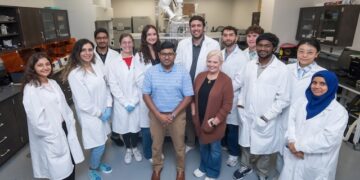




























Mo Maniruzzaman, a University of Mississippi researcher, received a $7 million grant to develop a lab that uses artificial intelligence and robotics to expedite the process of developing new medications.
AI powered, self driving labs are key to putting medications that could save lives into patient hands quicker. This lab will expand research and allow students and faculty to contribute to advancements when it comes to drug development.
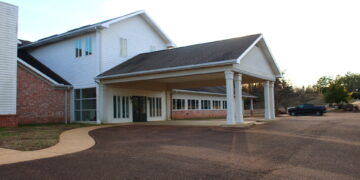
Maniruzzaman, professor and chair of the university Department of Pharmaceutics and Drug Delivery, plans to create the lab at Insight Park, the university’s research and business incubator. The project is expected to take two years as researchers combine existing technology into one automated system.
The grant was awarded by the Health Resources and Services Administration, an agency within the U.S. Department of Health and Human Services.
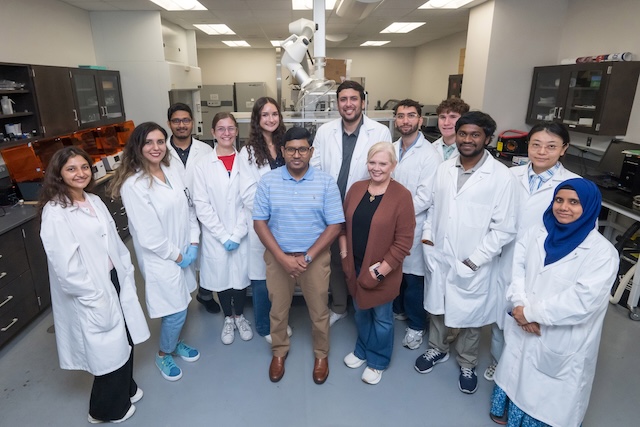
The lab, which Maniruzzaman refers to as a self-driving laboratory, will use AI, robotics and automated equipment to run experiments and test possible medications with less human involvement. Researchers hope the technology will help them study potential medications and develop ways to manufacture medications more efficiently.
Maniruzzaman said it currently takes about 8.5 years to transform an idea into a medication that is market-ready. He hopes the lab will help shorten that process by allowing experiments to run continuously.
“By integrating this self-driving concept that can run 24/7 without compromising quality, we can actually fast-track the discovery process,” Maniruzzaman said.
Some of the technology that will be used in the lab is already part of Maniruzzaman’s research. His team uses 3D printers and robotic equipment to input multiple medications into one pill or to create time-release medication, which allows for a more controlled and precisely timed medication release after a pill is taken.
Janhavi Deshmukh, a third-year pharmaceutical sciences doctoral student who works in the lab, said the technology could be useful for people who take several daily medications. The lab is also expected to include technology that allows researchers to monitor experiments remotely.
“This technology is so important for people who have chronic conditions and are taking multiple medications a day,” Deshmukh said. “What if instead, they could take only one pill that will release medication on a schedule? That’s what this technology allows us to do.”
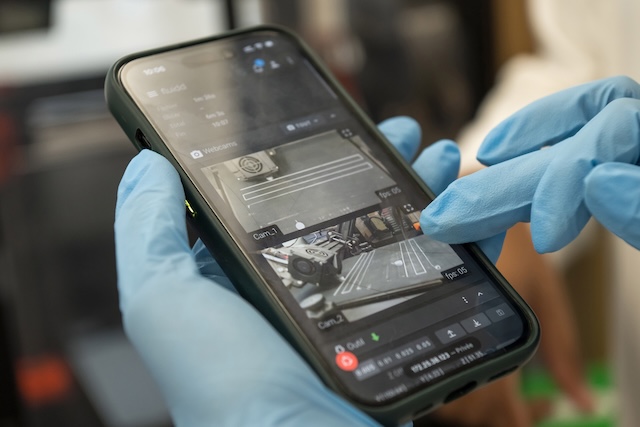
Rahat Kader Khan, a doctoral student in computer engineering, is assisting in upgrading a 3D printer with cameras that allow researchers to watch the printing process from their phones or computers.
“The system can track the progress of a print and let researchers know when it is finished and alert them if something goes wrong,” Khan said.
Although much of the work will be automated, Maniruzzaman said the goal is not to replace researchers. Instead, he said the technology will allow scientists to spend more time analyzing the results and solving problems while the machines handle the routine tasks.
“This lab can analyze millions of data points, predict a potential new drug candidate and then run automated experimentation, and it never gets tired,” Maniruzzaman said. “But it can only do that when paired with human insight.”