















William Dunlap has spent much of his life creating art inspired by Mississippi and the places he has encountered along the way. Originally from Houston, Miss., Dunlap graduated from the University of Mississippi with a Master of Fine Arts in sculpture and printmaking in 1969.
Dunlap studied sculpture and printmaking before exploring painting, but his interest in art began long before his formal education.
“I don’t know if there’s such a thing as a visual equivalent to a perfect pitch, but, if there is, I had it,” Dunlap said. “I just always wanted to draw and paint. … I never thought of doing anything else.”
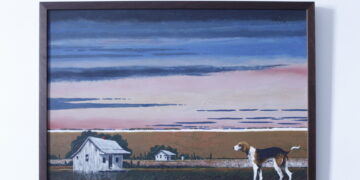
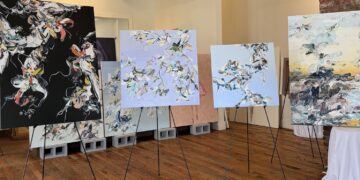
Dunlap specializes in what he calls “hypothetical realism,” a style of art that is not based on one specific place or thing but on scenes that feel familiar. Many of his landscapes are inspired by Mississippi and have since expanded to reflect other places where he has lived.
“There’s a subtle beauty to the landscape in Mississippi,” Dunlap said. “No mountains, no waterfalls, nothing dramatic, but the life is pretty extraordinary.”
Dunlap often paints scenes that look real, even though the places themselves do not exist.
“The things I paint, the places I paint, aren’t real, but they could be, and I’ve found that I’m very interested in the early light or the late light,” Dunlap said. “I like those big yellow-orange skies that you see in Mississippi a good deal.”
Although his paintings are fictional, the landscapes remain central to his work.
“Because the sense of a place is something I try to develop in my work, it’s always about place. It’s always about the landscape, but they’re invented, and they don’t really exist,” Dunlap said. “I couldn’t take you anywhere and say, ‘This is where I was standing when I made that painting.’ It just doesn’t happen.”
Animals also play an important role in Dunlap’s paintings, often taking the place of human figures. His use of dogs comes from a family connection to foxhunting.
“The dogs are … hounds (that) my maternal grandfather foxhunted with,” Dunlap said. “They don’t give a d–n about human beings. They don’t want to be pets. They just want to run.”
Dogs are not the only animals that fill in for humans in Dunlap’s paintings, though.
“I don’t put a lot of people in my work, but the animals, dogs, buffaloes, fish — they’re kind of stand-ins for the people,” Dunlap said.
Dunlap said he has always been proud of his Mississippi roots and hopes the state’s visual artists will receive more recognition.
“I’ve never backed down from being from Mississippi; it’s important to me,” Dunlap said. “I like to think that we visual artists have our time. The writers have had their run, the musicians have had their run, and they’re there, and they’re solid, but it’s time the visual artist got some attention in it. I hope to stay around for it.”
Regarding negative stereotypes surrounding Mississippi, Dunlap believes many people form opinions about the state without ever visiting.
“Everybody has an opinion about Mississippi, and the people who have the strongest opinions are generally the ones who haven’t been here,” Dunlap said. “I’ve traveled a good deal, lived in New York and lived in Washington, and I’m aware of the stereotype and the damage that it can do.”
Dunlap’s approach to art is driven by his own interests rather than audience expectations. He doesn’t begin a painting knowing what it will become.
“What I do to a painting predicts what I’m going to do next, so the painting tells me what’s happened. I’m not trying to make paintings of things. I’m trying to make the painting a thing itself,” Dunlap said. “I just know that I make these paintings because I want to see them, and I’m starting to write fiction for the same reason.”
Dunlap’s interest in writing grew out of journals he has kept since his undergraduate years at Mississippi College (now Mississippi Christian University). While going through old notebooks in his studio, he rediscovered sketches, ideas and story outlines that eventually inspired him to write fiction.
“I’ve kept journals since I was an undergraduate at Mississippi College,” Dunlap said. “I saw some sketches, some drawings that I made, and some ideas … for fiction, a little dialogue here, a little story outline there, and I just started to write. … I write them because I want to read them. … Sometimes, fiction tells a greater truth than something with facts.”
Dunlap published “Short Mean Fiction: Words and Pictures” in 2016, a collection of short stories accompanied by drawings. He has also published books about his artwork, including “Dunlap,” a 2006 book featuring more than 100 color reproductions spanning his career. He continues to write and share his thoughts about the writing process through his online publication on Substack.
His approach to creating art has also evolved over time, though he continues to build on ideas he has explored for decades.
“I’m making paintings that are not unlike what I was doing 30 years ago, but they’re just different,” Dunlap said. “I’ve twisted it and fine-tuned it a little bit and pushed it ahead. I’ve never really questioned what it is I’m supposed to be doing. I’m making paintings about what it’s like to be on the planet at any given time.”
Dunlap’s process often involves working on several paintings at once and returning to older pieces when he feels ready to continue them.
“I’ll work on something, and if it doesn’t come about, I’ll roll it up and put it away in storage,” Dunlap said. “I pulled out (paintings) 10 years after I started them … but sometimes (the paintings) want to be finished and sometimes they don’t.”
He often keeps several works in progress, allowing one painting to influence another.
“I’ve got a kind of repertoire of images that I work with, but you don’t finish a painting, you just abandon it, you know?” Dunlap said. “You work with it, and it’s in my nature to overwork things, and so I’ve got three or four things going at once. That way, I try to take the energy from one and put it in the other, and it always works out better for me that way.”
For Dunlap, continuing to create comes down to practice and persistence.
“There’s no substitute for work,” Dunlap said. “You have to just work, work, work. It’s like the rifle range, repetition, you just make the same painting over and over. … There’s no substitute for it..”