























The University of Mississippi confirmed the deaths of two students in an email to the campus community on Tuesday, Sept. 22. The causes of death are currently under investigation by law enforcement.
The university declined to confirm or deny the names of the two students who died. The university did not comment on why it had not released the students’ names or further information pertaining to student safety by the time of publication.
Friends of the students identified them as 18-year-old Aidan Hamilton, a freshman from Englewood, Colo., and 20-year-old Robert Strang, a junior from Atlanta. Both students died on Monday, Sept. 21.
Law enforcement dispatched to Stewart Hall on the University of Mississippi campus at 1:39 p.m., where they attempted CPR on Hamilton, according to dispatch records. Strang was found dead at an off-campus house on Van Buren Avenue, per individuals familiar with the situation.
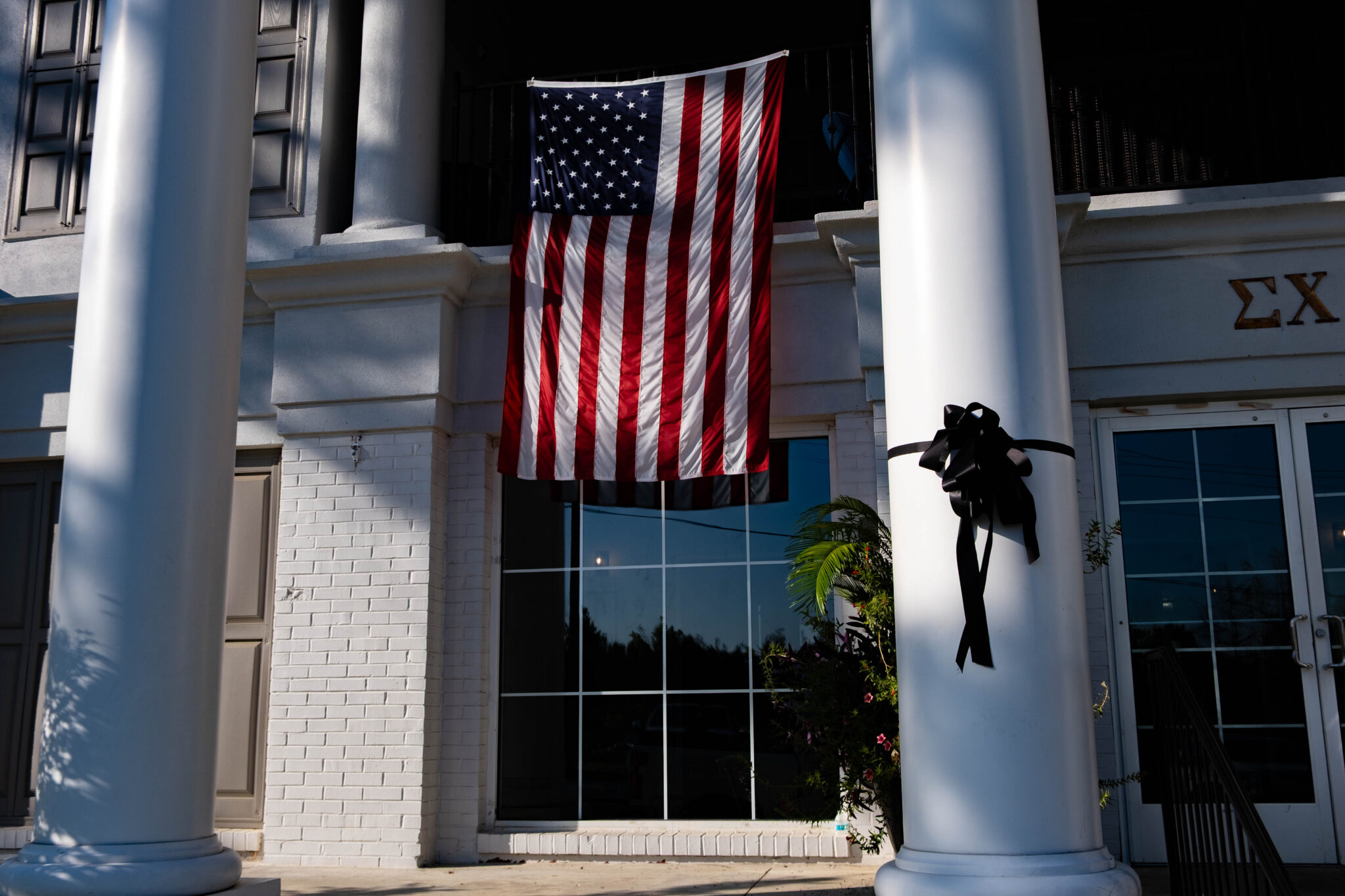
A black ribbon affixed to the front of the Sigma Chi house on Sept. 22. Photo by Jack Kirkland
Vice Chancellor for Student Affairs Shawnboda Mead addressed unconfirmed information regarding the number of student deaths and potential causes in the email. Speculative information has circulated in Facebook groups, message boards and various other social media platforms.
“We are aware that considerable unverified information is circulating on social media and in the community regarding these recent student deaths,” Mead said in the email. “The coroner’s office has confirmed two student deaths, and university police are not aware of any additional student deaths.”
The University Police Department is working closely with the Oxford Police Department and the Lafayette County Sheriff’s Office on the ongoing investigations.
Suspected drug use and contamination
The Lafayette County Metro Narcotics Unit announced in a Sept. 22 statement that no confirmed evidence indicates that the two deaths are connected. The unit did, however, caution the public to avoid kratom.
“Packaged kratom sold from a retail store was found during both investigations,” Lafayette County Metro Narcotics said. “Out of an abundance of caution, we encourage everyone to avoid kratom and any other medication or substance that was not prescribed to you or obtained from a trusted, regulated source.”
The unit has not confirmed that kratom or other substances were contributing factors in the two student deaths.
Coroner Glenn Coleman told the Clarion Ledger that toxicology tests and autopsies were ordered for Hamilton and Strang. He expects toxicology results to be completed in two to three weeks.
Kratom is an herbal extract that acts as a stimulant in small amounts and a sedative in high doses, according to the Mayo Clinic. In cities and counties in Mississippi where kratom is legal, kratom can be purchased at convenience stores, CBD stores and specialized smoke and vape shops.
The supplement is sold as a remedy for opioid withdrawal symptoms and is widely available in liquid, pill and powder forms. Kratom products lack clear labels disclosing their ingredients and potency.
The city of Oxford banned the sale of synthetic kratom in August 2019, followed by Lafayette County.
“The use, purchase, possession, distribution, sale or offering for sale of kratom and other synthetic opioid products has been illegal throughout Lafayette County since January 2021,” Lafayette County said in a news release published on Sept. 23.
Kratom is not approved by the Food and Drug Administration. The Drug Enforcement Administration calls it a drug of concern. Kratom use resulted in over 3,400 reports to poison control centers from 2014 to 2019, including reports of death.
Lafayette County Metro Narcotics said it will release any information that poses a public safety threat through official sources.
Several fraternities and sororities at the University of Mississippi issued announcements to their members concerning the drug cychlorphine, a potent synthetic opioid that does not show up on standard fentanyl test strips. Such announcements urged members to avoid any unprescribed substances and to address suspected drug overdoses by administering naloxone.
“Because it is invisible to common harm-reduction testing tools, emergency personnel and health agencies emphasize that if an overdose occurs, naloxone (Narcan) must still be administered immediately. However, due to cychlorphine’s extreme potency, multiple consecutive doses of naloxone are frequently required to restore breathing,” the announcement distributed to several Greek organizations said.
The presence of cychlorphine in the student deaths has not been confirmed by law enforcement at the time of publication.
Many Greek organizations also cancelled social events scheduled for this week out of respect for the student deaths. Rafters, a bar on the Square in Oxford, closed for the evening of Sept. 22 in observance of the deaths.
Students navigate grief and confusion
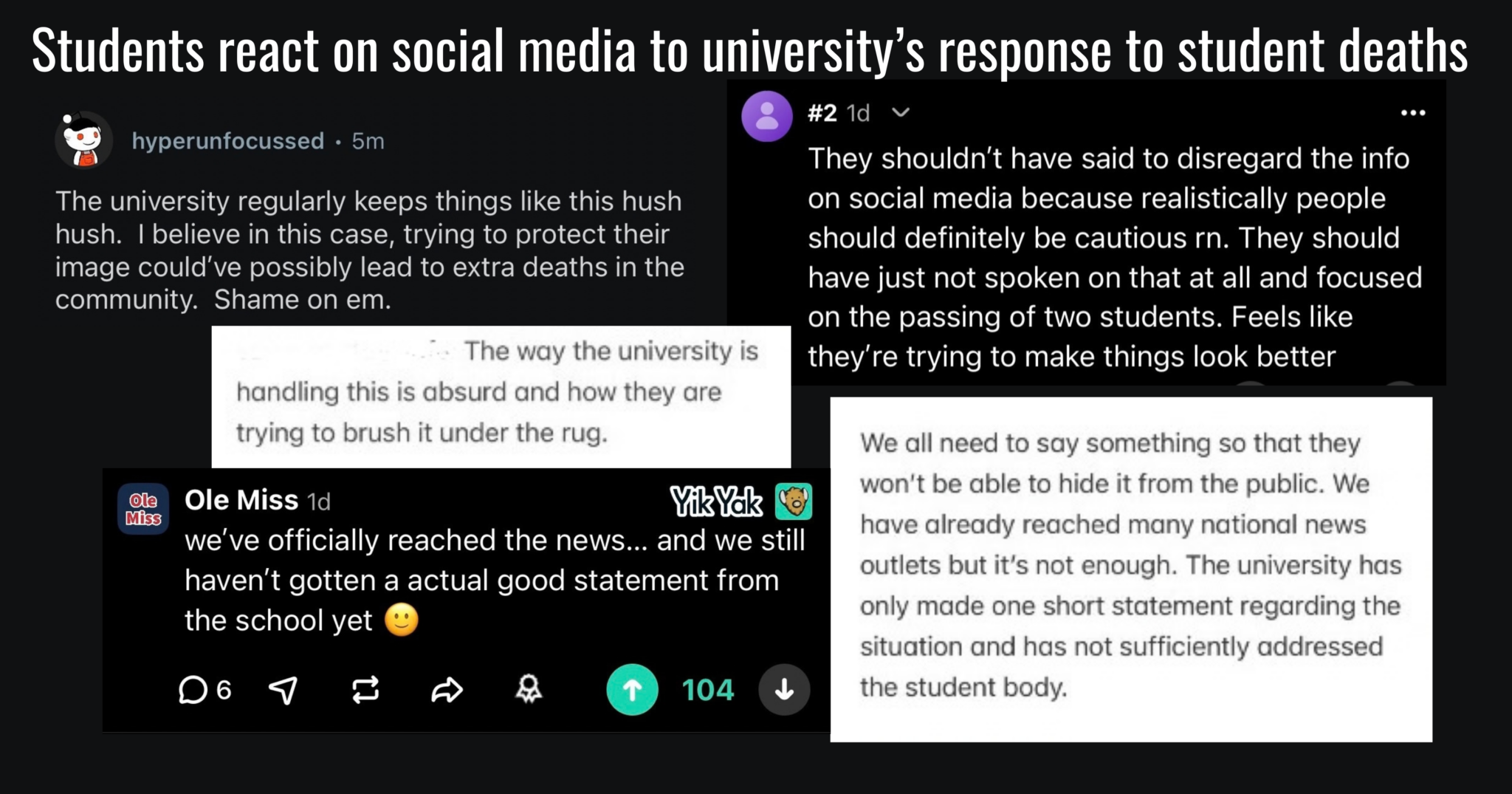
Across the University of Mississippi, students are widely concerned about the lack of information provided by the university regarding the deaths and potential danger of substances like kratom.
“I had to sit my students down and tell them that I’m here for them. I gave them some counseling support centers,” a graduate student said, who wished to remain anonymous over concern for professional repercussions. “I think there’s an element of shame in this. … During all drug overdoses, I think at universities, it’s shame and not really knowing how to approach the situation which I think results in not approaching it at all. I think (that) can be just as harmful as approaching it badly.”
Students made hundreds of posts on social media platforms expressing opinions, largely disparaging, of the university’s response to the students’ deaths. Many students took to Yik Yak to share their thoughts — a social media platform on which enrolled University of Mississippi students can make anonymous remarks.
Darryl Harlan, a senior sociology and criminal justice double major from Pearl, Miss., serves as a resident assistant at Residential Hall 3. Harlan expressed difficulty answering questions from the students in his residence hall about the deaths and reported danger of kratom and other illicit substances.
“The first thing that went through my mind was, ‘This is crazy,’ because I watch over kids all the time,” Harlan said. “It’s just hard to navigate when you don’t know what to tell your residents because they’re all scared. They don’t know what’s happening, but there’s nothing I can do.”
The Alpha Tau Omega fraternity held a prayer vigil on Wednesday, Sept. 23 at their chapter facility. Approximately 150 students attended the vigil, along with local religious leaders.
Neither Hamilton nor Strang were members of Alpha Tau Omega, but the chapter felt it necessary to provide a space for students to grieve.
Current Alpha Tau Omega chaplain Adam Spector, a junior biomedical engineering major from Brentwood, Tenn., said he wanted to bring unity to the community grieving the two deaths.
“(Alpha Tau Omega) felt called to create a space for reflection, prayer and support for those affected by the events that have happened on our campus,” Spector said. “We recognize that grief touches each person differently, and we wanted to bring students, families and friends together in a spirit of compassion and unity.”
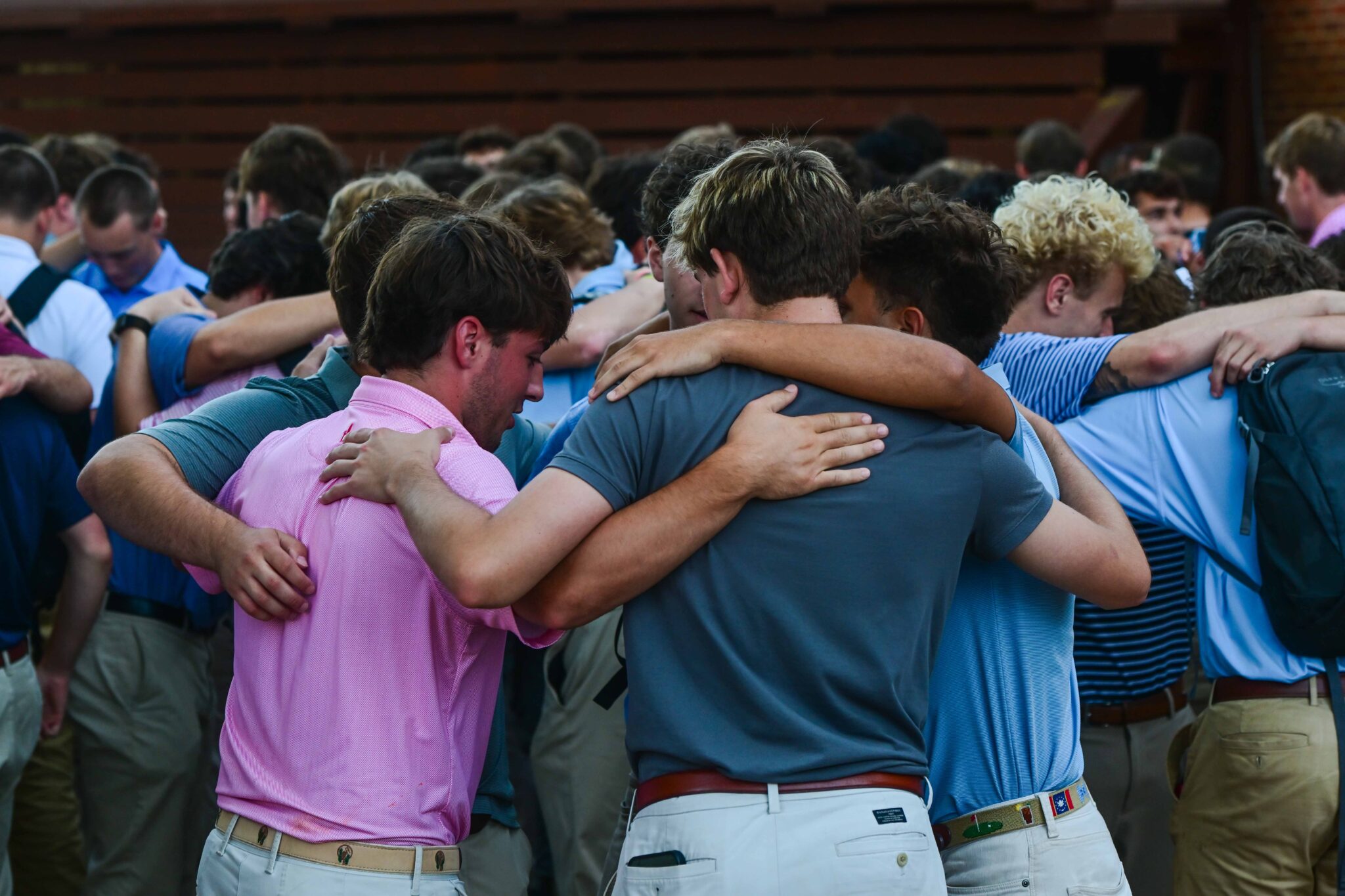
Fraternity members join together in group prayer during a service on Sept. 23 at the Alpha Tau Omega house. Photo by Gavin Gallegos
Spector said his goal was to remember the students who died and to encourage meaningful conversations, promote healing and reaffirm a commitment to supporting every member of the campus community.
“We pray for comfort for grieving families and friends, strength for those affected by addiction and wisdom as we work together to foster a culture of care, awareness and compassion,” Spector said.
The University Counseling Center and UMatter are available for free to students needing support.
NewsWatch Ole Miss contributed reporting.