






















The Protect College Sports Act (PCSA), which would bring sweeping changes to college sports, passed through the U.S. Senate two weeks ago. The bill must still go through the U.S. House of Representatives, where it will likely be amended. The most notable features of the bill are a one-time transfer rule, a cap for teams per conference and a new revenue share limit.
U.S. Sens. Ted Cruz (R-Texas) and Maria Cantwell (D-Wash.) introduced the bill on May 27.
The PCSA passed 77 to 22 in the Senate, with both Mississippi Sens. Roger Wicker and Cindy Hyde-Smith voting to approve the bill.
“College sports are at a breaking point. Fans can see their favorite teams being hollowed out by transfer chaos, fake NIL bidding wars, eligibility lawsuits and a system that allows the richest programs to keep pulling away,” Cruz said in a statement. “The Protect College Sports Act is a bipartisan plan to restore order.”
Student-athletes can still profit from their name, image and likeness, Cruz said. The senator emphasized, however, that college sports still needs real rules, competitive balance, rivalries and a true connection to education.
“This bill protects athletes and fans and keeps college sports from becoming a two-conference minor league,” Cruz said.
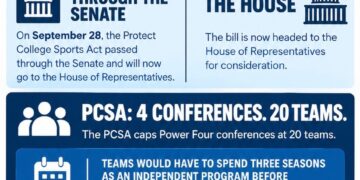
With the PCSA through the Senate, it will now go to the House. The SCORE Act, the PCSA’s predecessor, could not get enough votes in the House, so it will be interesting to see how the House handles the latest bill that will shake up college sports.
Most notably, the bill would more than double the revenue share cap. Currently, college athletic departments can share $20.5 million with student athletes. With the bill, they can spend an additional $22.5 million for retaining players, plus $5 million specifically for women’s and Olympic sports.
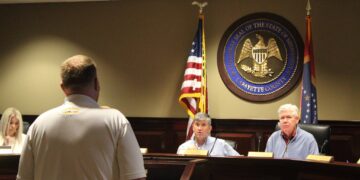
Ole Miss Vice Chancellor for Intercollegiate Athletics Keith Carter highlighted the need for legislation in an event at the Charles Overby Center for Southern Journalism and Politics on Sept. 17.
“If we get to another football portal window and the (player) market increases another 50, 60, 70%, like we’ve been seeing every year,” Carter said, “basically, you’re going to be looking at $80 to $90 million, so can (Ole Miss) hang there for a while? Maybe. Can Texas hang there for a while? Maybe a little longer than us.”
The longer college sports go without further regulation, the more money schools will spend on players. Ole Miss, and many other programs, may not be able to keep up if the checks get too big.
The bill caps agent endorsement contract fees at 5%. Agent fees now are around 20-25%. Athlete-agent law will be updated to cover NIL. Athletic associations will have to maintain a public registry of agents, allowing associations to decertify or fine agents who break rules.
The Senate attempted to vote on the PCSA in early August. Senate Majority Leader John Thune filed a cloture motion, which would end debate regarding the bill; however, the Senate went into August recess without taking action. The bill had numerous roadblocks that slowed its path to the floor, including objections from Sens. Tommy Tuberville and John Kennedy and the Congressional Black Caucus.
Florida Sens. Ashley Moody and Rick Sott voted against advancing the bill because it limits schools from changing conferences, which Miami and FSU may seek to do in the future. Both schools currently reside in the ACC and may look to move to a stronger conference.
As currently written, the PCSA caps Power Four conferences at 20 teams. The SEC is currently at 16, the Big 10 at 18, the Big 12 at 16 and the ACC at 16. Additionally, a team would have to spend three seasons as an independent program before it could join another conference.
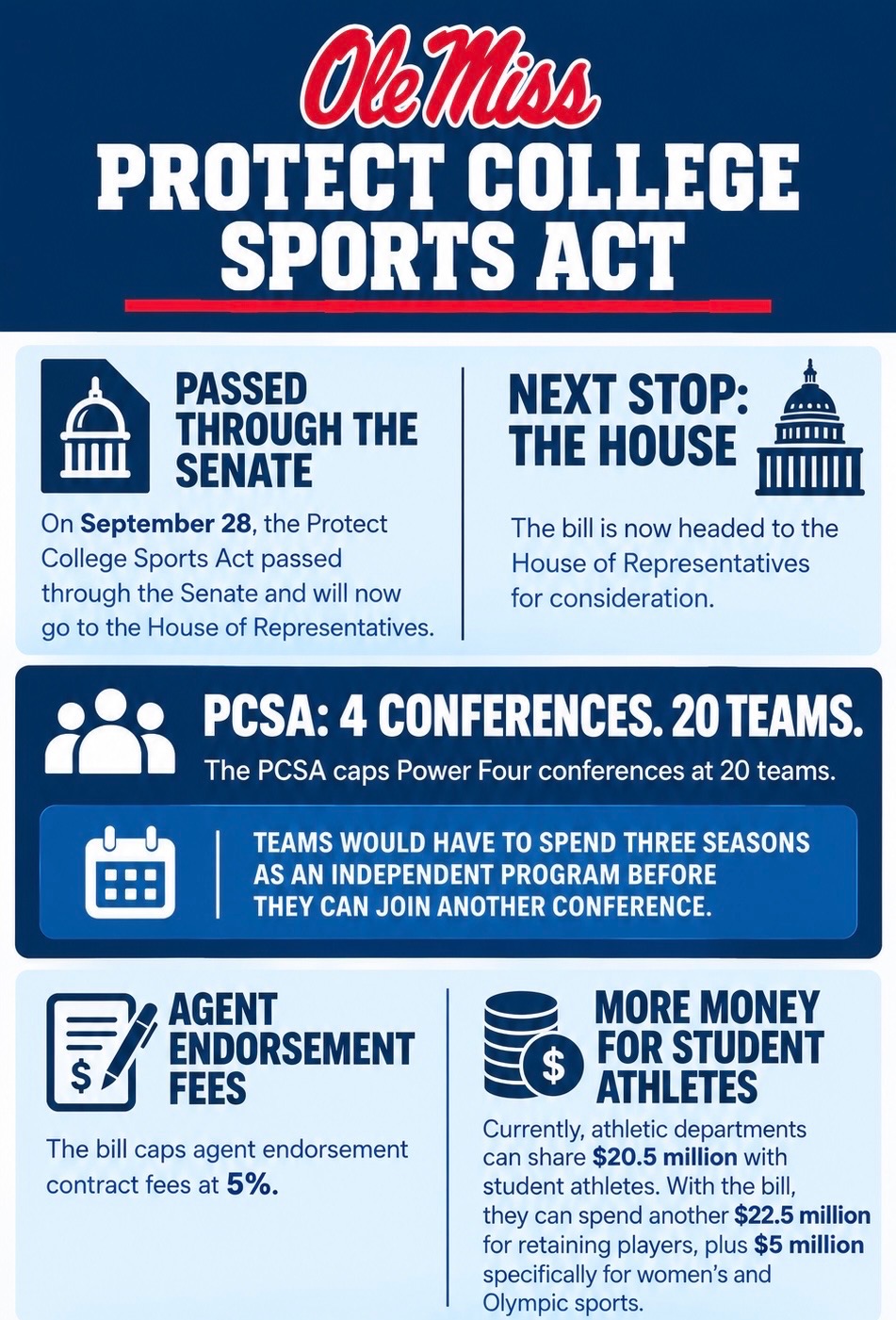
The provision capping power conferences to 20 teams and making it harder to switch conferences prevented the bill from reaching the floor for a time. The House will almost certainly amend that portion of the bill. Reps. Neal Dunn (R-Fla.) and Mario Diaz-Balart (R-Fla.), along with 20 members of Congress, have already sent a letter to the House urging changes to the bill.
If the House amends the bill then passes it, the bill must still go back through the Senate before it can be sent to the president.
While the PCSA getting through the Senate is good news for many administrators, others are preparing for additional ways to regulate college sports.
“There’s probably plans A, B and C right now. Plan A is probably the congressional bill that today moves through another step in the process of being passed as legislation,” Yahoo Sports college football writer Ross Dellenger said at the Overby Center event on Sept. 17. “(The bill) would put up guardrails, limitations, restrictions around athlete movement, athlete pay and some agent registry stuff. Plan B is a conference-only governance structure where leagues make their own rules and enforce them as opposed to the NCAA.”
The NCAA has constantly been sued for years over antitrust violations. According to Dellenger, if conferences can make their own rules and enforce them on a smaller scale, the conferences believe they could avoid some of the issues with legal challenges.
Plan C has proved effective for many years, though it would bring a variety of new things to the sport, like employment status.
“(Plan) C is collective bargaining. It’s the NFL model or the pro model that has worked in professional leagues for decades now,” Dellenger said. “(Plan) ‘A’ is preferred and ‘B’ is being worked on, as ‘A’ continues to move through the U.S. Capitol right now. Then, ‘C’ is something that many college leaders don’t want to do yet.”