






























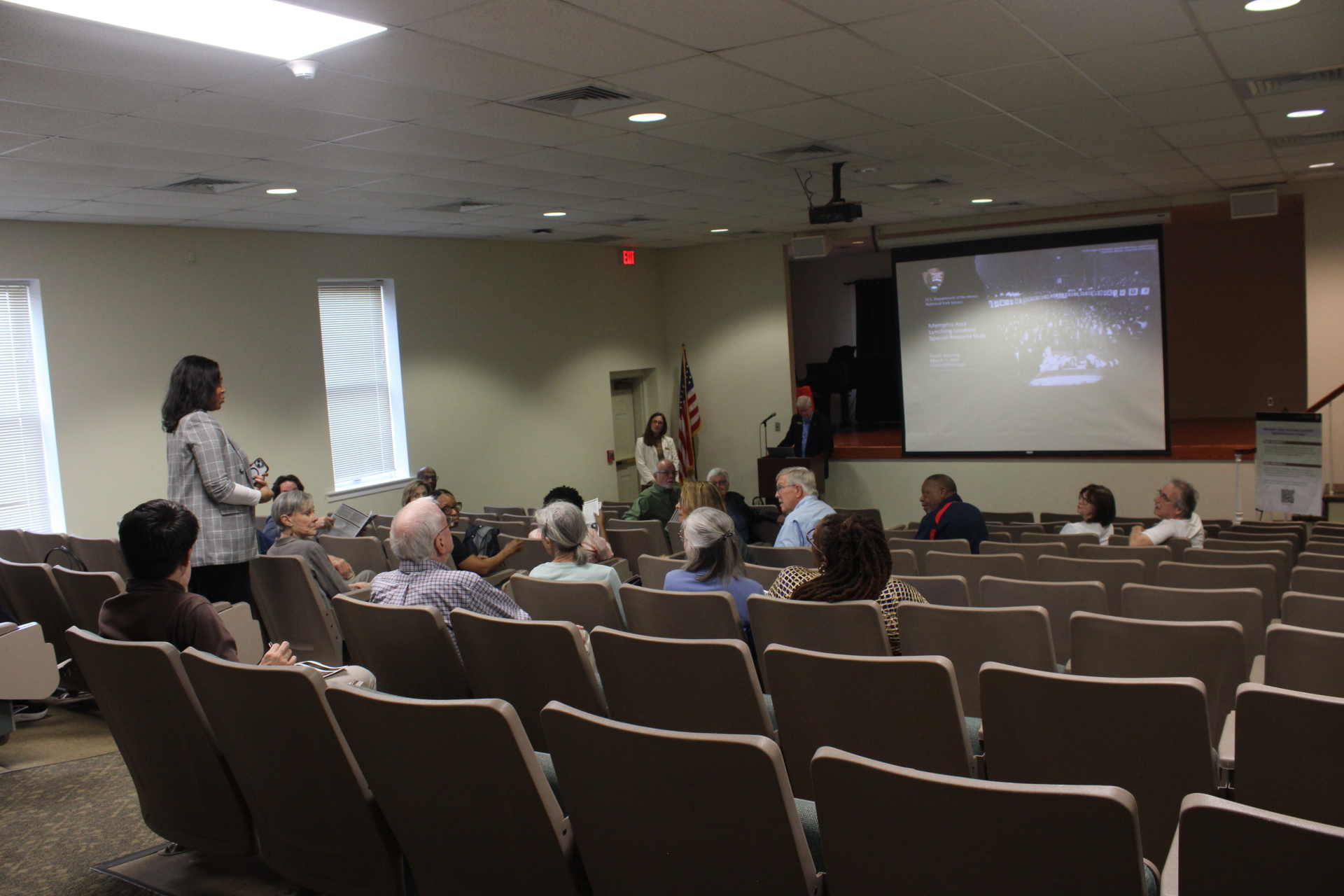
The National Park Service (NPS) held a listening session Tuesday, March 3, in the auditorium of the Lafayette County & Oxford Public Library for its special resource study, collecting information for potential inclusion of historical lynching sites in Oxford as a future unit of the national park system.
The NPS is conducting the study on sites across the Memphis area for potential addition to the National Park System. The study was commissioned by U.S. House Resolution 7912, or the “Evaluating Lynching Locations (ELL) for National Park Sites Act,” in 2022.
The definition of lynching used by the NPS for the purpose of this study is “a group killing outside of the law committed under the pretext of service to justice, race or tradition.”
Among the potential sites identified by the NPS are the Lafayette County lynching sites of Harris Tunstal in 1885, Lawson Patton in 1908 and Elwood Higginbotham in 1935.
Charles Lawson, a project coordinator with the NPS, said the Oxford sites were identified for his study due to the groundwork laid by community organizations such as the Lafayette County Remembrance Project.
“We’re studying Memphis, (Brownsville, Tenn.) and Oxford because of the interest we have gotten from the public and the support from community projects like the Lafayette County Remembrance Project,” Lawson said. “We know there’s an interested public here.”
The Lafayette County Remembrance Project was founded by members of the William Winter Institute for Racial Reconciliation, now known as the Alluvial Collective, in 2018. They were inspired to take on the work of remembrance after participating in racial reconciliation workshops sponsored by the institute. Other organizations, such as the Equal Justice Initiative and the university’s Center for the Study of Southern Culture, have aided the group’s efforts.
Rhondalyn Peairs is an Oxford native and community historian. She is optimistic about the NPS preservation process.
“This will be a long process. That’s why you have these listening sessions to garner additional information,” Peairs said. “Overall, any work that lets us better understand the history of our country, especially in its 250th anniversary year, is worthwhile.”
The Lafayette Community Remembrance Project has identified four additional documented lynchings in the county’s history: William McGregory in 1890, an unknown victim in 1891, William Steen in 1893 and William Chandler in 1895.
Alonzo Hilliard, a community member involved with the Lafayette Community Remembrance Project, reflected on the importance of the meeting as a recognition of the group’s work.
“The work that has been done in this community has been recognized at a national level,” Hilliard said. “The National Park Service is here to look at what we are doing in this community, and to give credit for what we have done and what the lynching conversation means on a national level. It means a lot to me.”
He also reflected on what the work has meant to the Black community.
“We’ve had families of first cousins spread across the country as far as Ohio, and they didn’t know each other,” Hilliard said. “They never came back to Lafayette County before we did this work, and it’s only because we choose to remember that these families are reunited and the community is able to heal.”
For any site to be included in the National Park Service System, it must be proven that NPS management will benefit its historic preservation, that NPS management is feasible and that the site is connected to nationally significant history.
The Special Resource Study period for open comment opened on February 2 and will close on April 3. Comments can be submitted online at the NPS website or by email at memphis_study@nps.gov.