






























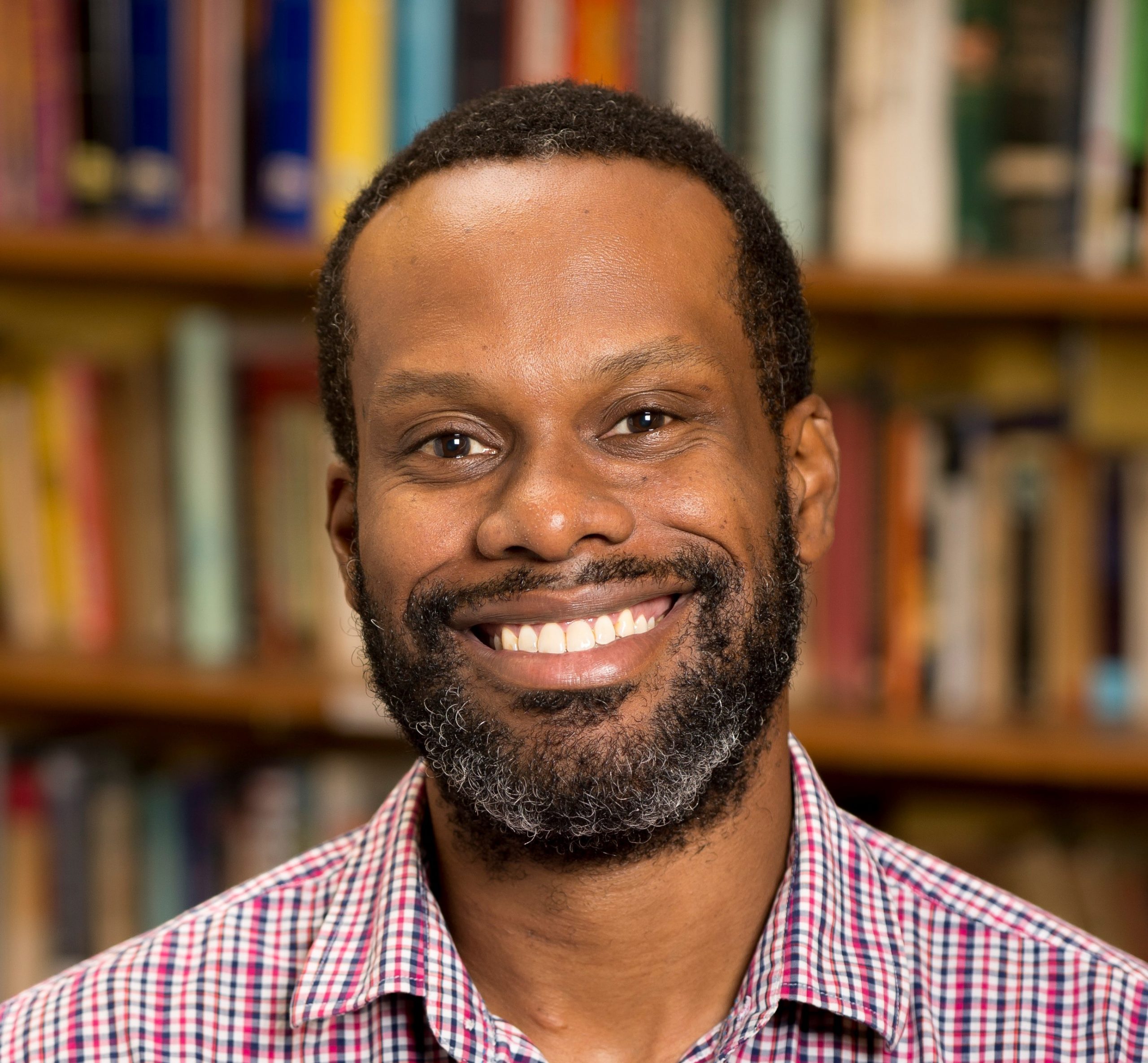
This year, Richard Purcell was awarded the Mississippi Humanities Council Teacher of the Year for the University of Mississippi. Purcell is the Hubert H. McAlexander Chair in English and director of the interdisciplinary minor in cinema studies.
As part of the award, Purcell delivered his lecture titled “Race, Speculative Value, and Art of the Turn of the Twenty-First Century” in Bryant Hall on Tuesday, March 3. His speech started with an outline of the development of contemporary art through the 1980s and 1990s and how Black artists were both included and excluded from that development.
“Artists of color began to appear in primary collections, but museums, like the City Museum of Harlem, began to be seen as legitimate institutions in the conciliation of art galleries that showed works,” Purcell said, “There are both value from the aesthetic innovation and engagement to contemporary art practices, as well as their monetary value.
Purcell also analyzed how Black popular culture became a part of the mainstream art market and connected that to the idea of “conjuncture.” Conjuncture was an idea popularized by Stuart Hall, a sociologist, cultural theorist and political activist who was active from the mid 1900s to early 2000s. It describes a period where social, political, or other ideological contradictions come together and create a moment of opportunity for growth and action.
“(The 1980s and 1990s were) a moment in which Black conceptual art practices (were) … not being focused on by dominant contemporary art museums, but coming into the mainstream of art criticism, discourse and purchase,” Purcell said. “1991, also, is a period where Black popular cultural forms, whether it be musicals, cinematic or otherwise, are becoming much more visible to not only audiences in the United States but also globally. So this contradiction between that which was once marginal becoming central.”
Purcell went on to connect this critical analysis of the art movements of the 1990s through the lens of conjuncture to modern representations of Black people, their art and its connection to labor.
“There is a long fraught history within western intellectual culture and traditions concerning the relationship between Blackness, art and the labors of creativity. These raised from the enlightened denials of the Black creativity, romanticist projections upon Black muses, to the essentialist discourse of Black talent that have emerged between enslavement and industrial modernity,” Purcell said. “Black artists and intellectuals have long struggled against, as well as embraced the weight of these various discourses, which have always persisted alongside conceptions of the Black body as a commodity designed for work.”
Graduate students from the English department came to the lecture to support him and his accomplishments. Simon Ross is a third-year English Ph.D. candidate from Scarsdale, N.Y., and took Purcell’s race and media course.
“I could see the ways in which the class that he taught me is reflected in the work that he’s currently working on, so there’s this kind of feedback where his scholarship is informed by how he interacts with graduate students and vice versa,” Ross said. “There’s this really exciting situation there, and that he’s kind of experimenting with these different mediums in the classroom to actually produce new, interesting, scholarly work.”
Beyond the appreciation for Purcell’s work, some of the attendants also felt that awards like this allow for not only a singular person’s efforts to be highlighted, but also the work of the whole humanities department. Gabrielle Bowden, from Gulfport, Miss., is in her fourth year of her Ph.D. in English.
“I feel like we are at a conjuncture right now … where there’s kind of devaluation and a suspicion of the humanities broadly,” Bowden said. “I think the humanities are becoming more and more important as we are entering a new age of rampant media, where it’s kind of impossible to tell what’s true, what’s not. You really need the skills of discernment that the humanities teach.”
Doug Sullivan-González spoke as a representative of the Mississippi Humanities Council before Purcell’s lecture. Sullivan-González is an interim chair of history and a professor of history at UM, and he is the past chair of the Board of the Mississippi Humanities Council.
“Since our founding in 1972, the Mississippi Humanities Council has celebrated educators who demonstrate the vital role that humanities play in creating engaged, informed citizens,” Sullivan-González said. “Our work creates opportunities for people to learn about themselves and the larger world and encourages thoughtful, civil conservations that strengthen our community. Our motto is, ‘the humanities are for everyone.’”